Portal:Rivers
Wikipedia portal for content related to Rivers
From Wikipedia, the free encyclopedia

| Portal | WikiProject Rivers | Talk page |
 The Rivers Portal
 Introduction

A river is a natural stream of fresh water that flows on land or inside caves towards another body of water at a lower elevation, such as an ocean, lake, or another river. A river may run dry before reaching the end of its course if it runs out of water, or only flow during certain seasons. Rivers are regulated by the water cycle, the processes by which water moves around the Earth. Water first enters rivers through precipitation, whether from rainfall, the runoff of water down a slope, the melting of glaciers or snow, or seepage from aquifers beneath the surface of the Earth.
Rivers flow in channeled watercourses and merge in confluences to form drainage basins, areas where surface water eventually flows to a common outlet. Drainage divides keep rivers separated from other courses of water and causes upstream water within the confines of the divide to fall into the downhill stream. Rivers have a great effect on the landscape around them. They may regularly overflow their banks and flood the surrounding area, spreading nutrients to the surrounding area. Sediment or alluvium carried by rivers shapes the landscape around it, forming deltas and islands where the flow slows down. Rivers rarely run in a straight line, instead, they bend or meander; the locations of a river's banks can change frequently. Rivers get their alluvium from erosion, which carves rock into canyons and valleys.
Rivers have sustained human and animal life for millennia, including the first human civilizations. The organisms that live around or in a river such as fish, aquatic plants, and insects have different roles, including processing organic matter and predation. Rivers have produced abundant resources for humans, including food, transportation, drinking water, and recreation. Humans have engineered rivers to prevent flooding, irrigate crops, perform work with water wheels, and produce hydroelectricity from dams. People associate rivers with life and fertility and have strong religious, political, social, and mythological attachments to them. (Full article...)
Selected article -

Tryon Creek is a 4.85-mile (7.81 km) tributary of the Willamette River in the U.S. state of Oregon. Part of the drainage basin of the Columbia River, its watershed covers about 6.5 square miles (16.8 km2) in Multnomah and Clackamas counties. The stream flows southeast from the Tualatin Mountains (West Hills) through the Multnomah Village neighborhood of Portland and the Tryon Creek State Natural Area to the Willamette in the city of Lake Oswego. Parks and open spaces cover about 21 percent of the watershed, while single-family homes dominate most of the remainder. The largest of the parks is the state natural area, which straddles the border between the two cities and counties.
The bedrock under the watershed includes part of the last exotic terrane, a chain of seamounts, acquired by the North American Plate as it moved west during the Eocene. Known as the Waverly Hills Formation, it lies buried under ash and lava from later volcanic eruptions, sediments from flooding and erosion, and layers of wind-blown silt. Two dormant volcanoes from the Boring Lava Field are in the Tryon Creek watershed. (Full article...)
Selected Quote

Selected picture

The Tetons and the Snake River (1942)
General images -
 Common water hyacinth in flower (from River ecosystem)
 Pondweed is an autochthonous energy source. (from River ecosystem)
 The Effra is one of the subterranean rivers of London. It empties into the Thames by Vauxhall Bridge, from which this photograph was taken. (from Subterranean river)
 A whitewater canoe with yellow air bags. (from Whitewater)
 A subterranean river in the Cross Cave system of Slovenia. (Scale shown by people in photograph.) (from Subterranean river)
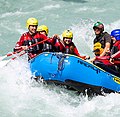 Rafting is a watersport where buoyancy aids, helmets and wetsuits are mandatory and often imposed by law, due to the constant risk of falling off the boat and into the rapids (from Whitewater)
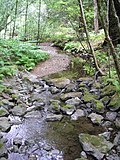 This stream operating together with its environment can be thought of as forming a river ecosystem. (from River ecosystem)
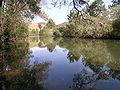 A pensive Cooplacurripa River, NSW (from River ecosystem)
 New Zealand longfin eels can weigh over 50 kilograms. (from River ecosystem)
 Anthropogenic influences on river systems. Examples are mainly from settings with a modest technological influence, especially in the period of about 10,000 to 4000 cal yr BP. (from River ecosystem)
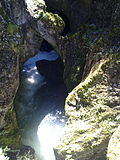 Devil's Throat Cave subterranean river from above (from Subterranean river)
 Periphyton (from River ecosystem)
 Leaf litter is an allochthonous energy source. (from River ecosystem)
 In Dante's Inferno, Charon ferries souls across the subterranean river Acheron. (from Subterranean river)
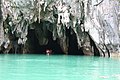 The Puerto Princesa cave can be entered by boat. (from Subterranean river)
 The cave of source of the Buna can be entered by boat and dived through a cave system serving as an effluence of the Zalomka. (from Subterranean river)
 The brook trout is native to small streams, creeks, lakes, and spring ponds. (from River ecosystem)
 Rapids in Mount Robson Provincial Park (from River ecosystem)
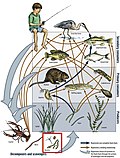 Example of a river food web. Fungi (aquatic hyphomycetes) and Bacteria can be seen in the red box at the bottom. Fungi and bacteria (and other decomposers, like worms) decompose and recycle nutrients back to the habitat, which is shown by the light blue arrows. Without fungi and bacteria, the rest of the food web would starve, because there would not be enough nutrients for the animals higher up in the food web. The dark orange arrows show how some animals consume others in the food web. For example, lobsters may be eaten by humans. The dark blue arrows represent one complete food chain, beginning with the consumption of algae by the water flea, Daphnia, which is consumed by a small fish, which is consumed by a larger fish, which is at the end consumed by the great blue heron. (from River ecosystem)
 Flowing rivers can act as dispersal vectors for plant matter and invertebrates. (from River ecosystem)
 Different biofilm components in streams. Principal components are algae and bacteria. (from River ecosystem)
 Whitewater at Yosemite (from Whitewater)
 Co-occurrence network of a bacterial community in a stream (from River ecosystem)
 A forest stream in the winter near Erzhausen, Germany (from River ecosystem)
 Map of the world showing elevation levels (from Upland and lowland)
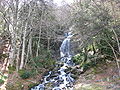 Cascade in the Pyrénées (from River ecosystem)


.jpg)

.jpg)


.jpg)


Did you know?
- ... that the 2010 sockeye salmon run on the Adams River (pictured) in British Columbia, Canada, is expected to be the largest since 1913, with an estimated 9 million fish returning to the river to spawn?
- ... that three swimming holes on Big Wapwallopen Creek are the most dangerous ones in Luzerne County, Pennsylvania?
- ... that the name for the Texas stream Cibolo Creek comes from the Native American and Spanish word for Buffalo, who were hunted along its steep banks?
Related portals


Selected Panorama

Topics
Subcategories

Quality content
 | This is a list of recognized content, updated weekly by JL-Bot (talk · contribs) (typically on Saturdays). There is no need to edit the list yourself. If an article is missing from the list, make sure it is tagged (e.g. {{WikiProject Rivers}}) or categorized correctly and wait for the next update. See WP:RECOG for configuration options. |
Featured articles
 Aliso Creek (Orange County)
- Balch Creek
- Big Butte Creek
- Bull Run River (Oregon)
- Chetco River
- Colorado River
- Columbia River
- Columbia Slough
- Fanno Creek
- Johnson Creek (Willamette River tributary)
- Jordan River (Utah)
- Little Butte Creek
- Nile
- Plunketts Creek (Loyalsock Creek tributary)
- River Parrett
- Rogue River (Oregon)
- St. Johns River
- Tryon Creek
- Waterfalls in Ricketts Glen State Park
- White Deer Hole Creek
- Willamette River

Featured lists
Good articles
 1886 St. Croix River log jam
- Abrahams Creek
- Acelhuate River
- Adams River (British Columbia)
- Big Wapwallopen Creek
- Black Creek (Susquehanna River tributary)
- Briar Creek (Susquehanna River tributary)
- Brunswick Falls
- Buffalo Creek (West Branch Susquehanna River tributary)
- Canajoharie Creek
- Catawissa Creek
- Celilo Falls
- Cem (river)
- Chimacum Creek
- Chollas Creek
- Cibolo Creek
- Clayton Falls Creek
- Covering of the Senne
- Darby Creek (Pennsylvania)
- Delta River
- Eddy Creek (Lackawanna River tributary)
- Esopus Creek
- Estuaries of Texas
- Everglades
- Fishing Creek (North Branch Susquehanna River tributary)
- Flushing River
- Fonteyn Kill
- Fossil Creek
- River Frome, Bristol
- Gowanus Canal
- Grande Ronde River
- Great Zab
- Hammersley Fork
- Harveys Creek
- Hudson River
- Hull Creek (Lackawanna River tributary)
- River Hull
- Hunlock Creek
- River Irwell
- Islais Creek
- Ithan Creek
- Jiloca (river)
- Kaweah River
- Kettle Creek (Pennsylvania)
- Keyser Creek
- Kings River (California)
- Kissena Creek
- Klamath River
- Kootenay River
- Kızılırmak Delta
- Laguna Canyon
- Leggetts Creek
- Little Applegate River
- Little Catawissa Creek
- Little Fishing Creek
- Little Wapwallopen Creek
- Mahanoy Creek
- Mahoning Creek (Susquehanna River tributary)
- Meadow Brook (Lackawanna River tributary)
- Merced River
- Messers Run
- Middle Fork Snoqualmie River
- Minetta Creek
- Minnehaha Park (Minneapolis)
- Missouri River
- Mosquito Creek (Washington)
- Moston Brook
- Mud Creek (Chillisquaque Creek tributary)
- Muncy Creek
- Nanticoke Creek
- Neepaulakating Creek
- Nescopeck Creek
- Ombla
- Petitcodiac River
- Potlatch River
- Richland Creek (Nashville, Tennessee)
- River Arun
- River Brue
- River
- River Tone
- River Torrens
- River Weaver
- Roaring Brook (Lackawanna River tributary)
- Roaring Creek (Pennsylvania)
- River Rother, East Sussex
- River Rother, West Sussex
- Salt Creek (Washington)
- San Juan Creek
- Santa Ana River
- Sava
- Saw Mill River
- Scotch Run (Catawissa Creek tributary)
- Severn bore
- Shickshinny Creek
- Shimna River
- Shinano River
- Snake River
- Solomon Creek
- South Fork Snoqualmie River
- Spring Brook (Lackawanna River tributary)
- Stafford Meadow Brook
- Stanislaus River
- Stikine River
- Stony Brook (Charles River tributary, Boston)
- Suiattle River
- Sulphur Creek (California)
- Tabaru River
- Tangascootack Creek
- Toby Creek
- Trinity River (California)
- River Trym
- Twomile Run
- Waatch River
- Wainui Falls
- Walla Walla River
- River Welland
- West Branch Fishing Creek
- West Creek (Pennsylvania)
- West Kill
- River Witham
- Yellala Falls
- Zarqa River

Things to do

- Join WikiProject Rivers
- Help select future pictures and articles.
- Add items to Did You Know?
- Add the portal link to the top of the See Also section of all relevant pages. This can be done by adding
{{Portal|Rivers}}immediately under the section header.
Associated Wikimedia
The following Wikimedia Foundation sister projects provide more on this subject:
-
 Commons
Free media repository -
 Wikidata
Free knowledge base -
 Wikiquote
Collection of quotations -
 Wikisource
Free-content library -
 Wikiversity
Free learning tools -
 Wikivoyage
Free travel guide -
 Wiktionary
Dictionary and thesaurus


