Portal:Spain
Wikipedia portal for content related to Spain
From Wikipedia, the free encyclopedia

The Spain Portal (Bienvenido al portal español)
.svg)
Spain, officially the Kingdom of Spain, is a country in Southern and Western Europe with territories in North Africa. Featuring the southernmost point of continental Europe, it is the largest country in Southern Europe and the fourth-most populous European Union (EU) member state. Spanning the majority of the Iberian Peninsula, its territory also includes the Canary Islands, in the Eastern Atlantic Ocean; the Balearic Islands, in the Western Mediterranean Sea; and the autonomous cities of Ceuta and Melilla, in mainland Africa. Peninsular Spain is bordered to the north by France, Andorra, and the Bay of Biscay; to the east and south by the Mediterranean Sea and Gibraltar and Morocco, through its exclaves in North Africa; and to the west by Portugal and the Atlantic Ocean. Spain's capital and largest city is Madrid; other major urban areas include Barcelona, Valencia, Seville, Zaragoza, Málaga, Murcia, and Palma de Mallorca.
In early antiquity, the Iberian Peninsula was inhabited by Iberians, Celts, and other pre-Roman peoples. The Roman conquest of the Iberian peninsula created the province of Hispania, which became deeply Romanised and later Christianised. After the fall of the Western Roman Empire, the peninsula was conquered by tribes from Central Europe, among them the Visigoths, who established the Visigothic Kingdom centred on Toledo. In the early 8th century, most of the peninsula was conquered by the Umayyad Caliphate, with Al-Andalus centred on Córdoba. The northern Christian kingdoms of Iberia launched the so-called Reconquista, gradually repelling and ultimately expelling Islamic rule from the peninsula, culminating with the fall of the Nasrid Kingdom of Granada. The dynastic union of the Crown of Castile and the Crown of Aragon in 1479 under the Catholic Monarchs is often seen as the de facto unification of Spain as a nation state. (Full article...)
 Featured article –


The First Punic War (264–241 BC) was the first of three wars fought between Rome and Carthage, the two main powers of the western Mediterranean in the early 3rd century BC. For 23 years, in the longest continuous conflict and greatest naval war of antiquity, the two powers struggled for supremacy. The war was fought primarily on the Mediterranean island of Sicily and its surrounding waters, and also in North Africa. After immense losses on both sides, the Carthaginians were defeated and Rome gained territory from Carthage. (Full article...)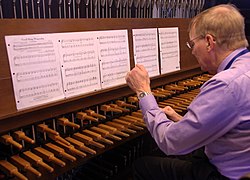
A carillonist plays the 56-bell carillon of the Plummer Building, Rochester, Minnesota, US
A carillon is a pitched percussion instrument that is played with a keyboard and consists of at least 23 bells. The bells are cast in bronze, hung in fixed suspension, and tuned in chromatic order so that they can be sounded harmoniously together. They are struck with clappers connected to a keyboard of wooden batons played with the hands and pedals played with the feet. Often housed in bell towers, carillons are usually owned by churches, universities, or municipalities. They can include an automatic system through which the time is announced and simple tunes are played throughout the day. (Full article...)
Hurricane Leslie (known as Storm Leslie or Cyclone Leslie while extratropical) was the strongest cyclone of tropical origin to strike the Iberian Peninsula since 1842. A large, long-lived, and very erratic tropical cyclone, Leslie was the twelfth named storm and sixth hurricane of the 2018 Atlantic hurricane season.[1] The storm had a non-tropical origin, developing from an extratropical cyclone that was situated over the northern Atlantic on 22 September. The low quickly acquired subtropical characteristics and was classified as Subtropical Storm Leslie on the following day. The cyclone meandered over the northern Atlantic and gradually weakened, before merging with a frontal system on 25 September, which later intensified into a powerful hurricane-force extratropical low over the northern Atlantic. (Full article...)- The Lince (Spanish pronunciation: [ˈlinθe], meaning "Lynx") was a Spanish development programme for a proposed main battle tank that unfolded during the late 1980s and early 1990s. The intention was to replace the M47 and M48 Patton tanks that the Spanish Army had received under the U.S. Mutual Defense Assistance Act between 1954 and 1975, and to complement the AMX-30E tanks manufactured for the army during the 1970s. Companies from several nations, such as German Krauss-Maffei, Spanish Santa Bárbara, and French GIAT, made bids for the development contract. The main priorities were mobility and firepower, with secondary priority placed on protection; the Lince tank was to have been lighter and faster than its competitors. To achieve a sufficient level of firepower and protection, the Lince was to use Rheinmetall's 120 mm L/44 tank-gun and German composite armour from the Leopard 2A4. (Full article...)

An M48 Patton tank of the Spanish Army on display at the El Goloso Museum of Armored Vehicles in October 2007.
Tanks in the Spanish Army have over 90 years of history, from the French Renault FTs first delivered in 1919 to the Leopard 2 and B1 Centauro models of the early 21st century. The Spanish FTs took part in combat during the Rif War and participated in the first amphibious landing with tanks in history, at Alhucemas. In 1925, the Spanish Army began to undertake a program to develop and produce a Spanish tank, an upgraded version of the Renault FT, called the Trubia A4. Although the prototype performed well during testing, the tank was never put into mass production. Spain also experimented with the Italian Fiat 3000, acquiring one tank in 1925, and with another indigenous tank program called the Landesa. However, none of these evolved into a major armor program, and as a result the FT remained the most important tank, in numbers, in the Spanish Army until the beginning of the Spanish Civil War. (Full article...)
In a protracted conflict during the Spanish colonization of the Americas, Spanish colonisers gradually incorporated the territory that became the modern country of Guatemala into the colonial Viceroyalty of New Spain. Before the conquest, this territory contained a number of competing Mesoamerican kingdoms, the majority of which were Maya. Many conquistadors viewed the Maya as "infidels" who needed to be forcefully converted and pacified, disregarding the achievements of their civilization. The first contact between the Maya and European explorers came in the early 16th century when a Spanish ship sailing from Panama to Santo Domingo (Hispaniola) was wrecked on the east coast of the Yucatán Peninsula in 1511. Several Spanish expeditions followed in 1517 and 1519, making landfall on various parts of the Yucatán coast. The Spanish conquest of the Maya was a prolonged affair; the Maya kingdoms resisted integration into the Spanish Empire with such tenacity that their defeat took almost two centuries. (Full article...)
The black stork (Ciconia nigra) is a large bird in the stork family Ciconiidae. It was first described by Carl Linnaeus in the 10th edition of his Systema Naturae. Measuring on average 95 to 100 cm (37 to 39 in) from beak tip to end of tail with a 145-to-155 cm (57-to-61 in) wingspan, the adult black stork has mainly black plumage, with white underparts, long red legs and a long pointed red beak. A widespread but uncommon species, it breeds in scattered locations across Europe (predominantly in Portugal and Spain, and central and eastern parts), and east across the Palearctic to the Pacific Ocean. It is a long-distance migrant, with European populations wintering in tropical Sub-Saharan Africa, and Asian populations in the Indian subcontinent. When migrating between Europe and Africa, it avoids crossing broad expanses of the Mediterranean Sea and detours via the Levant in the east, the Strait of Sicily in the center, or the Strait of Gibraltar in the west. An isolated non-migratory population lives in Southern Africa. (Full article...)- The battle of New Carthage took place in early 209 BC when a Roman army under Publius Cornelius Scipio successfully assaulted New Carthage, the capital of Carthaginian Iberia, which was defended by a garrison under Mago. The battle was part of the Second Punic War. (Full article...)
Doménikos Theotokópoulos (Greek: Δομήνικος Θεοτοκόπουλος, pronounced [ðoˈminikos θeotoˈkopulos]; 1 October 1541 – 7 April 1614), most widely known as El Greco (Spanish pronunciation: [el ˈɣɾeko]; "The Greek"), was a Greek painter, sculptor and architect of the Spanish Renaissance, regarded as one of the greatest artists of all time. El Greco was a nickname, and the artist normally signed his paintings with his full birth name in Greek letters often adding the word Κρής (Krḗs), which means "Cretan" in Ancient Greek. (Full article...)- The Colossus of Rhodes is a 1954 oil painting by the Spanish surrealist Salvador Dalí. It is one of a series of seven paintings he created for the 1956 film Seven Wonders of the World, each depicting one of the wonders. The work shows the Colossus of Rhodes, the ancient statue of the Greek titan-god of the sun, Helios. The painting was not used for the film and was donated to the Kunstmuseum Bern in 1981, where it remains. (Full article...)
Abu Abdullah Muhammad ibn Ismail also known as Muhammad IV (14 April 1315 – 25 August 1333), was the ruler of the Emirate of Granada on the Iberian Peninsula from 1325 to 1333. He was the sixth Sultan of the Nasrid dynasty, succeeding to the throne at ten years old when his father, Ismail I (r. 1314–1325), was assassinated. (Full article...)
The Punic Wars were a series of wars fought between the Roman Republic and the Carthaginian Empire during the period 264 to 146 BC. Three such wars took place, involving a total of forty-three years of warfare on both land and sea across the western Mediterranean region, and a four-year-long revolt against Carthage. (Full article...)
The Italian War of 1542–1546 was a conflict late in the Italian Wars, pitting Francis I of France and Suleiman I of the Ottoman Empire against the Holy Roman Emperor Charles V and Henry VIII of England. The course of the war saw extensive fighting in Italy, France, and the Low Countries, as well as attempted invasions of Spain and England. The conflict was inconclusive and ruinously expensive for the major participants. (Full article...)
The Spanish conquest of Petén was the last stage of the conquest of Guatemala, a prolonged conflict during the Spanish colonisation of the Americas. A wide lowland plain covered with dense rainforest, Petén contains a central drainage basin with a series of lakes and areas of savannah. It is crossed by several ranges of low karstic hills and rises to the south as it nears the Guatemalan Highlands. The conquest of Petén, a region now incorporated into the modern republic of Guatemala, climaxed in 1697 with the capture of Nojpetén, the island capital of the Itza kingdom, by Martín de Ursúa y Arizmendi. With the defeat of the Itza, the last independent and unconquered native kingdom in the Americas fell to European colonisers. (Full article...)- The Nyon Conference was a diplomatic conference held in Nyon, Switzerland, in September 1937 to address attacks on international shipping in the Mediterranean Sea during the Spanish Civil War. The conference was convened in part because Italy had been carrying out unrestricted submarine warfare, although the final conference agreement did not accuse Italy directly; instead, the attacks were referred to as "piracy" by an unidentified body. Italy was not officially at war, nor did any submarine identify itself. The conference was designed to strengthen non-intervention in the Spanish Civil War. The United Kingdom and France led the conference, which was also attended by Bulgaria, Egypt, Greece, Romania, Turkey, the Soviet Union and Yugoslavia. (Full article...)
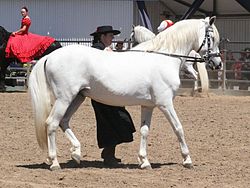
The Andalusian or Pura Raza Española, also known as the Pure Spanish Horse or PRE, is a Spanish breed of riding horse from the Iberian Peninsula, where its ancestors have lived for thousands of years. The Andalusian has been recognized as a distinct breed since the 15th century, and its conformation has changed very little over the centuries. Throughout its history, it has been known for its prowess as a war horse, and was prized by the nobility. The breed was used as a tool of diplomacy by the Spanish government, and kings across Europe rode and owned Spanish horses. During the 19th century, warfare, disease, and crossbreeding reduced herd numbers dramatically, and despite some recovery in the late 19th century, the trend continued into the early 20th century. Exports of Andalusians from Spain were restricted until the 1960s, but the breed has since spread throughout the world, despite its low population. In 2010, more than 185,000 registered Andalusians existed worldwide. (Full article...)
The AMX-30E (E stands for España, Spanish for Spain) is a Spanish main battle tank based on France's AMX-30. Although originally the Spanish government sought to procure the German Leopard 1, the AMX-30 was ultimately awarded the contract due to its lower price and the ability to manufacture it in Spain. 280 units were manufactured by Santa Bárbara Sistemas for the Spanish Army, between 1974 and 1983. (Full article...)
Plate 34: Por una navaja (For a clasp knife). A garroted priest grasps a crucifix in his hands. Pinned to his chest is a description of the crime for which he was killed—possession of a knife.
The Disasters of War (Spanish: Los desastres de la guerra) is a series of 82 prints created between 1810 and 1820 by the Spanish painter and printmaker Francisco Goya. Although Goya did not make known his intention when creating the plates, art historians view them as a visual protest against the violence of the 1808 Dos de Mayo Uprising, the subsequent cruel war that ended in Spanish victory in the Peninsular War of 1808–1814 and the setbacks to the liberal cause following the restoration of the Bourbon monarchy in 1814. During the conflicts between Napoleon's French Empire and Spain, Goya retained his position as first court painter to the Spanish crown and continued to produce portraits of the Spanish and French rulers. Although deeply affected by the war, he kept private his thoughts on the art he produced in response to the conflict and its aftermath. (Full article...)
The European rabbit (Oryctolagus cuniculus) or coney is a species of rabbit native to the Iberian Peninsula and southwestern France. It has been introduced to hundreds of locations around the world. Wild and domesticated European rabbits around the world can vary widely in size, shape, and colour. The average adult European rabbit is smaller than the European hare, though size and weight vary with habitat and diet. (Full article...)
The 2015 Vuelta a España was a three-week Grand Tour cycling race. The race was the 70th edition of the Vuelta a España and took place principally in Spain, although two stages took place partly or wholly in Andorra, and was the 22nd race in the 2015 UCI World Tour. The 3,358.1-kilometre (2,086.6 mi) race included 21 stages, beginning in Marbella on 22 August 2015 and finishing in Madrid on 13 September. It was won by Fabio Aru (Astana Pro Team), with Joaquim Rodríguez (Team Katusha) second and Rafał Majka (Tinkoff–Saxo) third. (Full article...)- Muhammad III (Arabic: محمد الثالث; 15 August 1257 – 21 January 1314) was the ruler of the Emirate of Granada in Al-Andalus on the Iberian Peninsula from 8 April 1302 until 14 March 1309, and a member of the Nasrid dynasty. He ascended the Granadan throne after the death of his father Muhammad II, which according to rumours, was caused by Muhammad III poisoning him. He had the reputation of being both cultured and cruel. Later in his life, he became visually impaired—which caused him to be absent from many government activities and to rely on high officials, especially the powerful Vizier Ibn al-Hakim al-Rundi. (Full article...)
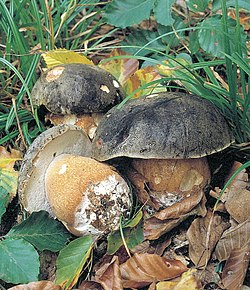
Boletus aereus, commonly known as the queen bolete, dark cep, or bronze bolete, is a species of fungus in the family Boletaceae. Described in 1789 by French mycologist Pierre Bulliard, it is closely related to several other European boletes, including B. reticulatus, B. pinophilus, and the popular B. edulis. Some populations in North Africa have in the past been classified as a separate species, B. mamorensis, which has been shown to be phylogenically conspecific to B. aereus and is now regarded as a synonym. (Full article...)- Abu'l-Walid Ismail I ibn Faraj (3 March 1279 – 8 July 1325) was the fifth Nasrid ruler of the Emirate of Granada on the Iberian Peninsula from 1314 to 1325. A grandson of Muhammad II on the side of his mother Fatima, he was the first of the lineage of sultans now known as the al-dawla al-isma'iliyya al-nasriyya (lit. 'the Nasrid dynasty of Ismail'). Historians characterise him as an effective ruler who improved the emirate's position with military victories during his reign. (Full article...)
Abu al-Hajjaj Yusuf ibn Ismail (29 June 1318 – 19 October 1354), known by the regnal name al-Muayyad billah (lit. 'He who is aided by God'), was the seventh Nasrid ruler of the Emirate of Granada on the Iberian Peninsula. The third son of Ismail I (r. 1314–1322), he was Sultan between 1333 and 1354, after his brother Muhammad IV (r. 1325–1333) was assassinated. (Full article...)
North View of Gibraltar from Spanish Lines by John Mace (1782)
The history of Gibraltar, a small peninsula on the southern Iberian coast near the entrance of the Mediterranean Sea, spans over 2,900 years. The peninsula was a place of reverence in ancient times, and it later became "one of the most densely fortified and fought-over places in Europe", as one historian has put it. Gibraltar's location has given it an outsized role in the history of Europe. Its fortified town, established in the Middle Ages, has hosted garrisons that have fought in numerous sieges and battles over the centuries. The Rock of Gibraltar is a limestone monolith and fortress in Gibraltar that has held historical and military significance and has become a tourist attraction. (Full article...)


.jpg)


.jpeg)


Selected biography

José María Teclo Morelos y Pavón (September 30, 1765, Valladolid, now Morelia, Michoacán – December 22, 1815, in San Cristóbal Ecatepec, State of México) was a Mexican priest and revolutionary rebel leader who led the Mexican War of Independence movement, assuming its leadership after the execution of Miguel Hidalgo in 1811. He was later captured by the Spanish colonial authorities and executed for treason in 1815.
Morelos was born into a poor family in the city of Valladolid, since renamed "Morelia" in his honor, in a house that is today a museum dedicated to his memory. He was a zambo of Amerindian, African from African American Registry and Spanish ancestry. His father was Manuel Morelos, a carpenter originally from Zindurio, a predominantly indigenous village a few kilometers west of Valladolid. His mother was Juana María Guadalupe Pérez Pavón, originally from San Juan Bautista de Apaseo, also near Valladolid. Valladolid was the seat of a bishop and of the government of the colonial Intendency of Michoacán. It was known as the "Garden of New Spain" because of its prosperity.
Selected picture

A light metro train Credit: FDV
A metro light train currently in operation with Madrid Metro. This train is pictured on line ML2 at Aravaca metro station.
Cala Figuera Credit: BuzzWoof
The harbor entrance to Cala Figuera, a district of Mallorca in the Balearic Islands. The town is located approximately 60 kilometers north of Palma de Mallorca. The earliest records of the town date back to 1306, although houses were not built on the land until the early 19th century.
Windmills Credit: Lourdes Cardenal
Active windmills shown turning in La Mancha. The area is now famous for its windmills and scenic views. Painting credit: Francisco GoyaCharles IV of Spain and His Family is a portrait of the royal family of Spain painted by Francisco Goya in 1800 and 1801. King Charles IV, his wife Maria Luisa of Parma, and his children and relatives are dressed in the height of contemporary fashion, lavishly adorned with jewelry and the sashes of the order of Charles III. The artist does not attempt to flatter the family; instead the group portrait is unflinchingly realist, both in detail and tone. The artist, seated at his easel, is visible in the background. The painting is in the collection of the Museo del Prado in Madrid.
 Photograph: Diego DelsoMoros is a municipality in the province of Zaragoza, Spain. Located in the Sistema Ibérico mountain range, the village lies on a hill, with the church and former town hall at the top, the residences in the middle, and the sheep pens at the bottom. The population of Moros has been steadily decreasing in recent decades, and was 478 in 2006.
 Photo credit: DiliffThe Torre Agbar is a landmark skyscraper and the third tallest building in Barcelona, Spain. It was designed by French architect Jean Nouvel, who stated that the shape of the Torre Agbar was inspired by the mountains of Montserrat that surround Barcelona, and by the shape of a geyser of water rising into the air. Its design combines a number of different architectural concepts, resulting in a striking structure built with reinforced concrete, covered with a facade of glass, and over 4,500 window openings cut out of the structural concrete.
Aneto Peak Credit: BrugesFR
Aneto is a mountain located in Benasque municipality, Aragon, area of the Pyreenes. The mountain is the highest mountain in the Pyrenees, and Spain's third-highest mountain.
Las Médulas mine. Credit: Rayet
Las Médulas, located near the town of Ponferrada in León province, Spain, used to be the most important gold mine in the Roman Empire. Las Médulas Cultural Landscape is listed by the UNESCO as one of the World Heritage Sites.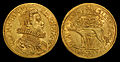 Coin design credit: Duchy of ParmaThe doubloon was a Spanish gold coin worth two escudos or 32 reales weighing 6.867 grams (0.221 troy ounces), introduced in 1537. It became the model for several other gold coins issued in Europe, including this 1626 two-doppie gold coin issued in Piacenza in northern Italy by the Duchy of Parma, depicting Odoardo Farnese, Duke of Parma, on the obverse. The coin is part of the National Numismatic Collection at the National Museum of American History.
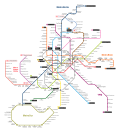 The Madrid Metro is a rapid transit system serving the Spanish capital, Madrid. It was inaugurated in 1919 by King Alfonso, with a single line which ran for 3.48 km (2.16 mi) between Puerta del Sol and Cuatro Caminos, with eight stops. The present system has 301 stations on 13 lines plus one branch line, totalling 294 km (183 mi).
 Painting credit: Federico de Madrazo y KuntzAmalia de Llano (April 29, 1822 – July 6, 1874) was a Spanish countess and writer. This 1853 oil-on-canvas portrait by Federico de Madrazo y Kuntz shows her seated in a fine armchair wearing sumptuous clothes, with her youth and beauty accentuated by the dark background, and is quite unlike a traditional Spanish portrait of the period.
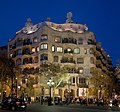 Photo credit: David IliffThe Casa Milà, a 1912 work by Catalán architect Antoni Gaudi, in the Eixample district of Barcelona, Spain. Gaudí's fascination with trencadís-influenced decoration and curves (predating biomorphism by almost 20 years) can be seen here.
 Photograph: J.Ligero & I.BarriosA three-month old Spanish ibex (Capra pyrenaica) in Sierra de Gredos, Spain. These ibexes are strong mountain animals characterized by their large and flexible hooves and short legs.
The two sexes of adults form separate social groups; juveniles stay with the female groups from birth until the following birth season, when they leave. Yearling males then join male groups, while females eventually return to their mothers' groups and stay several years. Banknote: Bank of SpainThe Spanish peseta is a former currency of Spain and, alongside the French franc, a former de facto currency in Andorra. It was introduced in 1868, replacing the peso, at a time when Spain was considering joining the Latin Monetary Union. Spain joined the euro in 1999, and the peseta was replaced by euro notes and coins in 2002.
This picture shows a 1000 peseta banknote from 1957. The obverse depicts the Catholic Monarchs while the reverse shows the coat of arms of Spain.
The Battle of Ravenna Credit: Ary Scheffer
An artists portrayal of the Battle of Ravenna (1512). This artwork also shows the death of Gaston de Foix, as well as the general scene during the time of battle.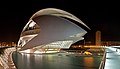 Photo credit: David IliffThe Queen Sofia Palace of the Arts (Valencian: Palau de les Arts Reina Sofía) is an opera house located in Valencia, Spain. The last to be completed of the City of Arts and Sciences complex, it was designed by architect Santiago Calatrava. The 14-story structure opened on 8 October 2005.
 Painting: Francisco GoyaThe Third of May 1808 is a painting completed in 1814 by the Spanish master Francisco Goya, now in the Museo del Prado, Madrid. Along with its companion piece of the same size, The Second of May 1808 (or The Charge of the Mamelukes), it was commissioned by the provisional government of Spain at Goya's suggestion. Goya sought to commemorate Spanish resistance to Napoleon's armies during the Peninsular War.
 The peaks of the Central Massif overlook the village of Sotres in Cabrales, located in the Picos de Europa, a mountain range in northern Spain forming part of the Cantabrian Mountains. The name (literally: "Peaks of Europe") is believed to derive from being the first European landforms visible to mariners arriving from the Americas.
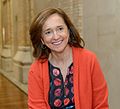 Photograph credit: Biblioteca Nacional de EspañaAna Santos Aramburo (born 1957) has been the director of the National Library of Spain since February 2013. Having received a degree in geography and history from the University of Zaragoza in Spain, she has spent much of her career working at the Complutense University of Madrid, first at the library of the Faculty of Economics and Business Sciences, and later serving as deputy director of the university library. Later she served as Director of the Historical Library Marquis of Valdecilla, General Director of Libraries and Archives of the City of Madrid, and Director of Cultural Action at the National Library. This photograph of Santos shows her at the headquarters of the National Library of Spain in Madrid.
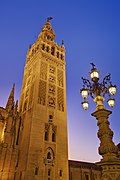 Photo: David IliffThe Giralda is a 104.5 m (343 ft) tall bell tower for the Seville Cathedral in Seville, Andalusia, Spain. It was originally constructed as a minaret in 1198, when Seville was ruled by the Almohad Caliphate. After the city was taken by the Christians in the Reconquista, the city's mosque was converted to a church. The upper third of the structure was completed during the Spanish Renaissance.
 Photograph: Diego DelsoThe Assut de l'Or Bridge is a white single-pylon cable-stayed bridge in the City of Arts and Sciences, Valencia, Spain. Completed in 2008, it was designed by Valencian architect and civil engineer Santiago Calatrava as a variant of his cantilever spar cable-stayed bridge in Seville.
The Puente Nuevo


.jpg)


.jpg)


.jpg)
Did you know...
- ... that painter Nicolino Calyo left Naples after participating in a failed uprising against King Ferdinand IV, then fled Spain following the outbreak of the First Carlist War?
- ... that Cuban swimmer Rafael Polinario had to defect to Canada instead of Spain after Fidel Castro's brother got on his plane?
- ... that lemon trees inspired a Spanish tourist train?
- ... that the surname Baena was popular among Spanish Jews forced to convert to Catholicism during the Reconquista, even though few Jews in Baena had Jewish surnames in the first place?
- ... that when the COVID-19 pandemic began, Masyita Crystallin was instructed by the Indonesian finance minister to study the Spanish flu to help formulate unconventional economic policies?
- ... that, during Real Madrid's 1927 tour of the Americas, José María Muñagorri nearly jumped into shark-infested waters to rescue a teammate?
 Good article –

- Spain in Our Hearts: Americans in the Spanish Civil War, 1936–1939 is a non-fiction book by Adam Hochschild that was first published by Houghton Mifflin Harcourt on March 29, 2016. The book is an account of the American volunteers who participated in the Spanish Civil War from 1936 to 1939. The story centers around several American volunteer fighters and journalists, tracing their motivations for joining the war and their experiences during the war which left many disillusioned. The book explains the involvement of foreign leaders including Adolf Hitler, Benito Mussolini and Joseph Stalin, and explains why the Republican faction ultimately lost. (Full article...)
The Battle of Cape St. Vincent was a naval engagement that took place on 16 June or 6 October 1606, during Eighty Years' War and Dutch–Portuguese War. A Spanish fleet under Admiral Luis Fajardo attacked the Dutch fleet led by Admiral Willem Haultain and Vice Admiral Regnier Klaazoon, which was blocking the Spanish-Portuguese coast to intercept the Spanish treasure fleet. The battle concluded in a Spanish victory; in which Klaazoon's flagship was destroyed, two ships were captured, and Haultain fled with the rest of the fleet to his country without having achieved his purpose. (Full article...)
Tomás de Yepes or Hiepes (also known as Thomas de Yepes or Hiepes; 1595 or 1600 – 16 June 1674) was a Spanish Baroque painter in the Kingdom of Valencia. He worked as a painter of still life and bodegón—still life paintings depicting pantry items. He made paintings both for clients and public events. Although his activity started in the second decade of the 17th century, most of the works attributed to him come after 1642. He continued to paint until the year of his death. (Full article...)
A motion of no confidence in the Spanish government of Mariano Rajoy was debated and voted in the Congress of Deputies between 13 and 14 June 2017. It was brought by Unidos Podemos leader Pablo Iglesias as a result of a corruption case involving high-ranking People's Party (PP) officials, amid accusations of maneuvers from the Rajoy government to influence the judicial system in order to cover-up the scandal. This was the third vote of no confidence held in Spain since the country's transition to democracy—after the unsuccessful 1980 and 1987 ones—as well as the first not to be registered by the main opposition party at the time. (Full article...)
Manuel de Trujillo y Torres (November 1762 – July 15, 1822) was a publicist and diplomat from Gran Colombia. He is best known for being received as the first ambassador of Gran Colombia by U.S. President James Monroe on June 19, 1822. This act represented the first U.S. recognition of a former Spanish colony's independence. (Full article...)
Mohand Amezian ben Ameziane Saïl (14 October 1894 – 27 April 1953) was an Algerian anarchist and anti-colonial activist. Born in Kabylia, he was largely self-taught and became an atheist and an anarchist after moving to Metropolitan France. After World War I, he joined the French anarchist movement and began agitating for Algerian independence. He was arrested and imprisoned several times during the 1930s, due to his anti-colonialist, anti-militarist and anti-fascist activism. He volunteered to fight in the Spanish Civil War and served in the Durruti Column until he was wounded and forced to return to France. After the Nazi occupation of France, he was interned in a concentration camp, but escaped and joined the French Resistance. With the liberation of France, he resumed his agitation for Algerian independence, calling for a social revolution to overthrow the French colonial empire. In his writings, he depicted native Kabyles as having their own libertarian and egalitarian tradition, and proposed the establishment of a non-hierarchical and secular society in an independent Algeria. He continued his activism up until his death, one year before the Algerian War of Independence broke out. (Full article...)
Lieutenant-Colonel Sir Duncan MacDougall (1787 – 10 December 1862) was a British Army officer who fought in the Peninsular War and War of 1812. He rose to command the 79th Regiment of Foot before serving as second-in-command of the British Auxiliary Legion during the First Carlist War. (Full article...)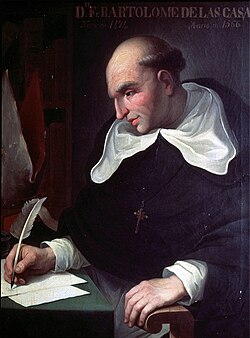
Bartolomé de las Casas, OP (US: /lɑːs ˈkɑːsəs/ lahss KAH-səss; Spanish pronunciation: [baɾtoloˈme ðe las ˈkasas]); 11 November 1484 – 18 July 1566) was a Spanish lawyer, clergyman, writer, and activist best known for his work as a historian and social reformer. He arrived in Hispaniola as a layman, then became a Dominican friar. He was appointed as the first resident Bishop of Chiapas, and the first officially appointed "Protector of the Indians". His extensive writings, the most famous being A Short Account of the Destruction of the Indies and Historia de Las Indias, chronicle the first decades of colonization of the Caribbean islands. He described and railed against the atrocities committed by the conquistadores against the Indigenous peoples. (Full article...)
Count Henry Russell (foreground) and Léonce Lourde-Rocheblave, seated near the entrance of the Russell Caves at the Vignemale, accompanied by their guides.
Pyreneanism (French: pyrénéisme; alternatively Pyreneism) is a 19th-century sporting culture as well as an artistic and literary movement centered around exploring the Pyrenees in order to create works inspired by the experience, whether for contemplative, artistic, or scientific purposes. The term was coined in 1898 by the scholar Henri Beraldi in his book Cent ans aux Pyrénées (transl. A Hundred Years in the Pyrenees), where he described a specific way of engaging with the Pyrenean mountains. According to his definition, "the ideal Pyreneist knows how to climb, write, and feel," setting them apart from the typical mountaineer through a more intellectual approach that goes beyond mere physical performance. (Full article...)
Ibn Rushd (14 April 1126 – 11 December 1198), Latinized as Averroes, was an Andalusian polymath and jurist who was proficient in a variety of intellectual fields, including philosophy, theology, medicine, astronomy, physics, psychology, mathematics, neurology, Islamic jurisprudence and law, and linguistics. The author of more than 100 books and treatises, his philosophical works include numerous commentaries on Aristotle, for which he was known in the Western world as "The Commentator" and "Father of Rationalism". (Full article...)
Trajan (/ˈtreɪ.dʒən/ ⓘ TRAY-jən; born Marcus Ulpius Traianus, 18 September 53 – c. 9 August 117) was a Roman emperor from AD 98 to 117, remembered as the second of the Five Good Emperors of the Nerva–Antonine dynasty. He was a philanthropic ruler and a successful soldier-emperor who presided over one of the greatest military expansions in Roman history, during which, by the time of his death, the Roman Empire reached its maximum territorial extent. He was given the title of optimus princeps ('the best ruler') by the Roman Senate. (Full article...)
Anna Yolanda Bellón Cramling (born 30 April 2002) is a Spanish-Swedish chess player, Twitch live streamer, and YouTuber who holds the title of Woman FIDE Master (WFM). She had a peak FIDE rating of 2175 in March 2018. Cramling represented Sweden in the 2016 and 2022 Chess Olympiad as well as two European Team Chess Championships. (Full article...)- Ciutat Morta ([siwˈtat ˈmɔr.tə], "Dead City") is a 2013 Catalan documentary about the 4F case, directed by Xavier Artigas and Xapo Ortega. The film covers the repercussions of the events of February 4, 2006, when a Guàrdia Urbana officer in Barcelona was grievously injured and several people were arrested. This resulted in a long court-case and ultimately four people were convicted and imprisoned, one of whom committed suicide. (Full article...)
The Battle of the Lippe was a cavalry action fought on 2 September 1595 on the banks of the Lippe river, in Germany, between a corps of Spanish cavalry led by Juan de Córdoba and a corps of Dutch cavalry, supported by English troops, led by Philip of Nassau. The Dutch stadtholder Maurice of Nassau, taking advantage of the fact that the bulk of the Spanish army was busied in operations in France, besieged the town of Groenlo in Gelderland, but the elderly governor of the citadel of Antwerp, Cristóbal de Mondragón, organized a relief army and forced Maurice to lift the siege. Mondragón next moved to Wesel, positioning his troops on the southern bank of the Lippe river to cover Rheinberg from a Dutch attack. Maurice aimed then, relying on his superior army, to entice Mondragón into a pitched battle, planning to use an ambush to draw the Spanish army into a trap. However, the plan was discovered by the Spanish commander, who organized a counter-ambush. (Full article...)- The long term causes of the Spanish Civil War date back to the end of the 19th century, when the owners of large estates, called latifundios, held most of the power in a land-based oligarchy. The landowners' power was unsuccessfully challenged by the industrial and merchant sectors. In 1868 popular uprisings led to the overthrow of Queen Isabella II of the House of Bourbon. In 1873 Isabella's replacement, King Amadeo I of the House of Savoy, abdicated due to increasing political pressure, and the short-lived First Spanish Republic was proclaimed. After the restoration of the Bourbons in December 1874, Carlists and anarchists emerged in opposition to the monarchy. Alejandro Lerroux helped bring republicanism to the fore in Catalonia, where poverty was particularly acute. Growing resentment of conscription and of the military culminated in the Tragic Week in Barcelona in 1909. After the First World War, the working class, the industrial class, and the military united in hopes of removing the corrupt central government, but were unsuccessful. Fears of communism grew. A military coup brought Miguel Primo de Rivera to power in 1923, and he ran Spain as a military dictatorship. Support for his regime gradually faded, and he resigned in January 1930. There was little support for the monarchy in the major cities, and King Alfonso XIII abdicated; the Second Spanish Republic was formed, whose power would remain until the culmination of the Spanish Civil War. Monarchists would continue to oppose the Republic. (Full article...)
Marina de Escobar Montaña (8 February 1554 – 9 June 1633) was a Spanish Catholic mystic of the Counter-Reformation era. Restricted in her activity due to poor health, she devoted herself to prayer and contemplation under the guidance of her Jesuit confessors and spiritual advisors. Marina experienced visions of a number of saints, and within her lifetime she acquired a reputation throughout Spain as a holy woman, especially in her home city of Valladolid. (Full article...)
Hadrian (/ˈheɪdriən/ ⓘ HAY-dree-ən; born Publius Aelius Hadrianus, 24 January 76 – 10 July 138) was Roman emperor from 117 to 138. Hadrian was born in Italica, in the present-day Andalusian province of Seville in southern Spain, an Italic settlement in Hispania Baetica; his gens Aelia came from the town of Hadria in eastern Italy. He was a member of the Nerva–Antonine dynasty. (Full article...)
A motion of no confidence in the Spanish government of Mariano Rajoy was debated and voted in the Congress of Deputies between 31 May and 1 June 2018. It was brought by Spanish Socialist Workers' Party (PSOE) leader Pedro Sánchez after the governing People's Party (PP) was found to have profited from the illegal kickbacks-for-contracts scheme of the Gürtel case in a court ruling made public the previous day. This was the fourth motion of no confidence since the Spanish transition to democracy and the first one to be successful, as well the second to be submitted against Mariano Rajoy after Unidos Podemos's motion the previous year. Coincidentally, it was held 38 years after the first such vote of no confidence in Spain on 30 May 1980. (Full article...)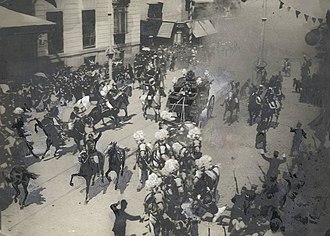
The bombing on 31 May 1906
The Morral affair was the attempted regicide of Spanish King Alfonso XIII and his bride, Queen Victoria Eugenie, on their wedding day, 31 May 1906, and its subsequent effects. The attacker, Mateu Morral, acting on a desire to spur revolution, threw a bomb concealed in a floral bouquet from a Madrid hotel window as the King's procession passed, killing 24 bystanders and soldiers and wounding over 100 others, while leaving the royals unscathed. Morral sought refuge from republican journalist José Nakens but fled in the night to Torrejón de Ardoz, whose villagers reported the interloper. Two days after the attack, militiamen accosted Morral, who killed one before killing himself. Morral was likely involved in a similar attack on the king a year earlier. (Full article...)
Political map of the Emirate of Granada
Abu al-Hajjaj Yusuf ibn Muhammad (Arabic: أبو الحجاج يوسف بن محمد; c. 1356 – 5 October 1392) was sultan of the Emirate of Granada, the last Muslim state in the Iberian Peninsula, from January 1391 until his death. He was the 11th sultan of the Nasrid dynasty and the first son of his predecessor, Muhammad V (r. 1354–1359, 1362–1391). (Full article...)
The Battle of Orbetello, also known as the Battle of Isola del Giglio, was a major naval engagement of the Franco-Spanish War of 1635. It was fought on 14 June 1646 off the Spanish-ruled town of Orbetello, on the coast of Tuscany, Italy, between a French fleet led by Admiral Armand de Maillé, Marquis of Brézé, and a Spanish fleet commanded by Miguel de Noronha, 4th Count of Linhares sent to break the blockade of Orbetello and relieve the town, besieged since 12 May by a French army under the command of Prince Thomas of Savoy. The Battle of Orbetello was tactically very unusual, since it was fought by sailing ships towed by galleys in a light breeze. (Full article...)
The Mediterranean campaign of 1798 was a series of major naval operations surrounding a French expeditionary force sent to Egypt under Napoleon Bonaparte during the French Revolutionary Wars. The French Republic sought to capture Egypt as the first stage in an effort to threaten British India and support Tipu Sultan, and thus force Great Britain to make peace. Departing Toulon in May 1798 with over 40,000 troops and hundreds of ships, Bonaparte's fleet sailed southeastwards across the Mediterranean Sea. They were followed by a small British squadron under Rear-Admiral Sir Horatio Nelson, later reinforced to 13 ships of the line, whose pursuit was hampered by a lack of scouting frigates and reliable information. Bonaparte's first target was the island of Malta, which was under the government of the Knights of St. John and theoretically granted its owner control of the Central Mediterranean. Bonaparte's forces landed on the island and rapidly overwhelmed the defenders, securing the port city of Valletta before continuing to Egypt. When Nelson learned of the French capture of the island, he guessed the French target to be Egypt and sailed for Alexandria, but passed the French during the night of 22 June without discovering them and arrived off Egypt first. (Full article...)
Nahikari García Pérez (born 10 March 1997) is a Spanish professional footballer who plays as a forward for Denver Summit FC of the National Women's Soccer League (NWSL) and the Spain national team. (Full article...)
Elections to Spain's legislature, the Cortes Generales, were held on 19 November 1933 for all 473 seats in the unicameral Cortes of the Second Spanish Republic. Since the previous elections of 1931, a new constitution had been ratified, and the franchise extended to more than six million women. The governing Republican-Socialist coalition had fallen apart, with the Radical Republican Party beginning to support a newly united political right. (Full article...)- The 2009 Palma Nova bombing occurred on 30 July 2009, when a limpet bomb went off outside a Civil Guard barracks in the town of Palma Nova, Majorca, Spain. The bomb was placed under a patrol car and two Civil Guard officers died as a result of the explosion. A second device was found under another Civil Guard vehicle at nearby barracks and safely exploded by police. On 9 August, the Basque nationalist and separatist organisation ETA claimed responsibility for the attack, while four other bombs exploded around restaurants and shopping centres in Palma, Majorca, causing no injuries. (Full article...)
.jpg)

.jpg)

.jpg)


.jpg)


.jpg)


.jpg)

General images
 Visigothic King Roderic haranguing his troops before the Battle of Guadalete (from History of Spain)
 Two women and a man during the siege of the Alcázar (from History of Spain)
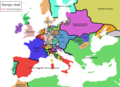 A map of Europe in 1648, after the Peace of Westphalia (from History of Spain)
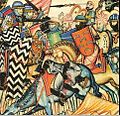 A battle of the Reconquista from the Cantigas de Santa Maria (from History of Spain)
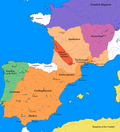 The greatest extent of the Visigothic Kingdom of Toulouse, c. 500, showing Territory lost after Vouillé in light orange (from History of Spain)
 Taking of Oran by Francisco Jiménez de Cisneros in 1509. (from History of Spain)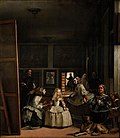

 Celebrations of the proclamation of the 2nd Republic in Barcelona. (from History of Spain)
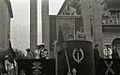 Franco visiting Tolosa in 1948 (from History of Spain)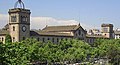
 Inner view of Granada Cathedral (from Spanish Golden Age)
 An 18th-century map of the Iberian Peninsula (from History of Spain)
 Plaza Mayor built in 1619 during the reign of Philip III. (from Spanish Golden Age)
 The Port of Seville in the late 16th century. Seville became one of the most populous and cosmopolitan European cities after the expeditions to the New World. (from History of Spain)
 The realms of Philip II of Spain (from Spanish Golden Age)
 Royal Site of San Lorenzo de El Escorial. Built between 1563 and 1584 by order of King Philip II, it is the largest Renaissance building in the world. (from Spanish Golden Age)
 Ruins of Guernica (from History of Spain)
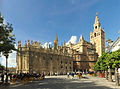 Cathedral of Saint Mary of the See in Sevilla. (from Culture of Spain)
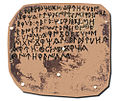 Illustration depicting the (now lost) Luzaga's Bronze, an example of the Celtiberian script. (from History of Spain)
 The Defence of Cádiz Against the English oil on canvas by Francisco de Zurbarán (from Spanish Golden Age)
 Recognition of the Duke of Anjou as King of Spain, under the name of Philip V, November 16, 1700 (from History of Spain)
 The Conquest of Tenochtitlán (from History of Spain)
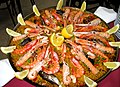 Paella mixta (from Culture of Spain)
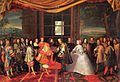 Louis XIV of France and Philip IV of Spain at the Meeting on the Isle of Pheasants in June 1660, part of the process to put an end to the Franco-Spanish War (1635–59). (from History of Spain)
 Roman Empire, 3rd century (from History of Spain)
 The Third of May 1808, Napoleon's troops shoot hostages. Goya (from History of Spain)
 Proclamation of the Spanish Republic in Madrid (from History of Spain)
 Jamón ibérico (from Culture of Spain)
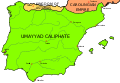 al-Andalus at its greatest extent, 720 (from History of Spain)
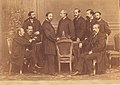 Members of the provisional government after the 1868 Glorious Revolution, by Jean Laurent. (from History of Spain)
 Wedding portrait of the Catholic Monarchs (from History of Spain)
 Map of territories that were once part of the Spanish Empire (from History of Spain)
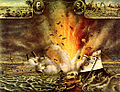 The explosion of the USS Maine launched the Spanish–American War in April 1898 (from History of Spain)
 El paseo de las Delicias, a 1784–1785 painting by Ramón Bayeu depicting a meeting of members of the aristocracy in the aforementioned location. (from History of Spain)
 Cabeza de Luis Buñuel, sculptor's work by Iñaki, in the center Buñuel Calanda. (from Culture of Spain)
 Execution of Torrijos and his men in 1831. Ferdinand VII took repressive measures against the liberal forces in his country. (from History of Spain)
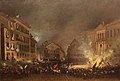 Episode of the 1854 Spanish Revolution in the Puerta del Sol, by Eugenio Lucas Velázquez. (from History of Spain)
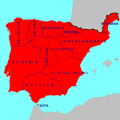 Visigothic Hispania and its regional divisions in 700, prior to the Muslim conquest (from History of Spain)
 Panoramic view of the lower level patio of the Palace (from Spanish Golden Age)
 Landing of Columbus by John Vanderlyn, 1847. Christopher Columbus leads expedition to the New World, 1492, sponsored by Spanish crown (from History of Spain)
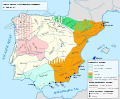 The Iberian Peninsula in the 3rd century BC (from History of Spain)
 The Virgin of the Rosary (1675–80) by Bartolomé Esteban Murillo (from Spanish Golden Age)
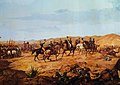 The pro-independence forces delivered a crushing defeat to the royalists and secured the independence of Peru in the 1824 battle of Ayacucho. (from History of Spain)
 Façade of the Cathedral of Valladolid (from Spanish Golden Age)
 Charles I of Spain (better known in the English-speaking world as the Holy Roman Emperor Charles V) was the most powerful European monarch of his day. (from History of Spain)
 Visigothic church, San Pedro de la Nave. Zamora. Spain (from History of Spain)
 1894 satirical cartoon depicting the tacit accord for seamless government change (turnismo) between the leaders of two dynastic parties (Sagasta and Cánovas del Castillo), with the country being lied in an allegorical fashion. (from History of Spain)
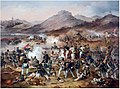 Battle of the First Carlist War, by Francisco de Paula Van Halen (from History of Spain)
![Image 56Detail of the votive crown of Recceswinth from the Treasure of Guarrazar, (Toledo-Spain) hanging in Madrid. The hanging letters spell [R]ECCESVINTHVS REX OFFERET [King R. offers this]. (from History of Spain)](//upload.wikimedia.org/wikipedia/commons/thumb/f/f2/Corona_de_%2829049230050%29.jpg/60px-Corona_de_%2829049230050%29.jpg) Detail of the votive crown of Recceswinth from the Treasure of Guarrazar, (Toledo-Spain) hanging in Madrid. The hanging letters spell [R]ECCESVINTHVS REX OFFERET [King R. offers this]. (from History of Spain)
Detail of the votive crown of Recceswinth from the Treasure of Guarrazar, (Toledo-Spain) hanging in Madrid. The hanging letters spell [R]ECCESVINTHVS REX OFFERET [King R. offers this]. (from History of Spain) The successful 1925 Alhucemas landing turned the luck in the Rif War towards Spain's favour. (from History of Spain)
 The promulgation of the Constitution of 1812, oil painting by Salvador Viniegra. (from History of Spain)

 Felipe González signing the treaty of accession to the European Economic Community on 12 June 1985. (from History of Spain)
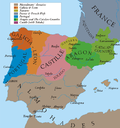 The Christian kingdoms of Hispania and the Islamic Almohad empire c. 1210
 Ethnology of the Iberian Peninsula c. 200 BC (from History of Spain)
 The title page of the Gramática de la lengua castellana (1492), the first grammar of a modern European language to be published. (from History of Spain)
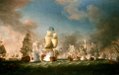 The Battle of Cape Passaro, 11 August 1718 (from History of Spain)

 The Second of May 1808 was the beginning of the popular Spanish resistance against Napoleon. (from History of Spain)
 People's militias attacking on a Rebel position in Somosierra in the early stages of the war. (from History of Spain)
.jpg)


.jpeg)


_-_Fondo_Car-Kutxa_Fototeka.jpg)


_en_Prins_Juan_Carlos,_Bestanddeelnr_254-9762.jpg)


.jpg)

.jpg)
.jpg)
.svg)


.jpg)

.jpg)
.JPG)


_(cropped).jpg)


.jpg)


![Image 56Detail of the votive crown of Recceswinth from the Treasure of Guarrazar, (Toledo-Spain) hanging in Madrid. The hanging letters spell [R]ECCESVINTHVS REX OFFERET [King R. offers this]. (from History of Spain)](#/media/File:Corona_de_(29049230050).jpg)


In the news
- 17 May 2026 – 2026 Andalusian regional election
- In Spain, ruling People's Party of Andalusia loses its absolute majority in the Andalusian parliament, whilst the PSOE-A posts its worst result ever. The far-right Vox and the left-wing Adelante Andalucía are the only parties to gain votes and seats. (El Mundo)
- 12 May 2026 – MV Hondius hantavirus outbreak
- The Spanish health ministry confirms the country's first case of hantavirus in a Spanish passenger from the MV Hondius who has been in isolation at a hospital in Madrid since 11 May. (The Economic Times)
- 11 May 2026 – Eurovision Song Contest 2026, International reactions to the Gaza war
- Public broadcasters in Ireland, Slovenia, and Spain announce that they will not air the 70th Eurovision Song Contest in protest over Israel's participation amid the Gaza war. (AFP via Al Arabiya)
- 10 May 2026 – MV Hondius hantavirus outbreak
- MV Hondius arrives on Tenerife, Spain, after being anchored at the Canary Islands. Passengers on the ship evacuate after previously being exposed to the hantavirus. (AP)
- 12 May 2026 – MV Hondius hantavirus outbreak
- The Spanish health ministry confirms the country's first case of hantavirus in a Spanish passenger from the MV Hondius who has been in isolation at a hospital in Madrid since 11 May. (The Economic Times)
Spain topics
Categories

WikiProjects
- Main project

- Related projects
WikiProject Basque • WikiProject Catalan-speaking Countries • WikiProject Galicia • Spanish Translation of the Week
Things you can do

- Add {{WikiProject Spain}} to article talk pages which have some relation to Spain
- Help write new Spain-related articles and improve and expand existent ones
- Assess: unassessed Spain-related articles
- Suggest: selected articles, biographies, pictures, did you knows? and quotes for this Portal
Related portals


.svg)

Associated Wikimedia
The following Wikimedia Foundation sister projects provide more on this subject:
-
 Commons
Free media repository -
 Wikidata
Free knowledge base -
 Wikiquote
Collection of quotations -
 Wikisource
Free-content library -
 Wikiversity
Free learning tools -
 Wikivoyage
Free travel guide -
 Wiktionary
Dictionary and thesaurus


- "Atlantic hurricane best track (HURDAT version 2)" (Database). United States National Hurricane Center. April 4, 2025.
 This article incorporates text from this source, which is in the public domain.
- Landsea, Chris (April 2022). "The revised Atlantic hurricane database (HURDAT2) - Chris Landsea – April 2022" (PDF). Hurricane Research Division – NOAA/AOML. Miami, Florida: Hurricane Research Division – via Atlantic Oceanographic and Meteorological Laboratory.
