Potassium azide
From Wikipedia, the free encyclopedia
| |||
 | |||
| Names | |||
|---|---|---|---|
| IUPAC name
Potassium azide | |||
| Identifiers | |||
3D model (JSmol) |
|||
| ChemSpider | |||
| ECHA InfoCard | 100.039.997 | ||
| EC Number |
| ||
PubChem CID |
|||
| UNII | |||
CompTox Dashboard (EPA) |
|||
| |||
| |||
| Properties | |||
| KN3 | |||
| Molar mass | 81.1184 g/mol | ||
| Appearance | Colorless crystals[1] | ||
| Density | 2.038 g/cm3 [1] | ||
| Melting point | 350 °C (662 °F; 623 K) (in vacuum)[1] | ||
| Boiling point | decomposes | ||
| 41.4 g/100 mL (0 °C) 50.8 g/100 mL (20 °C) 105.7 g/100 mL (100 °C) | |||
| Solubility | 0.1375 g/100 g in ethanol (16 °C)[2] insoluble in ether | ||
| Thermochemistry | |||
Std enthalpy of formation (ΔfH⦵298) |
−1.7 kJ/mol | ||
| Hazards | |||
| Occupational safety and health (OHS/OSH): | |||
Main hazards |
Very Toxic, explosive if strongly heated | ||
| NFPA 704 (fire diamond) | |||
| Lethal dose or concentration (LD, LC): | |||
LD50 (median dose) |
27 mg/kg (oral, rat)[3] | ||
| Related compounds | |||
Other cations |
Sodium azide, copper(II) azide, lead(II) azide, silver azide | ||
Except where otherwise noted, data are given for materials in their standard state (at 25 °C [77 °F], 100 kPa).
| |||


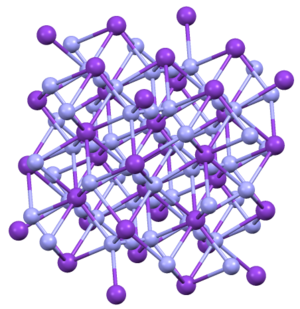
Potassium azide is the inorganic compound having the formula KN3. It is a white, water-soluble salt. It is used as a reagent in the laboratory.
It has been found to act as a nitrification inhibitor in soil.[4]
