Serbophilia
Love of Serbian culture, language or people
From Wikipedia, the free encyclopedia
Serbophilia (Serbian: Србофилија, romanized: Srbofilija) is the admiration, appreciation and/or emulation of a non-Serbian person who expresses a strong interest, positive predisposition or appreciation for the Serbs, Serbia, Republika Srpska, Serbian language, culture or history. Its opposite is Serbophobia.


History
20th century
World War I
During World War I, Serbophilia was present in western countries.[1]
Breakup of Yugoslavia
Political scientist Sabrina P. Ramet writes that Serbophilia in France during the 1990s was "traditional", partly as a response to the closeness between Germany and Croatia. Business ties continued during the war and fostered a desire for economic normalization.[2]
Serbophiles
- Jacob Grimm — German philologist, jurist and mythologist. Learnt Serbian in order to read Serbian epic poetry.[3][4]
- Archibald Reiss — German-Swiss publicist, chemist, forensic scientist, a professor at the University of Lausanne.[5]
- Victor Hugo — French poet, novelist, and dramatist of the Romantic movement. Hugo wrote the speech Pour la Serbie.[citation needed]
- Alphonse de Lamartine — French author, poet, and statesman.[6][7]
- Helen of Anjou — French noblewoman who became queen consort of the Serbian Kingdom.[citation needed]
- Mircea I and Vlad III Dracula[8]
- Several notable composers used motifs from Serbian folk music and composed works inspired by Serbian history or culture, such as:
- Johannes Brahms— German composer, pianist, and conductor of the Romantic period.[9][page needed]
- Franz Liszt — Hungarian composer, virtuoso pianist, conductor, music teacher, arranger, and organist of the Romantic era.[9][page needed]
- Arthur Rubinstein — Polish-American classical pianist.[9][page needed]
- Antonín Dvořák — Czech composer, one of the first to achieve worldwide recognition.[9][page needed]
- Pyotr Ilyich Tchaikovsky — Russian composer of the Romantic period (See Serbo-Russian March).[9][page needed]
- Nikolai Rimsky-Korsakov — Russian composer, and a member of the group of composers known as The Five (See Fantasy on Serbian Themes).[9][page needed]
- Franz Schubert — Austrian composer of the late Classical and early Romantic eras.[9][page needed]
- Hans Huber — Swiss composer. Between 1894 and 1918, he composed five operas.[9][page needed]
- Rebecca West (1892–1983) — British travel writer. Was described by American media as having a pro-Serbian stance.[10][11]
- Flora Sandes — British Irish volunteer in World War I.[11]
- Ruth Mitchell — American volunteer in the Chetniks, World War II. Sister of Billy Mitchell.[12][13][14]
- Richard Grenell — American diplomat, public official, and Trump administration official.[15]
- Robert De Niro — American actor[16]
- Johnny Depp — American actor and musician[17][18][19][20][21]
- John Challis — English actor best known for portraying Terrance Aubrey "Boycie" Boyce in the BBC Television sitcom Only Fools and Horses (1981–2003) and its sequel/spin-off The Green Green Grass (2005–2009) [22]
- Peter Handke — Austrian novelist and playwright, Nobel Prize winner. Supported Serbia in the Yugoslav Wars.[23]
- Eduard Limonov — Russian writer and poet.[24][25]
- Ángel Pulido — Spanish physician, publicist and politician, who stood out as prominent philosephardite during the Restoration [26][failed verification]
- Essad Pasha Toptani — Ottoman Albanian politician.[27]
- Anna Dandolo— Venetian noblewoman who became Queen of Serbia.[28]
- Józef Bartłomiej Zimorowic — Polish poet and historian of the Baroque era.[29][failed verification]
- Adam Jerzy Czartoryski — Polish nobleman, statesman, diplomat and author.[citation needed]
- Pavel Jozef Šafárik — Slovak philologist, poet, literary historian, historian and ethnographer in the Kingdom of Hungary. He was one of the first scientific Slavistics.[citation needed]
- Ján Kollár — Slovak writer (mainly poet), archaeologist, scientist, politician, and main ideologist of Pan-Slavism.[citation needed]
- Ľudovít Štúr — Slovak revolutionary politician and writer.[citation needed]
- Henry Bax-Ironside — British diplomat.[30]
- Eleftherios Venizelos — Greek statesman and a prominent leader of the Greek national liberation movement.[citation needed]
- Dimitrios Karatasos — Greek armatolos who participated in the Greek War of Independence, and several other rebellions, seeking to liberate his native Greek Macedonia.[31]
- Herbert Vivian — British journalist and author of Servia: The Poor Man's Paradise and The Servian Tragedy: With Some Impressions of Macedonia.[32]
- Alexander Kolchak — Imperial Russian admiral, military leader and polar explorer.[33]
- Yu Hua — Chinese author.[34]
- František Zach — Czech soldier and military theorist.[35]
- Viktor Orbán - Prime Minister of Hungary.[36][37][dubious – discuss]
- Steve Wozniak - Co-founder of Apple Inc. [38]
Gallery
 "A Threatening Situation", a comic published in the American newspaper the Brooklyn Eagle in July 1914
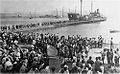 Departure for Serbia
 WWI poster - Kosovo Day, June 28, 1916, published in solidarity with the Serb allies
 WWI poster - Save Serbia (1915)
 American poster of the Serbian Relief Fund, organised by Mabel Grouitch, asking for donations to help Serbia on the brink of famine.


