R-4D
From Wikipedia, the free encyclopedia
Aerojet Rocketdyne
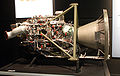
 RCS quad containing four R-4D thrusters, as used on the Apollo Service Module | |
| Country of origin | United States |
|---|---|
| Manufacturer | Marquardt Aerojet Rocketdyne |
| Application | Reaction control system |
| Liquid-fuel engine | |
| Propellant | NTO / MMH |
| Cycle | Pressure-fed |
| Performance | |
| Thrust, vacuum | 110 lbf (490 N) |
| Thrust-to-weight ratio | 13.74 |
| Chamber pressure | 100.5 psi (693 kPa) |
| Specific impulse, vacuum | 312 s (3.06 km/s) |
| Dimensions | |
| Length | 12 in (300 mm) |
| Diameter | 6 in (150 mm) |
| Dry mass | 8 lb (3.6 kg) |
| Used in | |
| European Service Module H-II Transfer Vehicle Space Shuttle Apollo CSM and LM Cassini Automated Transfer Vehicle | |
The R-4D is a small hypergolic rocket engine, originally designed by the Marquardt Corporation for use as a reaction control system thruster on vehicles of the Apollo lunar landing program. Aerojet Rocketdyne manufactures and markets modern versions of the R-4D.[1]
Developed as an attitude control thruster for the Apollo Command/Service Module and Lunar Module in the 1960s, each unit for the modules employed four quadruple clusters (pods). It was first flown on AS-201 in February 1966. Approximately 800 were produced during the Apollo program.[2]
Post-Apollo, modernized versions of the R-4D have been used in a variety of spacecraft, including the U.S. Navy's Leasat, Insat 1, Intelsat 6, Italsat, and BulgariaSat-1.[3] It has also been used on Japan's H-II Transfer Vehicle and the European Automated Transfer Vehicle, both of which delivered cargo to the International Space Station.[4] It is also used on the Orion spacecraft.[5]