The following parameterization has been used: such that (Note: these polytopes can be empty).[1]
Properties definition 1
Let be the set of convex bodies in . Assume and consider a set of uniformly distributed points in . The convex hull of these points, , is called a random polytope inscribed in . where the set stands for the convex hull of the set.[2] We define to be the expected volume of . For a large enough and given .
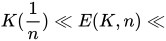
Note: If (a function that returns the amount of d-1 dimensional faces), then and formula can be evaluated for smooth convex sets and for polygons in the plane.
Absolutely continuous on with respect to Lebesgue measure.
Generates either 0 or 1 for the s with probability of each.
Assigns a measure of 0 to the set of elements in that correspond to empty polytopes.
Given this distribution, and our assumptions, the following properties hold:
A formula is derived for the expected number of dimensional faces on a polytope in with constraints: . (Note: where ). The upper bound, or worst case, for the number of vertices with constraints is much larger: .[1]
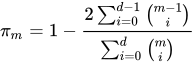
The probability that a new constraint is redundant is: . (Note: , and as we add more constraints, the probability a new constraint is redundant approaches 100%).[1]
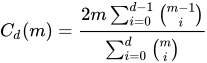
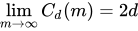
The expected number of non-redundant constraints is: . (Note: ).[1]
May, Jerrold H.; Smith, Robert L. (December 1982). "Random polytopes: Their definition, generation and aggregate properties". Mathematical Programming. 24 (1): 39–54. doi:10.1007/BF01585093. hdl:2027.42/47911. S2CID17838156.

.png)




![{\displaystyle K_{n}=[x_{1},...,x_{n}]}](http://wikimedia.org/api/rest_v1/media/math/render/svg/5a328022011b63b8ef8f462e23aca1f345042c76)
![{\displaystyle [S]}](http://wikimedia.org/api/rest_v1/media/math/render/svg/292bbb82029aa583c5d2ac5fa1d7e4fedf537d8b)




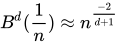


![{\displaystyle F=[x_{1},...,x_{d}]}](http://wikimedia.org/api/rest_v1/media/math/render/svg/bd4c6c618a7fdd255a294ae5363aa9c317de087f)


![{\displaystyle E_{\phi }(K_{n})={{n} \choose {d}}\int _{K}...\int _{K}[(1-V)^{n-d}+V^{n-d}]\phi (F)dx_{1}...dx_{d}}](http://wikimedia.org/api/rest_v1/media/math/render/svg/033495031ae38289e177493e97d92ffc17c30935)





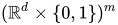



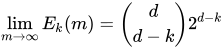

![{\displaystyle V_{max}={m-[{\frac {1}{2}}(d+1)] \choose m-d}+{m-[{\frac {1}{2}}(d+2)] \choose m-d}}](http://wikimedia.org/api/rest_v1/media/math/render/svg/821ad20a874e96ba28f492ac73653dbcc1151e4e)