Resolution (chromatography)
Measure of separation of two peaks
From Wikipedia, the free encyclopedia
In chromatography, resolution is a measure of the separation of two peaks of different retention time t in a chromatogram.[1][2][3][4]

Expression
Chromatographic peak resolution is given by
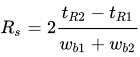
where tR is the retention time and wb is the peak width at baseline. The bigger the time-difference and/or the smaller the bandwidths, the better the resolution of the compounds. Here compound 1 elutes before compound 2.
If the peaks have the same width
- .

Plate number

The theoretical plate height is given by

where L is the column length and N the number of theoretical plates.[5] The relation between plate number and peak width at the base is given by
- .
