
Schwerte
Town in North Rhine-Westphalia, Germany
From Wikipedia, the free encyclopedia
Schwerte (German pronunciation: [ʃveːɐ̯tə] ⓘ; Westphalian: Schweierte) is a town in the district of Unna, in North Rhine-Westphalia, Germany.

Schwerte | |
|---|---|
Church of St. Victor | |
 Coat of arms | |
Location of Schwerte
within Unna district 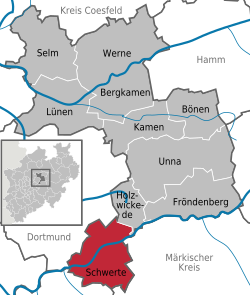 | |
 Location of Schwerte | |
  Schwerte  Schwerte | |
| Coordinates: 51°26′45″N 7°33′55″E | |
| Country | Germany |
| State | North Rhine-Westphalia |
| Admin. region | Arnsberg |
| District | Unna |
| Government | |
| • Mayor (2018–23) | Dimitrios Axourgos[1] (SPD) |
| Area | |
• Total | 56.23 km2 (21.71 sq mi) |
| Elevation | 120 m (390 ft) |
| Population (2024-12-31)[2] | |
• Total | 45,821 |
| • Density | 814.9/km2 (2,111/sq mi) |
| Time zone | UTC+01:00 (CET) |
| • Summer (DST) | UTC+02:00 (CEST) |
| Postal codes | 58239 |
| Dialling codes | 02304 |
| Vehicle registration | UN |
| Website | www.schwerte.de |
Geography
History
Schwerte received civic rights in the 12th century.
The railway facility in the eastern district of Schwerte became a branch of the Buchenwald concentration camp in April 1944. The camp had 445 prisoners in August and 670 in November 1944. The number of escapees was comparatively high; in November 1944 48 prisoners escaped. The camp in Schwerte was disbanded in December 1944 and the remaining prisoners were brought back to Buchenwald.[3]
Main sights
- The Romanesque church of St. Victor has a carved altar of 1523, and stained glass of the 14th and 15th centuries.
- The Wuckenhof is a timber-framed house built in the 16th century.[4]
- The Ruhrtalmuseum is situated in a former town hall, that was built in 1547.[5]
- The Rohrmeisterei was built in 1889 by a water purification company. It was a pumping station until 1924. Today it is part of the German route of industrial heritage (Route der Industriekultur).[6]

Economy
Today, there are some industries left, which are confined to the manufacture of iron and steel goods.
Twin towns – sister cities
 Béthune, France (1960)
- Bruay-la-Buissière, France (1965)
- Violaines, France (1969)
- Allouagne, France (1975)
 Hastings, England, UK (1982)
 Cava de' Tirreni, Italy (1984)
 Leppävirta, Finland (1992)
 Pyatigorsk, Russia (1992)
 Ioannina, Greece (2022)


Notable people
- Johannes Goddaeus (1555–1632), jurist
- Heinrich Rehkemper (1894–1949), baritone singer
- Erwin Rösener (1902–1946), SS-Obergruppenführer Nazi officer executed for war crimes
- Werner van der Zyl (1902–1984), rabbi
- Detlef Lewe (1939–2008), sprint canoer, lived in Schwerte
- Paul Kevenhörster (born 1941), political scientist
- Wolfgang Kleff (born 1946), footballer
- Rosemarie Trockel (born 1952), artist
- Carmen Rischer (born 1956), rhythmic gymnast
- Thomas Kroth (born 1959), footballer, lives in Schwerte
- Violetta Oblinger-Peters (born 1977), Austrian slalom canoeist
- Jens Ewald (born 1983), slalom canoeist
- Lasse Sobiech (born 1991), footballer
