Nose cone design
Geometry and construction of the foremost tip of airplanes, spacecraft and projectiles
From Wikipedia, the free encyclopedia
Because of the problem of the aerodynamic design of the nose cone section of any vehicle or body meant to travel through a compressible fluid medium (such as a rocket or aircraft, missile, shell or bullet), an important problem is the determination of the nose cone geometrical shape for optimum performance. For many applications, such a task requires the definition of a solid of revolution shape that experiences minimal resistance to rapid motion through such a fluid medium.

Nose cone shapes and equations
General dimensions
In all of the following nose cone shape equations, L is the overall length of the nose cone and R is the radius of the base of the nose cone. y is the radius at any point x, as x varies from 0, at the tip of the nose cone, to L. The equations define the two-dimensional profile of the nose shape. The full body of revolution of the nose cone is formed by rotating the profile around the centerline C⁄L. While the equations describe the "perfect" shape, practical nose cones are often blunted or truncated for manufacturing, aerodynamic, or thermodynamic reasons.[1][2]
Conic


Spherically blunted conic


Bi-conic


Tangent ogive


Spherically blunted tangent ogive


Secant ogive


For a chosen ogive radius ρ greater than or equal to the ogive radius of a tangent ogive with the same R and L:


_Render.png)
A smaller ogive radius can be chosen; for , you will get the shape shown on the right, where the ogive has a "bulge" on top, i.e. it has more than one x that results in some values of y.

Elliptical


Parabolic
A parabolic series nosecone is defined by where and is a series-specific constant.[3]


_Nose_Cone_Render.png)
_Nose_Cone_Render.png)
_Nose_Cone_Render.png)
For ,

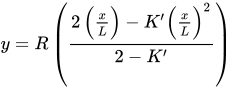
K′ can vary anywhere between 0 and 1, but the most common values used for nose cone shapes are:
| Parabola type | K′ value |
|---|---|
| Cone | 0 |
| Half | 1/2 |
| Three quarter | 3/4 |
| Full | 1 |
Power series
A power series nosecone is defined by where . will generate a concave geometry, while will generate a convex (or "flared") shape.[3]


 |
Half (n = 1/2) Three-quarter (n = 3/4) |
_Nose_Cone_Render.png)
_Nose_Cone_Render.png)
- For :


Common values of n include:
| Power type | n value |
|---|---|
| Cylinder | 0 |
| Half (parabola) | 1/2 |
| Three quarter | 3/4 |
| Cone | 1 |
Haack series
 |
LD-Haack (Von Kármán) (C = 0) LV-Haack (C = 1/3) |
_Nose_Cone_Render.png)

A Haack series nosecone is defined by:[3] where

- r is the radius divided by the maximum radius at a given θ or x,
- x is the distance from the nose divided by the total nose length.
Parametric formulation can be obtained by solving the θ formula for x (here, x is now distance from the nose, separated from the total nose length L, and y is the radius).

Special values of C (as described above) include:
| Haack series type | C value |
|---|---|
| LD-Haack (Von Kármán) | 0 |
| LV-Haack | 1/3 |
| Tangent | 2/3 |
Von Kármán ogive
The LD-Haack ogive is a special case of the Haack series with minimal drag for a given length and diameter, and is defined as a Haack series with C = 0, commonly called the Von Kármán or Von Kármán ogive. An ogive with minimal drag for a given length and volume can be called an LV-Haack series, defined by .[3] However, the LV-Haack series produces different values for radius as a function of x as opposed to the Sears-Haack body, which also attempts to provide a shape with minimal drag for a given length and volume. For example, the LV-Haack value for radius relative to maximum radius at x=0.5 is ≈ 0.7785, while a Sears-Haack body at the same point (halfway along the nose, which is 25% of the way along the body) has a radius relative to maximum radius of ≈ 0.8059.

Aerospike

An aerospike can be used to reduce the forebody pressure acting on supersonic aircraft. The aerospike creates a detached shock ahead of the body, thus reducing the drag acting on the aircraft.
Nose cone drag characteristics
Influence of the general shape


See also
Further reading
- Haack, Wolfgang (1941). "Geschoßformen kleinsten Wellenwiderstandes" (PDF). Bericht 139 der Lilienthal-Gesellschaft für Luftfahrtforschung: 14–28. Archived from the original (PDF) on 2007-09-27.
- U.S. Army Missile Command (17 July 1990). Design of Aerodynamically Stabilized Free Rockets. U.S. Government Printing Office. MIL-HDBK-762(MI).