Second-order cone programming
Convex optimization problem
From Wikipedia, the free encyclopedia
A second-order cone program (SOCP) is a convex optimization problem of the form
- minimize
- subject to


where the problem parameters are , and . is the optimization variable. is the Euclidean norm and indicates transpose.[1]



The name "second-order cone programming" comes from the nature of the individual constraints, which are each of the form:

These each define a subspace that is bounded by an inequality based on a second-order polynomial function defined on the optimization variable ; this can be shown to define a convex cone, hence the name "second-order cone".[2] By the definition of convex cones, their intersection can also be shown to be a convex cone, although not necessarily one that can be defined by a single second-order inequality. See below for a more detailed treatment.

SOCPs can be solved by interior point methods[3] and in general, can be solved more efficiently than semidefinite programming (SDP) problems.[4] Some engineering applications of SOCP include filter design, antenna array weight design, truss design, and grasping force optimization in robotics.[5] Applications in quantitative finance include portfolio optimization; some market impact constraints, because they are not linear, cannot be solved by quadratic programming but can be formulated as SOCP problems.[6][7][8]
Second-order cones
The standard or unit second-order cone of dimension is defined as

- .

The second-order cone is also known by the names quadratic cone, ice-cream cone[9], or Lorentz cone. For example, the standard second-order cone in is

- .
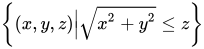
The set of points satisfying a second-order cone constraint is the inverse image of the unit second-order cone under an affine mapping:

and hence is convex.
The second-order cone can be embedded in the cone of the positive semidefinite matrices since
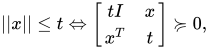
i.e., a second-order cone constraint is equivalent to a linear matrix inequality. The nomenclature here can be confusing; here means is a semidefinite matrix: that is to say


which is not a linear inequality in the conventional sense.
Similarly, we also have,
- .

Relation with other optimization problems

When for , the SOCP reduces to a linear program. When for , the SOCP is equivalent to a convex quadratically constrained linear program.


Convex quadratically constrained quadratic programs can also be formulated as SOCPs by reformulating the objective function as a constraint.[5] Semidefinite programming subsumes SOCPs as the SOCP constraints can be written as linear matrix inequalities (LMI) and can be reformulated as an instance of semidefinite program.[5] The converse, however, is not valid: there are positive semidefinite cones that do not admit any second-order cone representation.[4]
Any closed convex semialgebraic set in the plane can be written as a feasible region of a SOCP.[10] However, it is known that there exist convex semialgebraic sets of higher dimension that are not representable by SDPs; that is, there exist convex semialgebraic sets that can not be written as the feasible region of a SDP (nor, a fortiori, as the feasible region of a SOCP).[11]
Examples
Quadratic constraint
Consider a convex quadratic constraint of the form

This is equivalent to the SOCP constraint

Stochastic linear programming
Consider a stochastic linear program in inequality form
- minimize
- subject to


where the parameters are independent Gaussian random vectors with mean and covariance and . This problem can be expressed as the SOCP


- minimize
- subject to

where is the inverse normal cumulative distribution function.[1]

Stochastic second-order cone programming
We refer to second-order cone programs as deterministic second-order cone programs since data defining them are deterministic. Stochastic second-order cone programs are a class of optimization problems that are defined to handle uncertainty in data defining deterministic second-order cone programs.[12]
Other examples
Other modeling examples are available at the MOSEK modeling cookbook.[13]
Solvers and scripting (programming) languages
| Name | License | Brief info |
|---|---|---|
| ALGLIB | free/commercial | A dual-licensed C++/C#/Java/Python numerical analysis library with parallel SOCP solver. |
| AMPL | commercial | An algebraic modeling language with SOCP support |
| Artelys Knitro | commercial | |
| CPLEX | commercial | |
| FICO Xpress | commercial | |
| Gurobi Optimizer | commercial | |
| MATLAB | commercial | The coneprog function solves SOCP problems[14] using an interior-point algorithm[15] |
| MOSEK | commercial | parallel interior-point algorithm |
| NAG Numerical Library | commercial | General purpose numerical library with SOCP solver |
See also
- Power cones are generalizations of quadratic cones to powers other than 2.[16]