Selberg integral
Mathematical function
From Wikipedia, the free encyclopedia
In mathematics, the Selberg integral is a generalization of Euler beta function to n dimensions introduced by Atle Selberg.[1] It has applications in statistical mechanics, multivariable orthogonal polynomials, random matrix theory, Calogero–Moser–Sutherland model, and Knizhnik–Zamolodchikov equations.[2]
Selberg's integral formula
When , we have

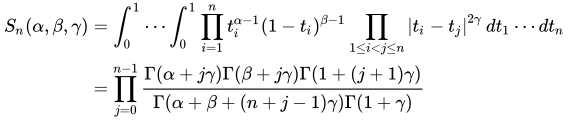
Selberg's formula implies Dixon's identity for well poised hypergeometric series, and some special cases of Dyson's conjecture. This is a corollary of Aomoto.
Aomoto's integral formula
Aomoto proved a slightly more general integral formula.[3] With the same conditions as Selberg's formula,


A proof is found in Chapter 8 of Andrews, Askey & Roy (1999).[4]
Mehta's integral
When ,


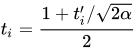
It is a corollary of Selberg, by setting , and change of variables with , then taking .


This was conjectured by Mehta & Dyson (1963), who were unaware of Selberg's earlier work.[5]
It is the partition function for a gas of point charges moving on a line that are attracted to the origin.[6]
In particular, when , the term on the right is .


Macdonald's integral
Macdonald (1982) conjectured the following extension of Mehta's integral to all finite root systems, Mehta's original case corresponding to the An−1 root system.[7]

The product is over the roots r of the roots system and the numbers dj are the degrees of the generators of the ring of invariants of the reflection group. Opdam (1989) gave a uniform proof for all crystallographic reflection groups.[8] Several years later he proved it in full generality, making use of computer-aided calculations by Garvan.[9]