Shannon multigraph
From Wikipedia, the free encyclopedia
In the mathematical discipline of graph theory, Shannon multigraphs, named after Claude Shannon by Vizing (1965),[1] are a special type of triangle graphs, which are used in the field of edge coloring in particular.
- A Shannon multigraph is multigraph with 3 vertices for which either of the following conditions holds:
- a) all 3 vertices are connected by the same number of edges.
- b) as in a) and one additional edge is added.
More precisely one speaks of Shannon multigraph Sh(n), if the three vertices are connected by , and edges respectively. This multigraph has maximum degree n. Its multiplicity (the maximum number of edges in a set of edges that all have the same endpoints) is .[2][3]


- Shannon multigraphs
 Sh(2)
Sh(2) Sh(3)
Sh(3) Sh(4)
Sh(4)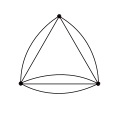 Sh(5)
Sh(5)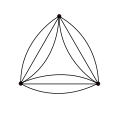 Sh(6)
Sh(6)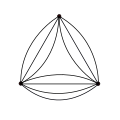 Sh(7)
Sh(7)


