Chaenorhinum minus
Plant species in the veronica family
From Wikipedia, the free encyclopedia
Chaenorhinum minus, also known as small toadflax in Europe and dwarf snapdragon in the US and Canada, is a very diminutive member of the plant family Plantaginaceae.[2] It is native to continental Europe.[3]

| Chaenorhinum minus | |
|---|---|
| |
Scientific classification  | |
| Kingdom: | Plantae |
| Clade: | Embryophytes |
| Clade: | Tracheophytes |
| Clade: | Angiosperms |
| Clade: | Eudicots |
| Clade: | Asterids |
| Order: | Lamiales |
| Family: | Plantaginaceae |
| Genus: | Chaenorhinum |
| Species: | C. minus |
| Binomial name | |
| Chaenorhinum minus | |
| Synonyms[1] | |
| |
Description
Chaenorhinum minus differs from many toadflaxes in having alternate leaves growing singly. Its leaves and sepals are covered with glandular hairs. Leaves are glaucous and sepals are green or purple. Flowers vary from pale purple to white. It is an annual herb, with a maximum height of 25 cm (9.8 in). It does not spread vegetatively.[3] Flowering occurs June–July.[2]
 Chaenorhinum minus in a garden setting in the United Kingdom
 A larger individual of Chaenorhinum minus in Austria
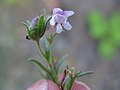 Flower of Chaenorhinum minus in Germany


Taxonomy
Chaenorhinum minus was given the name Antirrhinum minus in 1753 by Carl Linnaeus. The botanist René Louiche Desfontaines placed it in the genus Linaria in 1798 and finally it was moved to the genus Chaenorhinum in 1870 by Johan Lange, giving the species its accepted name. Together with its genus it is classified in the family Plantaginaceae.[1]
Subspecies
Four subspecies are accepted.[1]
- Chaenorhinum minus subsp. anatolicum P.H.Davis – Ukraine, south European Russia, Turkey, Syria, northern Iraq, and Transcaucasia[4]
- Chaenorhinum minus subsp. idaeum (Rech.f.) R.Fern. – Crete[5]
- Chaenorhinum minus subsp. minus – Europe, Turkey, Morocco, and Algeria[6]
- Chaenorhinum minus subsp. pseudorubrifolium Gamisans – Corsica[7]
Chaenorhinum minus has 24 synonyms of the species or of three of its four subspecies including 13 species names.[1][4][5][6]
| Name | Year | Synonym of: | Notes |
|---|---|---|---|
| Antirrhinum minor Raf. | 1840 | subsp. minus | = het. |
| Antirrhinum minus L. | 1753 | C. minus | ≡ hom. |
| Chaenorhinum idaeum Rech.f. | 1943 | subsp. idaeum | = het. |
| Chaenorhinum klokovii Kotov | 1954 | subsp. anatolicum | = het. |
| Chaenorhinum praetermissum (Delastre) Lange | 1870 | subsp. minus | = het. |
| Chaenorhinum viscidum (Moench) Simonk. | 1904 | subsp. minus | = het. |
| Linaria minor (L.) Desf. | 1798 | C. minus | ≡ hom. |
| Linaria praetermissa Delastre | 1842 | subsp. minus | = het. |
| Linaria viscida Moench | 1794 | subsp. minus | = het. |
| Microrrhinum idaeum (Rech.f.) Speta | 1977 | subsp. idaeum | = het. |
| Microrrhinum klokovii (Kotov) Speta | 1980 | subsp. anatolicum | = het. |
| Microrrhinum minus (L.) Fourr. | 1869 | C. minus | ≡ hom. |
| Microrrhinum praetermissum (Delastre) Speta | 1980 | subsp. minus | = het. |
| Notes: ≡ homotypic synonym; = heterotypic synonym | |||
Habitat and distribution
It is such a small plant that it relies upon disturbance to compete with other plants for light. Once a common weed in farmers' fields, it has suffered from agricultural intensification and is now mainly seen in gardens and around railways, as well as roadsides and industrial sites.[2][3] Its UK distribution shows it favours chalky soil.
This species is native to continental Europe, found mainly in south and central Europe, though it reaches as far north as Sweden. It is considered to have 'archaeophyte' status in the United Kingdom ie. is thought to have been introduced many centuries ago.[3] It has also been introduced to the US and Canada.[8]