Sunrise Seto
From Wikipedia, the free encyclopedia
 285 series EMU on a Sunrise Seto service, 2019 | |
| Overview | |
|---|---|
| Service type | Limited express |
| Status | Operational |
| Locale | Japan |
| Predecessor | Seto |
| First service | 10 July 1998 |
| Current operators | |
| Route | |
| Termini | Tokyo Takamatsu (extended to Kotohira seasonally) |
| Distance travelled | 804.7 km (500 mi) |
| Average journey time | 9 hours, 30 minutes |
| Service frequency | 1 round-trip daily |
| Train numbers | Westbound: 5031M Eastbound: 5032M |
| Lines used | Tōkaidō Main Line, Tōkaidō Freight Line, San'yō Main Line, Uno Line, Honshi-Bisan Line, Yosan Line, Dosan Line |
| On-board services | |
| Seating arrangements | None |
| Sleeping arrangements | Private compartments/open berths |
| Catering facilities | Vending machines |
| Technical | |
| Rolling stock | 285 series |
| Track gauge | 1,067 mm (3 ft 6 in) |
| Electrification | Overhead line, 1,500 V DC |
| Operating speed | 130 km/h (81 mph) |
The Sunrise Seto (Japanese: サンライズ瀬戸, Hepburn: Sanraizu Seto) is an overnight sleeping car train service in Japan operated by the East Japan Railway Company (JR East), Central Japan Railway Company (JR Central), West Japan Railway Company (JR West), and Shikoku Railway Company (JR Shikoku) since July 1998.[1][2]
The Sunrise Seto runs daily between Tokyo and Takamatsu in Kagawa Prefecture on the island of Shikoku, taking about 9 hours 30 minutes for the 804.7 km (500.0 mi) journey.[2] Between Tokyo and Okayama, the service operates in conjunction with the Sunrise Izumo service to Izumoshi. The combined 14-car train departs from Tokyo, and stops at Yokohama, Atami, Numazu, Fuji, Shizuoka, Hamamatsu (final midnight stop), Himeji (first morning stop), and arrives at Okayama, where the train splits, with the Sunrise Izumo half of the train heading to Izumoshi.[3] Between Okayama and Takamatsu, the 7-car Sunrise Seto train stops at Kojima and Sakaide, before arriving in Takamatsu. The return train departs from Takamatsu, and is coupled with the Sunrise Izumo from Izumoshi at Okayama Station, departing together from there, and arriving at Tokyo Station in the next morning.
There are seasonal extended services which Sunrise Seto trains from Tokyo run beyond Takamatsu, to Kotohira on the Dosan Line. These extended service trains run during particular seasons (Differs each year), and during the holidays.
Sunrise Izumo and Sunrise Seto pass through stations in Nagoya and Kyoto without stopping due to the fact that they arrive at these stations around midnight and are unable to play the announcements.
 A Sunrise Seto & Sunrise Izumo combined formation on the Sanyo Main Line, May 2012
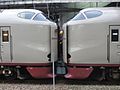 Sunrise Izumo and Sunrise Seto units being uncoupled at Okayama Station, March 2013
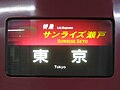 Destination indicator for a Tokyo-bound service


Station list
Trains make brief stops for several reasons, such as crew changes at JR region boundaries. Passengers cannot board or get off the train when it makes such stops.
Regularly, eastbound services will operate between Atami and Yokohama via the Tōkaidō Freight Line, where trains enter the line at Odawara and exit at Chigasaki back to the Tōkaidō Main Line.
| Line | Station | Distance (km) | Departure time[4][5] | Location | |||
|---|---|---|---|---|---|---|---|
| Between stations |
From Tokyo |
Westbound (to Takamatsu) |
Eastbound (to Tokyo) |
City | Prefecture | ||
| Tōkaidō Main Line | Tokyo | N/a | 0.0 | 21:50 | 07:08 Arrival | Chiyoda | Tokyo |
| Yokohama | 28.8 | 28.8 | 22:15 | 06:45 | Yokohama | Kanagawa | |
| Atami | 75.8 | 104.6 | 22:46 | 06:16 | Atami | Shizuoka | |
| Numazu | 21.6 | 126.2 | 23:23 | 05:45 | Numazu | ||
| Fuji | 20.0 | 146.2 | 23:39 | 05:27 | Fuji | ||
| Shizuoka | 34.0 | 180.2 | 23:53 | 05:10 | Shizuoka | ||
| Hamamatsu | 76.9 | 257.1 | 00:20 | 04:40 | Hamamatsu | ||
| Toyohashi | 36.5 | 293.6 | 01:12 | (Brief stop) | Toyohashi | Aichi | |
| Nagoya | 72.4 | 366.0 | (Brief stop) | (Brief stop) | Nagoya | ||
| Gifu | 30.3 | 396.3 | 01:46 | 00:46 | Gifu | Gifu | |
| Maibara | 49.6 | 445.9 | (Brief stop) | ↑ | Maibara | Shiga | |
| Ōsaka | 110.5 | 556.4 | (Brief stop) | (Brief stop) | Osaka | Osaka | |
| Sannomiya | 30.6 | 587.0 | 05:31 | 00:33 | Kobe | Hyogo | |
| San'yō Main Line | Himeji | 57.3 | 644.3 | ↓ | 00:11 | Himeji | |
| Okayama | 88.6 | 732.9 |
|
|
Okayama | Okayama | |
| Uno Line / Honshi-Bisan Line | |||||||
| Kojima | 27.8 | 760.7 | 06:53 | 22:01 | Kurashiki | ||
| Yosan Line | Sakaide | 22.7 | 783.4 | 07:10 | 21:44 | Sakaide | Kagawa |
| Takamatsu | 21.3 | 804.7 | 07:27 Arrival | 21:26 Departure | Takamatsu | ||
| Seasonal extended service | |||||||
| Yosan Line | Takamatsu | - | 804.7 | 07:54 | N/a | Takamatsu | Kagawa |
| Tadotsu | 32.7 | 837.4 | 08:35 | Tadotsu | |||
| Dosan Line | |||||||
| Zentsūji | 6.0 | 843.4 | 08:45 | Zentsuji | |||
| Kotohira | 5.3 | 848.7 | 08:52 Arrival | Kotohira | |||
Formation
Trains are formed of dedicated 7-car 285 series Sunrise Express electric multiple units (EMUs) owned by both JR Central and JR West.
When operating in the up (Tokyo-bound) direction, the cars are numbered 8 to 14 (cars 1 to 7 are the Sunrise Izumo), with car 14 at the Tokyo end. When operating in the down (Takamatsu-bound) direction, the cars are numbered 1 to 7, with car 7 at the Tokyo end.[1]
| Car No. | 1/8 | 2/9 | 3/10 | 4/11 | 5/12 | 6/13 | 7/14 |
|---|---|---|---|---|---|---|---|
| Numbering | KuHaNe 285 | SaHaNe 285 | MoHaNe 285 | SaRoHaNe 285 | MoHaNe 285 | SaHaNe 285 | KuHaNe 285 |
| Upper-level accommodations | B single | B single | B solo | A single | B single / Nobi-nobi area | B single | B single |
| Lower-level accommodations | B single / B single-twin | B single / B single-twin | Sunrise twin | B single / B single-twin | B single / B single-twin | ||
| Facilities | Lounge, vending machine, shower | Vending machine |
- Car 2/9 has a wheelchair-accessible compartment.
- Each car has toilet facilities.[6]
- Smoking is permitted in cabins in car 6/13, and some compartments in car 4/11.
Accommodation, Ticketing and Facilities
The Sunrise Express services consist of six types of accommodation. There are five types of berths: A Single Deluxe, B Sunrise Twin (2-person use), B Single Twin (1 or 2-person use), B Single and B Solo. There is also a carpeted sleeping space called the Nobi-nobi sleeping area.
To ride the train, several fares are required. All passengers require a basic fare ticket (乗車券, Jousha ken) and a limited express ticket (特急券, Tokkyu ken) based on the distance traveled. On top of these, those wishing to travel in a private room must also pay for a berth ticket (寝台券, Shindai ken), while those traveling in the Nobi-nobi sleeping area must pay a small seat reservation charge (座席指定料金, zaseki shitei ryoukin) in order to reserve an individual sleeping space.
The berth and seat reservation charges are fixed, regardless of where the journey starts and ends.
| Accommodation | Price |
|---|---|
| B Sunrise Twin | ¥15,400 |
| B Single Twin |
|
| A Single Deluxe | ¥13,980 |
| B Single | ¥7,700 |
| B Solo | ¥6,600 |
| Nobi-nobi sleeping area |
|
Tickets can be purchased up to one month before departure at a JR Midori no Madoguchi ticket counter or ticket machine in Japan, or online through the JR West Seat Reservation website.
A shower is located in cars 3 and 10. Passengers using the A Single Deluxe compartments are provided with a free shower card to use the showers on the train, while other passengers have to pay ¥330 for a 6-minute shower card if they desire to use the showers. Shower cards are not allocated to specific time slots, however due to the limited number of these cards issued on each train passengers are advised to purchase one as early as possible.
Mini lounge areas are located in cars 3 and 10 which have a bench table with 4 seats on each side of the train. Small drink vending machines are available in cars 3, 5, 10 and 12 - these only vend a limited variety of drinks such as Coca Cola, Real Gold (energy drink), green tea (cold) and water. There is no food available for purchase onboard the train - passengers are required to purchase food before boarding the train.
Other than the mini lounge areas in cars 3 & 10 there are no seating areas anywhere on the train. (The "A Single Deluxe" compartment has a seat and desk).
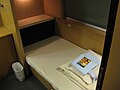 "A Single Deluxe" compartment
 Car 4/11 corridor
 "B Single" berth
 "B Single Twin" berth
 Nobi-nobi open-plan sleeping area (car 5/12, upper floor)
 Nobi-nobi open-plan sleeping area (car 5/12, lower floor)
 Shower (car 3/10)
 Lounge area (car 3/10)


.JPG)
.JPG)


Japan Rail Pass
Holders of the Japan Rail Pass can reserve a Nobi-nobi space (open-plan carpeted sleeping area with a small blanket provided) for free. Use of any berth requires payment of the limited express and berth charges.
All travel on Sunrise Seto requires a seat reservation at a Midori no Madoguchi ticket counter or ticket machine. The "seat" number shown on your reserved seat ticket is the number of your berth or Nobi-nobi space. Demand is high for this train so a seat reservation should be made as soon as possible after picking up your Japan Rail Pass.
History

The Sunrise Seto services were introduced together with the Sunrise Izumo on 10 July 1998.[9] Previously, the Seto operated as a separate "Blue train" service connecting Tokyo with Takamatsu.[10] The Sunrise Izumo was intended to attract more passengers to train transportation by introducing newly designed trains and by reducing the journey time.
Ridership on overnight trains in Japan continues to decline, and from March 2009, the Sunrise Izumo and Sunrise Seto became the only overnight sleeping car trains to operate west of Tokyo via the Tokaido Line.[11]
From the start of the revised timetable on 12 March 2021, the departure time of the Sunrise Izumo and Sunrise Seto from Tokyo was changed from 10:00 PM to 9:50 PM.[12] It is the first time that the departure time was changed since the services' introduction in 1998. The change cleared the 10:00 PM departure slot for one of the new Shōnan limited express services to Odawara.


.svg)
.svg)