System U
Special forms of a typed lambda calculus
From Wikipedia, the free encyclopedia
In mathematical logic, System U and System U− are pure type systems, i.e. special forms of a typed lambda calculus with an arbitrary number of sorts, axioms and rules (or dependencies between the sorts).
System U was proved inconsistent by Jean-Yves Girard in 1972[1] (and the question of consistency of System U− was formulated). This result led to the realization that Martin-Löf's original 1971 type theory was inconsistent, as it allowed the same "type in type" behaviour that Girard's paradox exploits.
Formal definition
System U is defined[2]: 352 as a pure type system with
- three sorts ;
- two axioms ; and
- five rules .

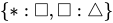

System U− is defined the same with the exception of the rule.

The sorts and are conventionally called “type” and “kind”, respectively; the sort doesn't have a specific name. The two axioms describe the containment of types in kinds () and kinds in (). Intuitively, the sorts describe a hierarchy in the nature of the terms.


- All values have a type, such as a base type (e.g. is read as “ is a boolean”) or a (dependent) function type (e.g. is read as “ is a function from natural numbers to booleans”).
- is the sort of all such types ( is read as “ is a type”). From we can build more terms, such as which is the kind of unary type-level operators (e.g. is read as “ is a function from types to types”, that is, a polymorphic type). The rules restrict how we can form new kinds.
- is the sort of all such kinds ( is read as “ is a kind”). Similarly we can build related terms, according to what the rules allow.
- is the sort of all such terms.





The rules govern the dependencies between the sorts: says that values may depend on values (functions), allows values to depend on types (polymorphism), allows types to depend on types (type operators), and so on.


Girard's paradox
The definitions of System U and U− allow the assignment of polymorphic kinds to generic constructors in analogy to polymorphic types of terms in classical polymorphic lambda calculi, such as System F. An example of such a generic constructor might be[2]: 353 (where k denotes a kind variable)
- .

This mechanism is sufficient to construct a term with the type (equivalent to the type ), which implies that every type is inhabited. By the Curry–Howard correspondence, this is equivalent to all logical propositions being provable, which makes the system inconsistent.


Girard's paradox is the type-theoretic analogue of the Burali-Forti paradox in set theory.[3]