TCR Touring Car
Touring car racing specification
From Wikipedia, the free encyclopedia
A TCR Touring Car is a touring car specification first introduced in 2014. Created by the WSC Group, led by Marcello Lotti, the ruleset is now employed by a multitude of series worldwide.

| TCR Touring Car | |
|---|---|
| Motor racing formula | |
| Category | Touring car racing |
| Country or region | International and regional |
| Inaugural season | 2015 |
| Status | Active |

All TCR Touring Cars are front wheel drive cars based on 4- or 5-door production vehicles, and are powered by 1.75 to 2.0 litre turbocharged engines.[1] While the bodyshell and suspension layout of the production vehicle is retained in a TCR car, and many models use a production gearbox, certain accommodations are made for the stresses of the racetrack including upgraded brakes and aerodynamics. Competition vehicles are subject to balance of performance (BoP) adjustments to ensure close racing between different vehicles.
History
The project to develop the TCR specification was spearheaded by former World Touring Car Championship manager Marcello Lotti. All TCR cars have a common forefather; the SEAT León Cup Racer racing car which was introduced as successor to the SEAT León Supercopa used in several successful single-make series. The 2.0L engine formula was derived from this car, as well as the standardised front splitter and rear wing.[2] Initially, the specification and accompanying international series was known as TC3, to indicate its intended position at the entry-level end of the touring car pyramid. However, upon being approved by the FIA in December 2014, the specification was renamed TCR.[3]
 An Audi RS 3 LMS TCR in the TCR Europe Series
 A Honda Civic Type R TCR (FK8), in the World Touring Car Cup pits at Hungaroring
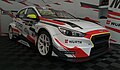 A Hyundai i30 N TCR in the TCR Europe Series
 A SEAT León TCR in the ADAC TCR Germany Touring Car Championship paddock

.jpg)


Technical regulations
On 15 September 2014, technical regulations for the category were announced.[4] On 22 January 2016, minor changes were applied.[1]
Eligible cars: 4/5-door vehicles
Body shell: Reinforced production body shell; wheel arch modifications allowed to accommodate tyres
Minimum weight: 1250 kg for cars with production gearbox, 1285 kg for cars with racing gearbox (both including the driver)
Minimum overall length: 4.2 metres
Maximum overall width: 1.95 metres
Engine: Turbo-charged petrol or diesel up to 2 litre
Torque: 420 N⋅m (310 lb⋅ft)
Power: 355 PS
Lubrication: Wet sump
Exhaust: Homologated catalytic converter using production parts
Traction: On two wheels
Gearbox: Production or TCR International Series sequential; production paddle shift accepted
Front Suspension: Production lay-out; parts free design
Rear Suspension: Original design of production car with reinforced components
Brakes:
- Front: max 6 piston calipers, brake discs max diameter 380mm
- Rear: max 2 piston callipers; production ABS accepted
Wheels: Maximum dimensions of rim: 10″ x 18″
Aerodynamics:
- Front splitter: 2014 SEAT León Eurocup
- Rear wing: FIA Appendix J Art. 263 2014
- Ground clearance: Minimum 80 mm
- Power/Weight Ratio: Subject to the Balance of Performance (changing between +70 and -20 kg from the minimum car weight)
- Drivetrain : FF layout
WTCR regulations
The FIA licensed the TCR regulations under the name of WTCR for usage in the World Touring Car Cup. The specification is identical, however it is frozen until the end of 2019, and cars are required to obtain an FIA passport after going through TCR homologation.
TCR Model of the Year
Since 2017, TCR organisers World Sporting Consulting (WSC) have awarded the TCR Model of the Year award for the most successful TCR car across a year.[5] The title is awarded on the basis of a points system that gives points to all the different TCR-certified cars competing in all the TCR-sanctioned races of the year.[6] The points are adjusted by coefficients that take into account the level of the competition, the number of cars participating and the number of manufacturers represented.[6]
Winners
| Year | Model |
|---|---|
| 2017 | SEAT León TCR[7][8] |
| 2018 | Audi RS 3 LMS TCR (2017)[9] |
| 2019 | Honda Civic Type R TCR (FK8)[10] |
| 2020 | Honda Civic Type R TCR (FK8)[11] |
| 2021 | Audi RS 3 LMS TCR (2021)[12] |
| 2022 | Audi RS 3 LMS TCR (2021)[13] |
| 2023 | Audi RS 3 LMS TCR (2021)[14] |
| 2024 | Honda Civic Type R TCR (FL5)[15] |
| 2025 | Cupra León VZ TCR[16] |
Eligible cars
.jpg)

.jpg)


_(45135437991).jpg)


_04.jpg)


.jpg)


.jpg)

.jpg)

List of TCR series
As premier class
International
Regional
National
- Italian Superturismo Championship[69]
- Russian Circuit Racing Series[70]
- TCR Asia Challenge[71]
- TCR Brazil Touring Car Championship
- TCR China Challenge
- TCR China Touring Car Championship[72]
- TCR Chinese Taipei Series
- TCR European Endurance
- TCR Panamá Touring Car Championship[73]
- TCR Mexico Series[74]
- TCR Spain Touring Car Championship
- TCR UK Touring Car Championship[75]
As subsidiary class
- 24H Series
- 24H Series Middle East
- Aurum 1006 km
- Austrian GT[76]
- Belcar
- Britcar
- Campeonato Nacional de Velocidade
- CEZ Circuit Endurance[77]
- China Endurance Championship[78]
- China Touring Car Championship
- DMV Super Touring & GT Cup[79]
- GT Challenge de las Américas[80]
- GTC Endurance Challenge[81]
- Golf Pro Car[82]
- Michelin Pilot Challenge[83]
- Nürburgring Langstrecken-Serie
- Scandinavian Touring Car Championship[84] (Series paused, planning for 2026/27 season)
- Spanish Touring Car Championship
- Sports Car Championship Canada
- Super Taikyu Series[85]
- Supercar Challenge
- Supercar Endurance Series
- TC America Series[86][87]
- TC France Series
- World Racing league[88]
Defunct series
- ADAC TCR Germany Touring Car Championship[89]
- Canadian Touring Car Championship[90]
- eTouring Car World Cup[91]
- European Touring Car Cup
- TC Open[92]
- TCR Australia Touring Car Series
- TCR Baltic Trophy[93]
- TCR Benelux Touring Car Championship[94]
- TCR Denmark Touring Car Series[95]
- TCR Iberico Touring Car Series[96]
- TCR International Series
- TCR Japan Touring Car Series[97]
- TCR Korea Touring Car Series
- TCR Las Américas Series[98]
- TCR Middle East Touring Car Series[99]
- TCR Malaysia Touring Car Championship[100]
- TCR New Zealand Series[101]
- TCR Portuguese Series[102]
- TCR Swiss Trophy[103]
- TCR Thailand Touring Car Championship[104]
- TCR USA[105]
- Touring Car Endurance Series
- UAE Touring Car Championship
- World Touring Car Championship
See also
Notes
- 2 modifications of SEQ and DSG.
- In 2018 SEAT began using the Cupra name for its TCR cars
- Also referred to as Cupra TCR
- 2 modifications of SEQ and DSG.
- The car made its debut as a guest entry at the 2020 TCR Europe Touring Car Series with homologation obtained in 2022.
- In TCR Australia Kelly Racing entered the Astra TCR cars badged as Holden.
- In the United Kingdom Opel is represented by its sister brand Vauxhall.
- Kissling Motorsport ceased cooperation with Opel, the development of the Astra TCR transferred to third-party companies Lubner Motorsport and VMax Engineering.
- The Hyundai i30 N TCR was allowed to race in 2017, but was ineligible to score points, because the car hadn't received its final homologation.
- The Lada was created by Lada Sport for the 2017 TCR Russian Series, with the option for full TCR homologation in 2018.
- Prototype was shown at the 2019 Shanghai Auto. The car made its debut in TCR Asia/TCR China round at Zhejiang International Circuit, but due to running on temporary homolagation it was ineligible to score points.
- The Cup version of the Peugeot 308 Racing Cup does not comply with the TCR regulations for the splitter, wing, power and engine volume, but is admitted to the TCR class with the ability to score points in any TCR competition with individual BoP parameters and lower weight.
- Three modifications of SEQ 2016, 2017 and 2018 and three DSG 2016, 2017 and 2018.
- 4 modifications of 2016, 2017, 2018 and version of DSG.
- The Audi TT Cup car was allowed to race and score points for the inaugural season in 2015, while Audi Sport evaluated a future TCR car.
- The car is built according to TCR rules, but homologation is not planned by the manufacturer. Takes part in the race of own class together with other TCR cars in Macau.
- The Citroën was allowed to race and score points in the TCR class of the TCR Italian Series, for the 2016 season, before the TCT class was created late on in the 2016 season.
- The Fiat is built to TCR specification, but did not receive an official TCR homologation.
- The car was built but did not receive homologation, did not take part in the races.
- The Mercedes A250 Turbo was not allowed to participate in the European Cup in the TCN-2 class since it does not have national homologation.
- The Opel Astra OPC was allowed to race and score points for the inaugural season in 2015, while Opel and Kissling Motorsport evaluated a future TCR car.
- The Renault was built to semi TCR spec by Ralf-Car Team for the 2015 TCR Russian Series, it was allowed to score points in the TCR class.