UTM theorem
Affirms the existence of a computable universal function
From Wikipedia, the free encyclopedia
In computability theory, the UTM theorem, or universal Turing machine theorem, is a basic result about Gödel numberings of the set of computable functions. It affirms the existence of a computable universal function, which is capable of calculating any other computable function.[1] The universal function is an abstract version of the universal Turing machine, thus the name of the theorem.
Roger's equivalence theorem provides a characterization of the Gödel numbering of the computable functions in terms of the smn theorem and the UTM theorem.
Theorem
The theorem states that a partial computable function u of two variables exists such that, for every computable function f of one variable, a number e exists such that for all x. This means that, for each x, either f(x) and u(e,x) are both defined and are equal, or are both undefined.[2]
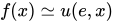
The theorem thus shows that, defining φe(x) as u(e, x), the sequence φ1, φ2, ... is an enumeration (numbering) of the partial computable functions. In fact, u can be chosen so this is the standard numbering. The function in the statement of the theorem is called a universal function.

