Urna
Spiral or circular dot placed on the forehead of Buddhist images
From Wikipedia, the free encyclopedia
In Buddhist art and culture, the Urna (Sanskrit: ūrṇā, ūrṇākeśa or ūrṇākośa, lit. "hair treasure")[1][2] is a spiral or circular mark placed on the forehead of Buddhist images as an auspicious sign.[2][3]

As set out in the Lakkhana Sutta (Discourse on Marks), the ūrṇā is the thirty-first physical characteristic of the Buddha.[4]
The urna is generally interpreted as a whorl of white hair which is a marks a Buddha as a great being (mahāpuruṣa). In the Mahayana Sutras, the Buddha is often depicted as shining light out of his urna to illuminate distant world systems.[1] This light became an object of meditation in Mahayana Buddhism.[5]
The urna is often seen on Buddhist sculptures from the 2nd century CE onwards. The urna remains part of standard Buddhist iconography today, often depicted as a gem placed slightly above and between the eyebrows of a Buddha or a bodhisattva.[1]
Gallery
 Buddha with urna depicted as a circular dot
 Buddha sculpture found within the vihāra of Wat Phra Si Sanphet, Phra Nakhon Si Ayutthaya Province, Thailand, 16th century CE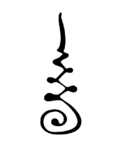

.jpg)

.svg)