Vibrating-sample magnetometer
Scientific instrument to measure magnetic properties
From Wikipedia, the free encyclopedia
A vibrating-sample magnetometer (VSM) (also referred to as a Foner magnetometer[1]/oscillation magnetometer) is a scientific instrument that measures magnetic properties based on Faraday's Law of Induction. Simon Foner at MIT Lincoln Laboratory invented VSM in 1955 and reported it in 1959.[2] Also it was mentioned by G.W. Van Oosterhout[3] and by P.J Flanders in 1956.[4] A sample is first placed in a constant magnetic field and if the sample is magnetic it will align its magnetization with the external field. The magnetic dipole moment of the sample creates a magnetic field that changes as a function of time as the sample is moved up and down. This is typically done through the use of a piezoelectric material. The alternating magnetic field induces an electric field in the pickup coils of the VSM.[5][6] The current is proportional to the magnetization of the sample - the greater the induced current, the greater the magnetization. As a result, typically a hysteresis curve will be recorded[7] and from there the magnetic properties of the sample can be deduced.


The idea of vibrating sample came from D. O. Smith's[8] vibrating-coil magnetometer.
Typical VSM overview
Working principle
Vibrating Sample Magnetometry is based on the physical principle of electromagnetic induction: A sample with magnetic moment is placed in a homogeneous magnetic field . The sample is vibrated in the field with position , which causes a change in the magnetic flux


in a sensing coil with cross-sectional area , is the vacuum permeability. According to Faraday's law of induction, the change in the magnetic flux is proportional to an induced electric voltage


.

The first factor is directly dependent on the device and is thus known to the experimenter. The second factor is proportional to . Factors of proportionality are determined through calibration of the setup.

Because with all further factors either determined from the device or through calibration, a measurement of the induced voltage directly yields the magnetic moment of the sample.[5]

Parts of a typical VSM setup

- Actively cooled electromagnet/power supply
- Amplifier
- Control Chassis
- Meter
- Computer interface
- Sensor coils
- Vibration exciter with sample holder
- Hall probe (optional)
Sample Operating Procedure
Source:[6]
Conditions for VSM to be effective
- Magnetic field must be strong enough to fully saturate the samples (or else inaccurate measurements will be taken)
- Magnetic field must be uniform across the sample space (otherwise the addition of field gradients[7][9] will induce force that alter the vibration once again leading to inaccurate results
Importance of pick-up coils
These allow the VSM to maximize the induced signal, reduce the noise, give a wide saddle point, minimize the volume in between the sample and electromagnet to achieve a more uniform magnetic field at the sample space.[7] The configuration of the coils can vary depending on the type of material being studied.[7]
Relation to Physics
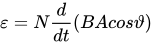
The VSM relies on Faraday's law of induction, with the detection of the emf given by ,[9] where N is the number of wire turns, A is the area, and the angle between the normal of the coil and the B field. However, N and A are often unnecessary if the VSM is properly calibrated.[9] By varying the strength of the electromagnet through computer software, the external field is swept from high to low and back to high.[9] Typically this is automated through a computer process and a cycle of data is printed out. The electromagnet is typically attached to a rotating base[9] so as to allow the measurements be taken as a function of angle. The external field is applied parallel to the sample length[9] and the aforementioned cycle prints out a hysteresis loop. Then using known magnetization of the calibration material and wire volume the high field voltage signal can be converted into emu units - useful for analysis.[9]

Advantages and Disadvantages
The precision and accuracy of VSM's are quite high even among other magnetometers and can be on the order of ~ emu.[7] VSM's further allow for a sample to be tested at varying angles with respect to its magnetization letting researchers minimize the effects of external influences.[10] However, VSM's are not well suited for determining the magnetization loop due to the demagnetizing effects incurred by the sample.[10] VSM's further suffer from temperature dependence and cannot be used on fragile samples that cannot undergo acceleration (from the vibration).[7][9][10]

See also
- Magnetometer
- Alternating (Field) Gradient Magnetometer (AFGM or AGM)
- SQUID Magnetometer
Further reading
- Dodrill, Brad; Lindemuth, Jeffrey R. (2021), Franco, Victorino; Dodrill, Brad (eds.), "Vibrating Sample Magnetometry", Magnetic Measurement Techniques for Materials Characterization, Springer International Publishing, pp. 15–37, doi:10.1007/978-3-030-70443-8_2, ISBN 978-3-030-70442-1
{{citation}}: CS1 maint: work parameter with ISBN (link)