Webb County, Texas
County in Texas, United States
From Wikipedia, the free encyclopedia
Webb County is a county located in the U.S. state of Texas. As of the 2020 census, its population was 267,114.[1][2] Its county seat and largest city is Laredo.[3] The county was named after James Webb (1792–1856), who served as secretary of the treasury, secretary of state, and attorney general of the Republic of Texas, and later judge of the United States District Court following the admission of Texas to statehood. By area, Webb County is the largest county in South Texas, the largest county in Texas outside of the Trans-Pecos region, and the sixth-largest in the state. Webb County comprises the Laredo metropolitan area. Webb County is the only county in the United States to border three foreign states or provinces, sharing borders with Coahuila, Nuevo Leon, and Tamaulipas.

Webb County | |
|---|---|
Webb County Courthouse in Laredo | |
 Seal | |
 Interactive map of Webb County | |
 Location within the U.S. state of Texas | |
| Country |  United States United States |
| State |  Texas Texas |
| Established | January 28, 1848 |
| Organized | March 16, 1848 |
| Named after | James Webb |
| County seat | Laredo |
| Largest city | Laredo |
| Government | |
| • Type | Commissioners Court |
| Area | |
• Total | 3,375 sq mi (8,740 km2) |
| • Land | 3,361 sq mi (8,700 km2) |
| • Water | 14 sq mi (36 km2) 0.4% |
| Population (2020) | |
• Total | 267,114 |
• Estimate (2025) | 281,224  |
| • Density | 79.47/sq mi (30.69/km2) |
| Time zone | UTC−6 (Central) |
| • Summer (DST) | UTC−5 (CDT) |
| Area code | 956 |
| FIPS code | 48479 |
| GNIS feature ID | 1384025 |
| Website | www |


Webb County has a minority majority, with 95.2% of the population of the county identifying as Hispanic. This makes Webb the county with the second-highest proportion of Hispanic people in the continental United States after Starr County, and it has the highest proportion of Hispanic people among counties with a population over 100,000.[4]
History
Webb County was split in 1856. Encinal County was established on February 1, 1856, and was to have consisted of the eastern portion of Webb County. However, Encinal County was never organized and was finally dissolved on March 12, 1899, with its territory returned as part of Webb County.
Much of Webb County history is based on the prevalence of ranching in the 19th century and continuing thereafter. The Webb County Heritage Foundation is a nonprofit organization that seeks to preserve documents and artifacts of the past to guarantee that the regional history is not lost to upcoming generations. In 2015, the foundation, headed by President James E. Moore, presented Heritage Awards to such local notables as the artist Janet Krueger, journalist Maria Eugenia Guerra, and Laredo Community College art instructor Martha F. Fenstermaker (1943-2014).[5]
Geography
According to the U.S. Census Bureau, the county has a total area of 3,376 square miles (8,740 km2), of which 3,361 square miles (8,700 km2) are land and 14 square miles (36 km2) (0.4%) are covered by water.[6]
Major highways
The Webb County–City of Laredo Regional Mobility Authority has responsibility for a comprehensive transport system in the region.

 Future I-2
 Future I-27
 I-35
I-35

 I-69W / US 59
 Bus. US 59 (Laredo)
 US 83
US 83 SH 44
SH 44 SH 84
SH 84 SH 255
 SH 359
 Loop 20
 Spur 260


Adjacent counties and municipalities
- Dimmit County (north)
- La Salle County (north)
- Duval County (east)
- Jim Hogg County (southeast)
- Zapata County (south)
- Maverick County (northwest)
- McMullen County, Texas (northeast)
- Guerrero, Coahuila, Mexico (west)
- Hidalgo, Coahuila, Mexico (west)
- Anáhuac, Nuevo León, Mexico (west)
- Nuevo Laredo, Tamaulipas, Mexico (south)
- Guerrero, Tamaulipas, Mexico (southwest)
Demographics
Racial and ethnic composition
| Census | Pop. | Note | %± |
|---|---|---|---|
| 1860 | 1,397 | — | |
| 1870 | 2,615 | 87.2% | |
| 1880 | 5,273 | 101.6% | |
| 1890 | 14,842 | 181.5% | |
| 1900 | 21,851 | 47.2% | |
| 1910 | 22,503 | 3.0% | |
| 1920 | 29,152 | 29.5% | |
| 1930 | 42,128 | 44.5% | |
| 1940 | 45,916 | 9.0% | |
| 1950 | 56,141 | 22.3% | |
| 1960 | 64,791 | 15.4% | |
| 1970 | 72,859 | 12.5% | |
| 1980 | 99,258 | 36.2% | |
| 1990 | 133,239 | 34.2% | |
| 2000 | 193,117 | 44.9% | |
| 2010 | 250,304 | 29.6% | |
| 2020 | 267,114 | 6.7% | |
| 2025 (est.) | 281,224 | [7] | 5.3% |
| U.S. Decennial Census[8] 1850–2010[9] 2010[10] 2020[11] | |||
| Race / Ethnicity (NH = Non-Hispanic) | Pop 1980[12] | Pop 1990[13] | Pop 2000[14] | Pop 2010[10] | Pop 2020[11] | % 1980 | % 1990 | % 2000 | % 2010 | % 2020 |
|---|---|---|---|---|---|---|---|---|---|---|
| White alone (NH) | 8,124 | 7,427 | 9,508 | 8,345 | 9,495 | 8.18% | 5.57% | 4.92% | 3.33% | 3.55% |
| Black or African American alone (NH) | 75 | 68 | 294 | 487 | 788 | 0.08% | 0.05% | 0.15% | 0.19% | 0.30% |
| Native American or Alaska Native alone (NH) | 111 | 44 | 144 | 95 | 135 | 0.11% | 0.03% | 0.07% | 0.04% | 0.05% |
| Asian alone (NH) | 94 | 397 | 783 | 1,320 | 1,300 | 0.09% | 0.30% | 0.41% | 0.53% | 0.49% |
| Native Hawaiian or Pacific Islander alone (NH) | x [15] | x [16] | 16 | 11 | 25 | x | x | 0.01% | 0.00% | 0.01% |
| Other race alone (NH) | 12 | 234 | 22 | 130 | 458 | 0.01% | 0.18% | 0.01% | 0.05% | 0.17% |
| Mixed race or Multiracial (NH) | x [17] | x [18] | 280 | 263 | 559 | x | x | 0.14% | 0.11% | 0.21% |
| Hispanic or Latino (any race) | 90,842 | 125,069 | 182,070 | 239,653 | 254,354 | 91.52% | 93.87% | 94.28% | 95.74% | 95.22% |
| Total | 99,258 | 133,239 | 193,117 | 250,304 | 267,114 | 100.00% | 100.00% | 100.00% | 100.00% | 100.00% |
2020 census
As of the 2020 census, the county had a population of 267,114. The median age was 30.6 years. 30.2% of residents were under the age of 18 and 10.4% of residents were 65 years of age or older. For every 100 females there were 94.7 males, and for every 100 females age 18 and over there were 91.3 males age 18 and over.[19][20]
The racial makeup of the county was 38.5% White, 0.4% Black or African American, 0.6% American Indian and Alaska Native, 0.5% Asian, <0.1% Native Hawaiian and Pacific Islander, 19.7% from some other race, and 40.2% from two or more races. Hispanic or Latino residents of any race comprised 95.2% of the population.[20]
94.1% of residents lived in urban areas, while 5.9% lived in rural areas.[21]
There were 78,282 households in the county, of which 48.7% had children under the age of 18 living in them. Of all households, 50.5% were married-couple households, 15.4% were households with a male householder and no spouse or partner present, and 28.7% were households with a female householder and no spouse or partner present. About 16.2% of all households were made up of individuals and 6.2% had someone living alone who was 65 years of age or older.[19]
There were 84,763 housing units, of which 7.6% were vacant. Among occupied housing units, 62.5% were owner-occupied and 37.5% were renter-occupied. The homeowner vacancy rate was 1.3% and the rental vacancy rate was 8.4%.[19]
2010 census
As of the 2010 census, the population was 250,304, an increase of roughly 57,000 from 2000.[10]
2000 census
As of the census[22] of 2000, 193,117 people, 50,740 households, and 43,433 families resided in the county. The population density was 58 people/sq mi (22/km2). The 55,206 housing units averaged 16/sq mi (6/km2). The racial makeup of the county was 82.16% White, 0.37% Black or African American, 0.47% Native American, 0.43% Asian, 14.02% from other races, and 2.54% from two or more races. About 94% of the population was Hispanic or Latino of any race.
Of the 50,740 households, 53.20% had children under 18 living with them, 62.60% were married couples living together, 18.30% had a female householder with no husband present, and 14.40% were not families; 12.40% of all households were made up of individuals, and 5.10% had someone living alone who was 65 years of age or older. The average household size was 3.75, and the average family size was 4.10.
In the county, the age distribution was 36.20% under 18, 11.40% from 18 to 24, 29.30% from 25 to 44, 15.60% from 45 to 64, and 7.60% who were 65 or older. The median age was 26 years. For every 100 females, there were 92.90 males. For every 100 females age 18 and over, there were 87.90 males.
The median income for a household in the county was $28,100, and for a family was $29,394. Males had a median income of $23,618 versus $19,018 for females. The per capita income for the county was $10,759. About 26.70% of families and 31.20% of the population were below the poverty line, including 39.40% of those under age 18 and 26.90% of those age 65 or over.
Politics
| Year | Republican | Democratic | Third party(ies) | |||
|---|---|---|---|---|---|---|
| No. | % | No. | % | No. | % | |
| 1912 | 888 | 56.31% | 654 | 41.47% | 35 | 2.22% |
| 1916 | 472 | 41.11% | 676 | 58.89% | 0 | 0.00% |
| 1920 | 468 | 41.90% | 633 | 56.67% | 16 | 1.43% |
| 1924 | 429 | 23.91% | 1,313 | 73.19% | 52 | 2.90% |
| 1928 | 767 | 32.16% | 1,615 | 67.71% | 3 | 0.13% |
| 1932 | 657 | 13.22% | 4,299 | 86.52% | 13 | 0.26% |
| 1936 | 696 | 16.22% | 3,594 | 83.78% | 0 | 0.00% |
| 1940 | 775 | 15.73% | 4,147 | 84.19% | 4 | 0.08% |
| 1944 | 776 | 13.93% | 4,742 | 85.12% | 53 | 0.95% |
| 1948 | 1,004 | 17.63% | 4,595 | 80.68% | 96 | 1.69% |
| 1952 | 2,784 | 30.95% | 6,208 | 69.01% | 4 | 0.04% |
| 1956 | 2,744 | 31.96% | 5,827 | 67.86% | 16 | 0.19% |
| 1960 | 1,802 | 15.19% | 10,059 | 84.78% | 4 | 0.03% |
| 1964 | 1,094 | 9.78% | 10,073 | 90.08% | 15 | 0.13% |
| 1968 | 2,103 | 17.78% | 9,419 | 79.65% | 304 | 2.57% |
| 1972 | 6,011 | 41.58% | 8,435 | 58.34% | 12 | 0.08% |
| 1976 | 4,222 | 28.72% | 10,362 | 70.50% | 114 | 0.78% |
| 1980 | 5,421 | 30.81% | 11,856 | 67.39% | 316 | 1.80% |
| 1984 | 8,582 | 40.99% | 12,308 | 58.79% | 46 | 0.22% |
| 1988 | 7,528 | 31.59% | 16,227 | 68.09% | 77 | 0.32% |
| 1992 | 7,789 | 31.32% | 14,509 | 58.35% | 2,568 | 10.33% |
| 1996 | 4,712 | 19.02% | 18,997 | 76.67% | 1,068 | 4.31% |
| 2000 | 13,076 | 41.42% | 18,120 | 57.39% | 375 | 1.19% |
| 2004 | 17,753 | 42.72% | 23,654 | 56.92% | 149 | 0.36% |
| 2008 | 13,119 | 28.02% | 33,452 | 71.45% | 250 | 0.53% |
| 2012 | 11,078 | 22.52% | 37,597 | 76.42% | 521 | 1.06% |
| 2016 | 12,947 | 22.48% | 42,307 | 73.47% | 2,331 | 4.05% |
| 2020 | 25,904 | 37.80% | 41,842 | 61.05% | 788 | 1.15% |
| 2024 | 33,384 | 50.69% | 31,952 | 48.51% | 529 | 0.80% |
| Year | Republican | Democratic | Third party(ies) | |||
|---|---|---|---|---|---|---|
| No. | % | No. | % | No. | % | |
| 2024 | 28,121 | 44.15% | 33,758 | 53.00% | 1,820 | 2.86% |
| Year | Republican | Democratic | Third party(ies) | |||
|---|---|---|---|---|---|---|
| No. | % | No. | % | No. | % | |
| 2020 | 23,153 | 34.87% | 40,822 | 61.49% | 2,418 | 3.64% |
| Year | Republican | Democratic | Third party(ies) | |||
|---|---|---|---|---|---|---|
| No. | % | No. | % | No. | % | |
| 2022 | 16,409 | 36.70% | 27,156 | 60.73% | 1,151 | 2.57% |
Webb County was a longtime Democratic stronghold.[27] However, since 2016, Webb County has been trending more towards the Republican Party due to Donald Trump attracting more Hispanic voters. This mirrors the same trend seen in other counties in South Texas. In 2024, the county flipped Republican by a slim majority, the first time it had done so since 1912. Webb was Biden's best county in 2020 of the counties that flipped to Trump in 2024 by margin; the county went from voting for Biden by 23% to voting for Trump by 2%. Overall, Webb County shifted to the right from 2012 to 2024 by 56 percentage points, representing one of the strongest such rightward shifts for any county in the country.[28]
Education
Three school districts serve Webb County:[29]
- Laredo Independent School District
- United Independent School District
- Webb Consolidated Independent School District
Prior to 1994, Webb CISD served only Bruni and Oilton. Mirando City Independent School District served the community of Mirando City from 1923 to 2005. Prior to 1994, all Mirando City children attended Mirando City ISD schools. After the spring of 1994, Mirando City High School closed.[30] Therefore, from the fall of 1994 to July 1, 2005, WCISD served high schoolers from Mirando City, while Mirando Elementary School in the Mirando City ISD served pupils from kindergarten through eighth grade. On May 9, 2005, the Texas Education Agency ordered the closure of Mirando City ISD. The district closed on July 1, 2005, and all students were rezoned to Webb CISD schools.[31]
The private Holding Institute is a former United Methodist boarding school operating as a downtown Laredo community center.
All residents are zoned to Laredo College.[32]
Communities
Cities
Census-designated places
- Aguilares
- Bonanza Hills
- Botines
- Bruni
- Colorado Acres
- Four Points
- Hillside Acres
- La Coma
- La Moca Ranch
- La Presa
- Laredo Ranchettes
- Laredo Ranchettes West
- Las Haciendas
- Las Pilas
- Los Altos
- Los Arcos
- Los Centenarios
- Los Corralitos
- Los Fresnos
- Los Huisaches
- Los Minerales
- Los Nopalitos
- Los Veteranos I
- Los Veteranos II
- Mirando City
- Oilton
- Pueblo East
- Pueblo Nuevo
- Ranchitos East
- Ranchitos Las Lomas
- Ranchos Penitas West
- San Carlos I
- San Carlos II
- Sunset Acres
- Tanquecitos South Acres
- Tanquecitos South Acres II
- Valle Verde
Former census designated places
Other unincorporated communities
Ghost towns
Planned community
- Talise[33]
Gallery
 Map of Webb and Encinal Counties in 1895
 Webb County Courthouse in 1905
 Webb County Courthouse today
 Entrance to the William N. "Billy" Hall Administrative Building annex of the Webb County Courthouse in Laredo
 The Webb County Appraisal District Office in Laredo appraises taxable real property for municipal and county governments, Laredo Community College, and both public school districts.
 Entrance to the J. O. Walker, Jr., Piedra Parada Ranch in eastern Webb County
 Opuntia cacti abound throughout much of Webb County.
 The Cactus Jack Ranch in northwestern Webb County is named for U.S. President Franklin D. Roosevelt's first vice president, John Nance Garner of Uvalde. Imported saguaro cacti are planted at the gate.
 Entrance gate to La Esperanza (Hope) Ranch in northwestern Webb County near the Dimmit County boundary
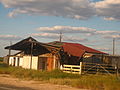 This abandoned building along U.S. Route 83 in northwestern Webb County reflects the isolation of the South Texas ranch country.
 Road through Tamaulipan thornscrub, Webb County, Texas, USA (10 June 2016)
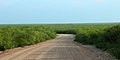 Road through Tamaulipan thornscrub, Webb County, Texas, USA (10 June 2016)

.jpg)


.jpg)
.jpg)
