−2
Negative integer two units from the origin in mathematics
From Wikipedia, the free encyclopedia
In mathematics, negative two or minus two is an integer two units from the origin,[1] denoted as −2[2] or −2.[3] It is the additive inverse of 2, following −3 and preceding −1, and is the largest negative even integer. Except in rare cases exploring integral ring prime elements,[4] negative two is generally not considered a prime number.[5]
Negative two is sometimes used to denote the square reciprocal in the notation of SI base units, such as m·s−2.[6] Additionally, in fields like software design, −1 is often used as an invalid return value for functions,[7] and similarly, negative two may indicate other invalid conditions beyond negative one.[8] For example, in the On-Line Encyclopedia of Integer Sequences, negative one denotes non-existence, while negative two indicates an infinite solution.[9][10]
Properties
- Negative two is a complementary Bell number (also known as Rao Uppuluri-Carpenter numbers),[11][12] and a Hermite number.
- Negative two makes the class number of the quadratic field equal to 1, meaning its ring of integers is a unique factorization domain.[Note 1][13] According to the Stark–Heegner theorem, only nine negative numbers have this property,[14][15][16] corresponding to Heegner numbers.[17]
- Negative two is the largest negative number unreachable from 1 in two steps using addition, subtraction, or multiplication.[23] The largest in one step is −1, and in three steps, −4.[23] This relates to the straight-line program combined with addition, subtraction, and multiplication,[24] exploring the algebraic complexity of integers in relation to NP = P.[25]
- Negative two is the second-order i.e., .[26][27]
- Negative two makes a triangular number.[28] Only nine integers have this property, with negative two being the smallest: −2, −1, 0, 1, 4, 5, 9, 56, and 636.[29]
![{\displaystyle \mathbb {Q} [{\sqrt {d}}]}](http://wikimedia.org/api/rest_v1/media/math/render/svg/86b4fd0d487fad901c09de8e288da7d2e50fd2eb)


Divisors of negative two
The divisors of negative two, including negative divisors, are identical to those of two: −2, −1, 1, 2. By definition, negative numbers are not typically subjected to prime factorization, though can be factored out as ,[30] making 2 a prime factor but not the result of prime factorization. As a Gaussian integer, negative two can be factored as , where is a Gaussian prime and is the imaginary unit.[31]


Powers of negative two
The first few powers of negative two are −2, 4, −8, 16, −32, 64, −128, oscillating between positive and negative.[32] The positive terms are powers of four, and the negative terms differ from powers of four by a factor of negative two.[33] This property makes negative two the largest negative number that can represent all real numbers as a base without using a negative sign or two's complement.[32][34][35][36] In 1957, some computers used a base-negative-two numeral system for calculations.[37] Similarly, using can represent complex numbers.[38]

The sum of the powers of negative two is a divergent geometric series. Although divergent, its generalized sum is .[39][40]


Using the geometric series formula,[41]
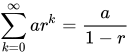
with the first term and common ratio , the result is . However, the series is divergent, with partial sums:[42]


- 1, −1, 3, −5, 11, −21, 43, −85, 171, −341...[42]
Though divergent, Euler assigned the value to this series,[43] known as Euler summation.[44]
Negative second power
The negative second power of a number is its square reciprocal, applicable to functions as well.[45] In daily life, it is occasionally used to denote units without a division sign, such as acceleration, typically written as m/s2 but also as m·s−2 in SI notation.[6]
Common topics related to the square reciprocal include: for any real number , its square reciprocal is always positive; the inverse-square law;[46] grid turbulence decay;[47] and the Basel problem.[48] The Basel problem states that the sum of the square reciprocals of natural numbers converges to :[49][48]



This value equals the Riemann zeta function at 2.[50][51]
For any real number, the square reciprocal is positive. For negative two, it is . The square reciprocals of the first few natural numbers are:
 ,
,  ...
...| Square reciprocal | 1 | 2 | 3 | 4 | 5 | 6 | 7 | 8 | 9 | 10 |
|---|---|---|---|---|---|---|---|---|---|---|
| 1 | ||||||||||
| 1 | 0.25 | 0.0625 | 0.04 | 0.0204081632...[Note 2] | 0.015625 | 0.01 |


Square root of negative two
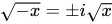
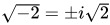
The square root of negative two, defined with the imaginary unit satisfying , is derived from . For negative two, it is .[Note 3][52][53][54][55] The principal value is .[Note 4][52][53][54][55]


Representation
Negative two is typically represented by adding a negative sign before 2,[56] commonly called "negative two" or "minus two" in English.[57]
In binary, especially in computing, negative numbers are often represented using two's complement.[58] Negative two is represented as "...11111110(2)", specifically "1110(2)" for 4-bit, "11111110(2)" for 8-bit, and "1111111111111110(2)" for 16-bit integers.[59] In signed notation, it is "−10(2)".[60]
Plus or minus two
Plus or minus two () is expressed using the plus-minus sign, representing both positive and negative two. It denotes the square roots of 4 or the solutions to the quadratic equation , i.e., . Plus or minus two appears more frequently in cultural contexts, such as music compositions[61] or the documentary ±2 °C, which explores the environmental impact of a global temperature change of two degrees.[62][63]


See also
Notes
- When , if the ring of integers of is a unique factorization domain, all numbers in have a unique factorization. For example, is not, as 6 can be factored in two ways in : and .
- The repeating decimal for 7's square reciprocal has a period of 42: 0.0204081632 6530612244 8979591836 7346938775 51... See reciprocal of 49.
- In the bi-imaginary number system , where is negative two and is two, it is . Donald E. Knuth (April 1, 1960). "A imaginary number system" [A imaginary number system]. Communications of the ACM. 3 (4): 245–247. doi:10.1145/367177.367233. Retrieved August 21, 2025.
- The principal value of the square root of –2 is taking the positive value; with respect to –2, that is .

![{\displaystyle \mathbb {Q} [{\sqrt {-5}}]}](http://wikimedia.org/api/rest_v1/media/math/render/svg/8b63d421239faeb1572bcd6a024c0ed526404276)
![{\displaystyle \mathbb {Z} [{\sqrt {-5}}]}](http://wikimedia.org/api/rest_v1/media/math/render/svg/a37499ef27234d8a67a65932184280bb17301312)




