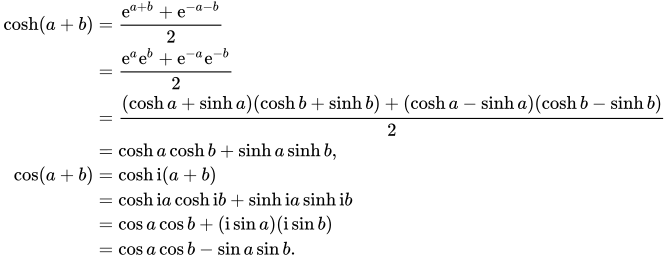
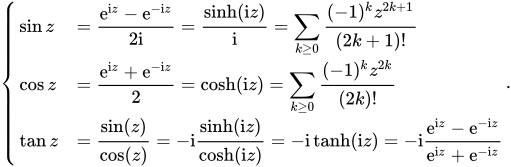
Trigonométrie complexe prolongement des fonctions trigonométriques aux nombres complexes par leur lien à l'exponentielle From Wikipedia, the free encyclopedia Cet article est une ébauche concernant l’analyse. Extension des fonctions circulaires Summarize Timeline Top Qs Fact Check Dans le plan des nombres complexes, grâce aux formules d'Euler, les fonctions trigonométriques satisfont les égalités suivantes : { sin z = e i z − e − i z 2 i = sinh ( i z ) i = ∑ k ≥ 0 ( − 1 ) k z 2 k + 1 ( 2 k + 1 ) ! cos z = e i z + e − i z 2 = cosh ( i z ) = ∑ k ≥ 0 ( − 1 ) k z 2 k ( 2 k ) ! tan z = sin ( z ) cos ( z ) = − i sinh ( i z ) cosh ( i z ) = − i tanh ( i z ) = − i e i z − e − i z e i z + e − i z . {\displaystyle {\begin{cases}\sin z&=\displaystyle {\frac {\mathrm {e} ^{\mathrm {i} z}-\mathrm {e} ^{-\mathrm {i} z}}{2\mathrm {i} }}={\frac {\sinh(\mathrm {i} z)}{\mathrm {i} }}=\sum _{k\geq 0}{\frac {(-1)^{k}z^{2k+1}}{\left(2k+1\right)!}}\\\cos z&=\displaystyle {\frac {\mathrm {e} ^{\mathrm {i} z}+\mathrm {e} ^{-\mathrm {i} z}}{2}}=\cosh(\mathrm {i} z)=\sum _{k\geq 0}{\frac {(-1)^{k}z^{2k}}{\left(2k\right)!}}\\\tan z&=\displaystyle {\frac {\sin(z)}{\cos(z)}}=-\mathrm {i} {\frac {\sinh(\mathrm {i} z)}{\cosh(\mathrm {i} z)}}=-\mathrm {i} \tanh(\mathrm {i} z)=-\mathrm {i} {\frac {\mathrm {e} ^{\mathrm {i} z}-\mathrm {e} ^{-\mathrm {i} z}}{\mathrm {e} ^{\mathrm {i} z}+\mathrm {e} ^{-\mathrm {i} z}}}\end{cases}}.} De même que leurs fonctions réciproques arcsin z = − i ln ( i z + 1 − z 2 ) {\displaystyle \arcsin z=-\mathrm {i} \ln \left(\mathrm {i} z+{\sqrt {1-z^{2}}}\right)} , arccos z = − i ln ( z + z 2 − 1 ) {\displaystyle \arccos z=-\mathrm {i} \ln \left(z+{\sqrt {z^{2}-1}}\right)} et arctan z = i 2 [ ln ( 1 − i z ) − ln ( 1 + i z ) ] {\displaystyle \arctan z={\frac {\mathrm {i} }{2}}\left[\ln \left(1-\mathrm {i} z\right)-\ln(1+\mathrm {i} z)\right]} . Ces fonctions réciproques souffrent des mêmes problèmes d'indétermination que le logarithme complexe. Rappel : e a + i b = e a e i b = e a ( cos ( b ) + i sin ( b ) ) {\displaystyle \mathrm {e} ^{a+\mathrm {i} b}=\mathrm {e} ^{a}\mathrm {e} ^{\mathrm {i} b}=\mathrm {e} ^{a}\left(\cos(b)+\mathrm {i} \sin(b)\right)} . Formules d'addition Summarize Timeline Top Qs Fact Check Pour tous nombres complexes a et b, on a par exemple cosh ( a + b ) = cosh a cosh b + sinh a sinh b cos ( a + b ) = cos a cos b − sin a sin b . {\displaystyle {\begin{aligned}\cosh(a+b)&=\cosh a\cosh b+\sinh a\sinh b\\\cos(a+b)&=\cos a\cos b-\sin a\sin b\end{aligned}}.} Démonstration cosh ( a + b ) = e a + b + e − a − b 2 = e a e b + e − a e − b 2 = ( cosh a + sinh a ) ( cosh b + sinh b ) + ( cosh a − sinh a ) ( cosh b − sinh b ) 2 = cosh a cosh b + sinh a sinh b , cos ( a + b ) = cosh i ( a + b ) = cosh i a cosh i b + sinh i a sinh i b = cos a cos b + ( i sin a ) ( i sin b ) = cos a cos b − sin a sin b . {\displaystyle {\begin{aligned}\cosh(a+b)&={\frac {{\rm {e}}^{a+b}+{\rm {e}}^{-a-b}}{2}}\\&={\frac {{\rm {e}}^{a}{\rm {e}}^{b}+{\rm {e}}^{-a}{\rm {e}}^{-b}}{2}}\\&={\frac {(\cosh a+\sinh a)(\cosh b+\sinh b)+(\cosh a-\sinh a)(\cosh b-\sinh b)}{2}}\\&=\cosh a\cosh b+\sinh a\sinh b,\\\cos(a+b)&=\cosh {\rm {i}}(a+b)\\&=\cosh {\rm {i}}a\cosh {\rm {i}}b+\sinh {\rm {i}}a\sinh {\rm {i}}b\\&=\cos a\cos b+({\rm {i}}\sin a)({\rm {i}}\sin b)\\&=\cos a\cos b-\sin a\sin b.\end{aligned}}} d'où (en remplaçant b par ib) : cosh ( a + i b ) = cosh a cos b + i sinh a sin b , cos ( a + i b ) = cos a cosh b − i sin a sinh b . {\displaystyle {\begin{aligned}\cosh(a+{\rm {i}}b)&=\cosh a\cos b+{\rm {i}}\sinh a\sin b,\\\cos(a+{\rm {i}}b)&=\cos a\cosh b-{\rm {i}}\sin a\sinh b.\end{aligned}}} Pour les autres fonctions trigonométriques, on fait de même. Pour tan, cot, tanh et coth, Il vaut mieux utiliser leurs définitions, soit tan z = sin z cos z , cot z = cos z sin z , tanh z = sinh z cosh z , coth z = cosh z sinh z . {\displaystyle \tan z={\frac {\sin z}{\cos z}},\quad \cot z={\frac {\cos z}{\sin z}},\quad \tanh z={\frac {\sinh z}{\cosh z}},\quad \coth z={\frac {\cosh z}{\sinh z}}.} Sujets liés Fonction trigonométrique Fonction exponentielle Exponentielle complexe Fonction hyperbolique Nombre complexe Portail des mathématiques Related Articles~TimelinesTop QsFact Checks






![{\displaystyle \arctan z={\frac {\mathrm {i} }{2}}\left[\ln \left(1-\mathrm {i} z\right)-\ln(1+\mathrm {i} z)\right]}](http://wikimedia.org/api/rest_v1/media/math/render/svg/4d0761e030769776419f62c8411dccba7a95f7a4)

