July 29 (Eastern Orthodox liturgics)
Day in the Eastern Orthodox liturgical calendar
From Wikipedia, the free encyclopedia
July 28 - Eastern Orthodox Church calendar - July 30

All fixed commemorations below are celebrated on August 11 by Old Calendar.[note 1]
For July 29th, Orthodox Churches on the Old Calendar commemorate the Saints listed on July 16.
Saints
- Virgin-martyr Seraphima (Serapia) of Antioch (c. 117-138)[1][2][3][note 2][note 3]
- Martyr Kallinikos of Cilicia in Asia Minor (c. 250)[1][3][6][7][8][note 4][note 5]
- Martyr Theodota and her three sons in Bithynia (c. 304)[1][3][6][9][10]
- Martyrs Benjamin and Berius, by the Palace of the Hebdomon.[3][6][11]
- Martyr Mamas, by drowning.[3][6][12]
- Martyr Basiliscus the Elder, by the sword.[3][6][13]
- Martyr Ioannis.[6][14][15]
- The holy Martyrs, a father and mother, with their two children, by fire.[3][15][16]
- Blessed John the Soldier (c. 361)[3][6][15][17] (see also: July 30)
- Saint Theodosius the Younger, the pious emperor (450)[1][3][6][18][19]
- Martyr Eustathius the Cobbler of Mtskheta, Georgia (589)[1][3][19][20][21][22]
- Saint Constantine I, Patriarch of Constantinople (677)[1][19][note 6] (see also: August 9)
Pre-Schism Western saints
- Saints Simplicius, Faustinus and Beatrix, two brothers and their sister martyred in Rome under Diocletian (c. 303)[3][4][25][note 7]
- Saint Faustinus (4th century)[4][note 8][note 9]
- Saint Prosper of Orleans, Bishop of Orleans in France (c.453)[4][26][note 10]
- Saint Lupus the Confessor, Bishop of Troyes, Gaul (479)[1][3][4][19][27][28][29][note 11][note 12]
- Saint Sulien (Sulian, Silin), born in Brittany, he founded a small monastery in Luxulyan in Cornwall (6th century)[4]
- Saint Kilian, an abbot of a monastery on the island of Inis Cealtra in Ireland, and author of a Life of St Brigid (7th century)[4][30]
- Saint Olaf II of Norway (Olav, Tola), King of Norway (1030)[1][4][19][31][32][note 13][note 14]
Post-Schism Orthodox saints
- Saint Constantine III Leichoudes, Patriarch of Constantinople (1063)[6][23][24]
- Saints Constantine[note 15] and Cosmas[note 16] of Kosinsk, in Pskov, Abbots (13th century)[1][3][19][33][34]
- Saint Romanus of Kirzach, founder of Kirzhach Monastery, disciple of St. Sergius of Radonezh (1392)[1][3][19][35]
- Saint Bogolep, Child Schemamonk of Chorny Yar, near Astrakhan (1667)[36]
- Hieromartyr Bessarion of Smolyan, Bulgaria (1670)[1][19][37][38][note 17]
- Martyr Daniel Kushnir of Mlievich (Daniel of Cherkassk), Ukraine (1766)[1][19]
New martyrs and confessors
- New Hieromartyrs Seraphim (Bogoslovsky) and Theognostus (Pivovarov), Hieromonks of a skete at Kyzyl-Zharskoe, Kazakhstan (1921)[1][19][27]
- New Hieromartyr Anatole (Smirnov), Hieromonk and hermit of the Caucasus Mountains, Abkhazia (1930-1935)[1][19][27]
- New Hieromartyr Pachomius (Rusin), Hieromonk, of Alma Ata, Kazakhstan (1938)[1][19][27]
- New Hieromartyr Alexis Krasnovsky, Priest (1938)[19][27]
Other commemorations
- Nativity of St. Nicholas the Wonderworker, Archbishop of Myra in Lycia (3rd century)[1][19][39]
- Icon of the Most Holy Theotokos of Rudoe Selo (19th century)[40][note 18]
- Repose of Archpriest Georges Florovsky (1979)[1]
Icon gallery
 Virgin-martyr Seraphima (Serapia), with her mistress.
 Martyr Kallinikos of Cilicia.

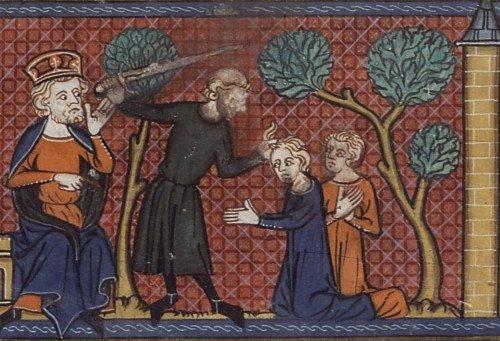 Martyrdom of Sts. Simplicius and Faustinus.
 Saint Olaf II of Norway, King of Norway.
 St. Constantine of Kosinsk.
 St. Cosmas of Kosinsk.
 Hieromartyr Bessarion of Smolyan, Bulgaria.
 Archpriest Georges Florovsky.


_Église_Saint-Loup_Vitrail_03.JPG)

_—_преподобный_Русской_православной_церкви,_игумен_Косинского_монастыря.jpg)
_Косинский_—_преподобный_Русской_православной_церкви_живший_в_13_веке.jpg)


Notes
- The notation Old Style or (OS) is sometimes used to indicate a date in the Julian Calendar (which is used by churches on the "Old Calendar").
The notation New Style or (NS), indicates a date in the Revised Julian calendar (which is used by churches on the "New Calendar"). - The Greek sources propose that the intended commemoration for July 29th for "Patriarch Constantine" is actually Constantine III Leichoudes († 1063).[6][23][24]
- "Also at Rome, on the road to Porto, the holy martyrs Simplicius, Faustinus, and Beatrix, in the time of the emperor Diocletian. The first two, after being subjected to many different torments, were condemned to suffer capital punishment; Beatrix, their sister, was smothered in prison."[5]
- A disciple of St Felix, Bishop of Martano near Spoleto in Italy, he was present at his martyrdom. St Faustinus suffered for Christ before reposing peacefully in Todi in Umbria.
- Born in Toul in France, he married the sister of St Hilary. After seven years, husband and wife separated by mutual consent, Lupus becoming a monk at Lérins. In 426 he became Bishop of Troyes. He accompanied St Germanus of Auxerre to Britain to oppose Pelagianism. In 453 he succeeded in saving Troyes from Attila. He reposed at the age of ninety-four.
- "At Troyes, in France, St. Lupus, bishop and confessor, who went with blessed Germanus to England to combat the Pelagian heresy, and by assiduous prayer defended the city of Troyes from the furor of Attila, who was devastating all France. At length, having religiously discharged the functions of the priesthood for fifty-two years, he rested in peace."[5]
- Son of King Harald of Norway. His early youth was spent as a pirate but in 1010 he was baptised in Rouen in France and in 1013 he helped Ethelred of England against the Danes. In 1015 he succeeded to the throne of Norway and at once called missionaries, mainly from England, to enlighten his homeland. He succeeded in part but was driven from his kingdom. In an attempt to recover it, he fell in battle at Stiklestad. In Norway he is regarded as the champion of national independence.
- See: (in Russian) Константин Косинский (преподобный). Википедии. (Russian Wikipedia).
- See: (in Russian) Косма Косинский. Википедии. (Russian Wikipedia).
- See: (in Bulgarian) Висарион Смоленски. Уикипедия. (Bulgarian Wikipedia).
- See: (in Ukrainian) Рудосільська ікона. Вікіпедія. (Ukrainian Wikipedia).