JR Shikoku 8000 series
Japanese train type
From Wikipedia, the free encyclopedia
The 8000 series (8000系) is a tilting limited express electric multiple unit (EMU) train operated by Shikoku Railway Company (JR Shikoku) in Shikoku, Japan, since 1992.[2]

- 2004–2006 (first)
- 2023– (second)
| 8000 series | |
|---|---|
8000 series on a Shiokaze service in May 2007 | |
| Manufacturers | Hitachi, Nippon Sharyo |
| Constructed | 1992–1997 |
| Entered service | 1992 |
| Refurbished |
|
| Number built | 48 vehicles (12 sets) |
| Number in service | 45 vehicles (11 sets) |
| Formation | 3/5 cars per trainset |
| Fleet numbers | L1–6, S1–6 |
| Capacity |
|
| Operator |  JR Shikoku JR Shikoku |
| Depot | Matsuyama |
| Specifications | |
| Car length | 22,600 mm (74 ft 2 in) |
| Width | 2,820 mm (9 ft 3 in) |
| Height | 3,360 mm (11 ft 0 in) |
| Floor height | 1,105 mm (3 ft 7.5 in) |
| Doors | Plug doors (2 per side) |
| Maximum speed | 130 km/h (80 mph) |
| Traction system | |
| Current collection | Overhead catenary |
| Safety system | ATS-SS |
| Track gauge | 1,067 mm (3 ft 6 in) |
Operations
Formations
As of 1 October 2013, 48 vehicles were in service, formed as 3- and 5-car sets, as shown below.[3]
3-car sets
Prototype set S1
| Car No. | 6 | 7 | 8 |
|---|---|---|---|
| Designation | Mc | M | Tc1 |
| Numbering | 8201 | 8101 | 8501 |
Cars 6 and 8 are each fitted with one S-PS59 lozenge-type pantograph.[3] The pantograph on car 8 was removed in 2010.[4] This set were retired from service by March 2018.
Sets S2–S6
| Car No. | 6 | 7 | 8 |
|---|---|---|---|
| Designation | Mc | T | Tc1 |
| Numbering | 8200 | 8300 | 8500 |
Cars 6 and 8 are each fitted with one S-PS59 lozenge-type pantograph.[3] The pantograph on car 8 was removed between 2010 and 2011.[4] Car 7 is removed from formations during off-peak seasons between 2011 and 2018.[4]
5-car sets L1–L6
| Car No. | 1 | 2 | 3 | 4 | 5 |
|---|---|---|---|---|---|
| Designation | Thsc | M1 | M2 | T | Tc2 |
| Numbering | 8000 | 8100 | 8150 | 8300 | 8400 |
- Half of car 1 includes Green car (first class) seating.[2] Cars 1 and 3 are each fitted with one S-PS59 lozenge-type pantograph.[3]
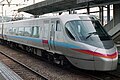 Streamlined end of set 8001 in original livery, 1992
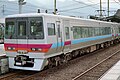 Gangwayed end of set 8201 in original livery, 1992
 A 5-car set in original livery, 1992
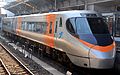 Set S2 in revised livery, 2011
 Car 1 with pantograph removed, 2011


History

The prototype set, S1, was delivered in May 1992,[2] and entered revenue service on 19 September 1992.[5]
On 8 August 1992, set 8001 achieved a speed of 160 km/h (99 mph) in a special test run.[3]
The subsequent fleet of full-production sets entered service from 18 March 1993.[6]
The entire fleet underwent life-extension refurbishment between 2004 and 2006.[5]

Beginning in 2023, the fleet underwent another programme of refurbishment. Refurbished sets received a new livery based on that of the newer 8600 series, as well as wheelchair spaces, power outlets, reupholstered seats, updated traction equipment, and Western-style toilets. In addition, smoking compartments were removed.[7][1] Treated "S" sets entered revenue service from 23 December 2023,[8][9] and treated "L" sets entered service from 2 August 2024.[10] The entire fleet is planned to be refurbished by 2027[1] at a pace of two to three sets per year.[11]
Livery variations
 An 8000 series EMU in Anpanman livery in March 2016
 An 8000 series set in May 2017 repainted in Taiwan Railways Administration EMU800-style livery


