The main concept in Abramov's algorithm is a universal denominator. Let  be a field of characteristic zero. The dispersion
  of two polynomials
 ![{\textstyle p,q\in \mathbb {K} [n]}](https://wikimedia.org/api/rest_v1/media/math/render/svg/36bcc87d3123b013a99b2fa730743a44a6a60db8) is defined as
is defined as where
where  denotes the set of non-negative integers. Therefore the dispersion is the maximum
  such that the polynomial
  and the
  -times shifted polynomial
  have a common factor. It is
  if such a does not exist. The dispersion can be computed as the largest non-negative integer root of the resultant
 ![{\textstyle \operatorname {res} _{n}(p(n),q(n+k))\in \mathbb {K} [k]}](https://wikimedia.org/api/rest_v1/media/math/render/svg/320e230996024a30e89c8e9f727bdc95cfc287b8) .[3][4] Let
.[3][4] Let  be a recurrence equation of order
  with polynomial coefficients
 ![{\displaystyle p_{k}\in \mathbb {K} [n]}](https://wikimedia.org/api/rest_v1/media/math/render/svg/99a01d50ae357ea8203df5b2f6cc55dc93819501) , polynomial right-hand side
, polynomial right-hand side ![{\textstyle f\in \mathbb {K} [n]}](https://wikimedia.org/api/rest_v1/media/math/render/svg/1630da272da3f2909cddd06710cb3f885ef1cd25) and rational sequence solution
and rational sequence solution  . It is possible to write
  for two relatively prime polynomials . Let
  and
and![{\displaystyle u(n)=\gcd([p_{0}(n+D)]^{\underline {D+1}},[p_{r}(n-r)]^{\underline {D+1}})}](https://wikimedia.org/api/rest_v1/media/math/render/svg/23b6a2e862fdeab2c12ec82af1bb0e9f9f7d68de) where
where ![{\textstyle [p(n)]^{\underline {k}}=p(n)p(n-1)\cdots p(n-k+1)}](https://wikimedia.org/api/rest_v1/media/math/render/svg/6aa8c3540431b8056a7e751814de7c71a0054bc2) denotes the falling factorial of a function. Then
denotes the falling factorial of a function. Then  divides
  . So the polynomial can be used as a denominator for all rational solutions
  and hence it is called a universal denominator.[5]

![{\textstyle z(n)\in \mathbb {K} [n]}](https://wikimedia.org/api/rest_v1/media/math/render/svg/212c7e9ae4dc08d65c2e1bb22e1c0b2b4f5c2168)




![{\textstyle \sum _{k=0}^{r}p_{k}(n)\,y(n+k)=f(n),p_{k},f\in \mathbb {K} [n],p_{0},p_{r}\neq 0}](https://wikimedia.org/api/rest_v1/media/math/render/svg/ed5b97019db025f15ab508dd0c09ec3610b17383)


![{\textstyle u(n)=\gcd([p_{0}(n+D)]^{\underline {D+1}},[p_{r}(n-r)]^{\underline {D+1}})}](https://wikimedia.org/api/rest_v1/media/math/render/svg/fabd1ca425f9e06bb5e3c10a1a03a1baa6c72fda)





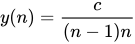
![{\displaystyle u(n)=\gcd([p_{0}(n+1)]^{\underline {2}},[p_{r}(n-1)]^{\underline {2}})=(n-1)n}](https://wikimedia.org/api/rest_v1/media/math/render/svg/a788d308c3a83d2d6916118a30edf810258ea45f)