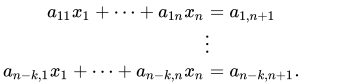
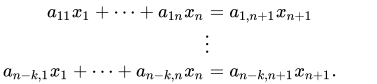
Given a finite-dimensional vector space V and a non-negative integer k, then Graffk(V) is the topological space of all affine k-dimensional subspaces of V.
It has a natural projection p:Graffk(V) → Grk(V), the Grassmannian of all linear k-dimensional subspaces of V by defining p(U) to be the translation of U to a subspace through the origin. This projection is a fibration, and if V is given an inner product, the fibre containing U can be identified with  , the orthogonal complement to p(U).
The fibres are therefore vector spaces, and the projection p is a vector bundle over the Grassmannian, which defines the manifold structure on Graffk(V).
, the orthogonal complement to p(U).
The fibres are therefore vector spaces, and the projection p is a vector bundle over the Grassmannian, which defines the manifold structure on Graffk(V).
As a homogeneous space, the affine Grassmannian of an n-dimensional vector space V can be identified with
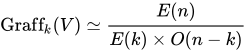
where E(n) is the Euclidean group of Rn and O(m) is the orthogonal group on Rm. It follows that the dimension is given by
![{\displaystyle \dim \left[\mathrm {Graff} _{k}(V)\right]=(n-k)(k+1)\,.}](https://wikimedia.org/api/rest_v1/media/math/render/svg/aee1697409bb3c8c88945a80be4298746f9de9ab)
(This relation is easier to deduce from the identification of next section, as the difference between the number of coefficients, (n−k)(n+1) and the dimension of the linear group acting on the equations, (n−k)2.)