Alexander's Ragtime Band
1911 song composed by Irving Berlin
From Wikipedia, the free encyclopedia
"Alexander's Ragtime Band" is a Tin Pan Alley song by American composer Irving Berlin released in 1911; it is often inaccurately cited as his first global hit.[a][6] Despite its title, the song is a march as opposed to a rag and contains little syncopation.[7] The song is a narrative sequel to Berlin's earlier 1910 composition "Alexander and His Clarinet".[8] This earlier composition recounts the reconciliation between an African-American musician named Alexander Adams and his flame Eliza Johnson as well as highlights Alexander's innovative musical style.[b][9] Berlin's friend Jack Alexander, a cornet-playing African-American bandleader, inspired the title character.[10]

(sheet music registration)
(phonograph recording)
| "Alexander's Ragtime Band" | |
|---|---|
| |
| Single by Arthur Collins & Byron G. Harlan | |
| Language | English |
| A-side | "Ocean Roll" by Eddie Morton[3] |
| Released | March 18, 1911[4] (sheet music registration) |
| Recorded | May 23, 1911[5] (phonograph recording) |
| Studio | Victor Records |
| Venue | Camden, New Jersey |
| Genre | |
| Length | 3:03[5] |
| Label | Victor 16908[5] |
| Songwriter | Irving Berlin |
Emma Carus, a famous contralto renowned for her high lung power, introduced Berlin's song to the public in Spring 1911.[11] Carus' brassy performance of "Alexander's Ragtime Band" at the American Music Hall in Chicago on April 18, 1911, electrified the audience,[11] and she toured other metropolises such as Detroit and New York City with acclaimed performances that featured the catchy tune.[11] Carus' tour showcased the song in the United States and contributed to its immense popularity.[1]
Amid the success of Carus' national tour, the comedic duo of Arthur Collins and Byron G. Harlan released a phonograph recording of the song on May 23, 1911, which became the best-selling record in the United States for ten consecutive weeks.[4] Berlin's jaunty melody "sold a million copies of sheet music in 1911, then another million in 1912, and continued to sell for years afterwards," and it became "the number one song from October 1911 through January 1912."[1] Although not a traditional ragtime song,[7] Berlin's composition kickstarted a ragtime jubilee—a belated celebration of the music which African-Americans had originated a decade prior in the 1890s.[12] The positive international reception of "Alexander's Ragtime Band" led to a musical and dance revival known as "the ragtime craze".[13]
Nearly two decades later, singer Bessie Smith recorded a 1927 cover which became one of the hit songs of that year.[14] The song's popularity re-surged in 1934 with the release of a close harmony cover by the Boswell Sisters,[15] and a 1938 musical film of the same name starring Tyrone Power and Alice Faye.[16] A variety of artists covered the song such as Al Jolson, Billy Murray, Louis Armstrong, Bing Crosby, and others.[17] The song had at least a dozen hit covers within fifty years of its release.[18]
History
Composition and difficulties


In March 1911, the Ted Snyder Company in New York City employed the 23-year-old Irving Berlin as a Tin Pan Alley songwriter.[19] One morning after arriving at work, Berlin decided to compose an instrumental ragtime number.[19] By this time, the ragtime phenomenon popularized by pianist Scott Joplin and other African-American musicians had begun to wane,[20] and over a decade had passed since the syncopated genre's initial heyday in the Gay Nineties.[19]
A tireless workaholic, Berlin composed the piece while in the noisy offices of Ted Snyder's music publishing firm where "five or six pianos and as many vocalists were making bedlam with songs of the day."[21] Berlin composed the lyrics of the song as a narrative sequel to his earlier 1910 composition "Alexander and His Clarinet".[8] This earlier composition recounts the reconciliation between an African-American musician named Alexander Adams and his flame Eliza Johnson as well as highlights Alexander's innovative musical style.[b][9] Berlin's friend Jack Alexander, a cornet-playing African-American bandleader, inspired the title character.[10]
By the next day, Berlin completed four pages of notes for the copyist-arranger.[22] Berlin registered the song in the name of the Ted Snyder Company as E252990 and published it on March 18, 1911.[23] Upon playing the composition for others,[24] listeners criticized the song as too lengthy ("running beyond the conventional 32 bars"), too rangy, and not "a real ragtime number".[25] In fact, the tune is a march as opposed to a rag and barely contains a trace of syncopation.[26] Its sole notability consists of quotes from Swanee River and a bugle call.[18] Due to such criticisms, the tune failed to impress listeners at the Ted Snyder Company.[25]


Undaunted by the lackluster response, Berlin submitted the song to Jesse L. Lasky, a Broadway theater producer planning an extravagant debut for his nightclub theater called the Follies Bergère.[25] Lasky hesitated to incorporate the pseudo-ragtime number into his show.[27] When the show opened on April 27, 1911, Lasky chose only to use its melody whistled by performer Otis Harlan.[27] Thus the song failed to find an appreciative audience.[28]
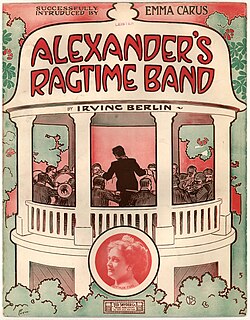
Fortunately for Berlin, vaudeville singer and baritone Emma Carus liked his humorous composition, and she introduced the song on April 18, 1911, at the American Music Hall in Chicago.[11] She next embarked on a tour of the Midwest in Spring 1911.[11] Carus showcased the song to the country and helped contribute to its immense popularity.[1] In gratitude, Berlin credited Carus on the cover of the sheet music.[1] The catchy song became linked with Carus in the public consciousness, although rival performers such as Al Jolson later co-opted the hit tune.[29]

Amid the success of Carus' national tour, the comedic duo of Arthur Collins and Byron G. Harlan released a phonograph recording of the song on May 23, 1911, which became the best-selling record in the United States for ten consecutive weeks.[4] Five days later, Berlin performed the song himself on May 28, 1911, in a special charity performance of the first Friars Frolic by the New York Friars Club at the New Amsterdam Theater.[30] A fellow composer in attendance, George M. Cohan, instantly recognized the catchiness of the tune and told Berlin that the song would be a hit.[31] Berlin's jaunty melody "sold a million copies of sheet music in 1911, then another million in 1912, and continued to sell for years afterwards."[1] Alexander's Ragtime Band became "the number one song from October 1911 through January 1912."[1]
Cultural sensation
In a few days, 'Alexander's Ragtime Band' will be whistled on the streets and played in the cafés. It is the most meritorious addition to the list of popular songs introduced this season. The vivacious comedienne [Emma Carus] had her audience singing the choruses with her, and those who did not sing, whistled.
Although neither Irving Berlin's first commercial hit nor his first composition to attract international attention, "Alexander's Ragtime Band" nevertheless catapulted Berlin's career.[6] American newspapers hailed Berlin's jumpy tune as the decade's musical sensation,[32] and he became a cultural luminary overnight.[18] An adoring international press touted him as the "King of Ragtime",[33] an inaccurate title as the song "had little to do with ragtime and everything to do with ragtime audacity, alerting Europe to hot times in the colonies."[34]
Baffled by this new title, Berlin insisted that he did not originate ragtime but merely "crystallized it and brought it to people's attention."[35] Historian Mark Sullivan claimed that, with the auspicious debut of "Alexander's Ragtime Band", Berlin "lifted ragtime from the depths of sordid dives to the apotheosis of fashionable vogue."[36]
Although not a traditional ragtime song,[7] Berlin's jaunty composition kickstarted a ragtime jubilee—a belated popular celebration of the musical style which African-American composers such as Scott Joplin had originated a decade earlier in the 1890s.[c] The positive international reception of "Alexander's Ragtime Band" in 1911 led to a musical and dance revival known as "the ragtime craze".[13]

At the time, ragtime music caught "its second wind" and ragtime dancing spread "like wildfire."[37] One dancing couple in particular who exemplified this faddish sensation were Vernon and Irene Castle.[38] The charismatic, trendsetting duo frequently danced to Berlin's "Alexander's Ragtime Band" and his other modernist compositions.[26] The Castles' modern dancing paired with Berlin's modern songs came to embody the ongoing culture clash between the waning propriety of the Edwardian era and the waxing joviality of the Ragtime revolution on the eve of World War I.[39] The Daily Express wrote in 1913 that:
In every London restaurant, park and theater, you hear [Berlin's] strains; Paris dances to it; Vienna has forsaken the waltz; Madrid has flung away her castanets, and Venice has forgotten her barcarolles. Ragtime has swept like a whirlwind over the earth.[40]
Writers such as Edward Jablonski and Ian Whitcomb have emphasized the irony that, in the 1910s, even the upper class of the Russian Empire—a reactionary nation from which Berlin's Jewish forebears had been compelled to flee decades earlier[41]—became enamored with "the ragtime beat with an abandon bordering on mania."[42] British socialite Lady Diana Cooper described Prince Felix Yusupov, an affluent Russian aristocrat who married the niece of Tsar Nicholas II and murdered Grigori Rasputin, as dancing "around the ballroom like a demented worm" and shouting, "More ragtime!"[41]
Hearing of such behavior, commentators diagnosed such individuals as "bitten by the ragtime bug" and behaving like "a dog with rabies."[43] They declared that "whether [the ragtime mania] is simply a passing phase of our decadent culture or an infectious disease which has come to stay, like la grippe or leprosy, time alone can show."[44]
Continued popularity

As the years passed, Berlin's "Alexander's Ragtime Band" had many recurrent manifestations as many artists covered it: Billy Murray, in 1912;[45] Bessie Smith, in 1927;[18] Oswald the Lucky Rabbit, in 1930;[46] the Boswell Sisters, in 1934;[15] Louis Armstrong, in 1937;[18] Bing Crosby and Connee Boswell, in 1938;[18] Johnny Mercer, in 1945;[18] Al Jolson, in 1947;[18] Nellie Lutcher, in 1948, and Ray Charles in 1959.[18] "Alexander's Ragtime Band" had a dozen hit covers within the half-century prior to 1960.[18]
Reflecting decades later upon the song's unlikely success, Berlin confessed his amazement at its immediate global acclaim and continued popularity.[47] He ascribed its unexpected success to the farcical lyrics which were "fundamentally right" and "started the heels and shoulders of all America and a good section of Europe to rocking."[47]
In 1937, 20th Century Fox approached Irving Berlin to write a story treatment for an upcoming film tentatively titled Alexander's Ragtime Band.[48] Berlin agreed to write a story outline for the film which featured twenty-six of Berlin's well-known musical scores.[49]
During press interviews promoting the film prior to its premiere, Berlin decried articles by the American press that painted ragtime as jazz's forerunner.[50] Berlin stated: "Ragtime really shouldn't be called 'the forerunner of jazz' or 'the father of jazz' because, as everyone will tell when they hear some of the old rags, ragtime and jazz are the same."[50]
Released on August 5, 1938, Alexander's Ragtime Band, starring Tyrone Power, Alice Faye, and Don Ameche became a smash hit and grossed in excess of $5 million.[51] After the film's release, writer Marie Cooper Dieckhaus sued Berlin for plagiarism.[52] At the trial, she argued that Berlin had taken the plot of her unpublished 1937 manuscript and reused many of its elements in the film.[53] She had circulated the manuscript in 1937 to various Hollywood studios, literary agents, and other individuals for their perusal.[52] The judge ruled that Berlin, after rejecting her manuscript, appropriated her work.[52] In 1946, an appellate court reversed the ruling on appeal.[54]
Alleged plagiarism

Allegations exist that Berlin purloined the melody for "Alexander's Ragtime Band", in particular, the four notes of "oh, ma honey", from drafts of "Mayflower Rag" and "A Real Slow Drag" by prolific composer Scott Joplin.[55] Berlin and Joplin knew each other in New York, and Berlin had opportunities to hear Joplin's scores prior to publication.[56] At the time, "one of Berlin's functions at the Ted Snyder Music Company was to be on the lookout for publishable music by other composers."[56] Berlin allegedly "heard Joplin's music in one of the offices, played by a staff musician (since Berlin could not read music) or by Joplin himself."[56] According to one account:
Joplin took some music to Irving Berlin, and Berlin kept it for some time. Joplin went back and Berlin said he couldn't use [the song]. When "Alexander's Ragtime Band" came out, Joplin said, "That's my tune."[45]
Joplin's widow claimed that, "after Scott had finished writing Treemonisha, and while he was showing it around, hoping to get it published, [Berlin] stole the theme, and made it into a popular song. The number was quite a hit, too, but that didn't do Scott any good."[45] A relative of John Stillwell Stark, Joplin's music publisher, asserted "the publication of 'Alexander's Ragtime Band' brought Joplin to tears because it was his [own] composition."[45] Joplin died bankrupt after undertaking the financial burden of his unsuccessful Treemonisha opera and was buried in a pauper's grave (remaining unmarked for 57 years) in Queens, New York, on April 1, 1917.[57] As writer Edward A. Berlin notes in King of Ragtime: Scott Joplin and His Era:
There were also rumors heard throughout Tin Pan Alley to the effect that Alexander's Ragtime Band had actually been written by a black man, and even a quarter-century later [composer] W.C. Handy told an audience that "Irving Berlin got all his ideas and most of his music from the late Scott Joplin." Berlin was aware of the rumors and addressed the issue in a magazine interview in 1916.[58]
For the next half-century, Berlin was angered by the allegation that a "'black boy' [sic] had written 'Alexander's Ragtime Band'."[59] Responding to his detractors, Berlin stated: "If a negro could write 'Alexander,' why couldn't I? ... If they could produce the negro and he had another hit like 'Alexander' in his system, I would choke it out of him and give him twenty thousands dollars in the bargain."[60] In 1914, Berlin may have alluded to the allegation in a Peerless Quartet recording of his composition "He's A Rag Picker."[59] The recording features a spoken line by Arthur Collins, possibly suggested by Berlin, in which a black character named Mose claims authorship of "Alexander's Ragtime Band."[61]
Lyrical implications
Although the 1911 sheet music cover drawn by artist John Frew depicts the band's musicians as either white or biracial,[2] Berlin's "Alexander's Ragtime Band" and his earlier 1910 composition "Alexander and His Clarinet" employ certain idiomatic expressions ("oh, ma honey", "honey lamb") and vernacular English ("bestest band what am") in the lyrics to indicate to the listener that the characters in the song should be understood to be African-American.[62] For example, an often-omitted second verse identifies the race of Alexander's clarinet player as an African-American:[63]
- There's a fiddle with notes that screeches
- Like a chicken—like a chicken—
- And the clarinet is a colored pet.[64]
Sheet music

 Page 1
 Page 2
 Page 3
 Page 4
 Page 5


Recorded versions
| Release | Performer | Vocalist | Recording date | Album | Label | Source |
|---|---|---|---|---|---|---|
| 1911 | Collins & Harlan | Arthur Collins & Byron G. Harlan | May 23, 1911 | The Oceana Roll/Alexander’s Ragtime Band (Single) | [65] | |
| 1927 | Bessie Smith and Her Blue Boys | Bessie Smith | March 2, 1927 | (Single) | Columbia Records | |
| 1935 | The Boswell Sisters | The Boswell Sisters | 1935 | (Single) | ||
| 1936 | Benny Goodman & His Orchestra | instrumental | October 7, 1936 | (Single) | [66] | |
| 1937 | Louis Armstrong & His Orchestra | Louis Armstrong | 1937 | (Single) | ||
| 1938 | Bing Crosby & Connie Boswell with Victor Young & His Orchestra | Bing Crosby & Connie Boswell | January 26, 1938 | (Single) | ||
| 1948 | The Andrews Sisters with Vic Schoen & His Orchestra | The Andrews Sisters | May 1948 | Irving Berlin Songs | Decca | |
| 1958 | Ella Fitzgerald | Ella Fitzgerald | March 19, 1958 | Ella Fitzgerald Sings the Irving Berlin Song Book | Verve | |
| 1959 | Ray Charles | Ray Charles | June 23, 1959 | The Genius of Ray Charles | Atlantic | |
| 1962 | King Curtis | instrumental | February 15, 1962 | Doing the Dixie Twist | Tru-Sound | |
| 1967 | Julie London | Julie London | 1967 | With Body & Soul | Liberty | |
| 1973 | Smacka Fitzgibbon | Smacka Fitzgibbon | August 1973 | Smacka's Party Album | ||
