Alyssoides
Species of plant
From Wikipedia, the free encyclopedia
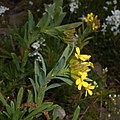
Alyssoides is a genus of flowering plants in the family Brassicaceae containing a single species, Alyssoides utriculata. A herbaceous perennial plant native to Southern Europe and Turkey, it grows on dry rocky slopes and on calcareous rocks, reaching heights of 20 to 50 cm and blooming with yellow flowers between April and May–July.[2]

| Alyssoides | |
|---|---|
| |
Scientific classification  | |
| Kingdom: | Plantae |
| Clade: | Tracheophytes |
| Clade: | Angiosperms |
| Clade: | Eudicots |
| Clade: | Rosids |
| Order: | Brassicales |
| Family: | Brassicaceae |
| Genus: | Alyssoides Mill. |
| Species: | A. utriculata |
| Binomial name | |
| Alyssoides utriculata | |
| Synonyms[1] | |
| |
The genus formerly contained a second species, Alyssoides cretica, but after molecular phylogenetic studies from 2008 and 2013 it was reassigned to the genus Lutzia.[3]
There are two subspecies: the A. utricalata subsp. utriculata, and A. utriculata subsp. bulgarica,[1] which characteristically differ by the pattern and shape of their hairs.[4]
Alyssoides utriculata is used as an ornamental plant and in gardening may be referred to as inflated bladderseed [5] or as (Greek) bladderpod[6] (not to be confused with other plants named bladderpod).
Distribution
The plant's distribution ranges from southern France to Turkey. It is found in the Massif Central of France, the Western Alps, the Apennines of Italy, the Dinaric Alps of Croatia, Bosnia and Herzegovina, Montenegro, and Albania;[7] in western Kosovo, in Serbia (the Tara and Rtanj mountains among others),[8] in the south of North Macedonia,[7] in Greece (from low elevations up to 2200(-2500) m; relatively common in the north-east, in more isolated locations in the north (Vourinos, Vermion, Olympus, and a few localities in Pindus) and the central areas (Pentelikon, Parnis, Parnassus and Giona)),[4] in Bulgaria (at elevations of 50–1900 m in Stara Planina, the Rhodopes, Strandzha and the southwest),[9] southwestern Romania,[7] and northern Anatolia.[10]
Gallery
 Botanical illustration
 Inflorescence
 Fruits
.png)


