Behrend's theorem
From Wikipedia, the free encyclopedia
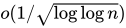
In arithmetic combinatorics, Behrend's theorem states that the subsets of the integers from 1 to in which no member of the set is a multiple of any other must have a logarithmic density that goes to zero as becomes large. The theorem is named after Felix Behrend, who published it in 1935.

The logarithmic density of a set of integers from 1 to can be defined by setting the weight of each integer to be , and dividing the total weight of the set by the th partial sum of the harmonic series (or, equivalently for the purposes of asymptotic analysis, dividing by ). The resulting number is 1 or close to 1 when the set includes all of the integers in that range, but smaller when many integers are missing, and particularly when the missing integers are themselves small.[1]


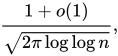
A subset of is called primitive if it has the property that no subset element is a multiple of any other element. Behrend's theorem states that the logarithmic density of any primitive subset must be small. More precisely, the logarithmic density of such a set must be .[1]

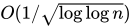
For infinite primitive sequences, the maximum possible density is smaller, .[2]