Belevitch's theorem
From Wikipedia, the free encyclopedia
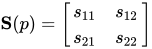
Belevitch's theorem is a theorem in electrical network analysis due to the Russo-Belgian mathematician Vitold Belevitch (1921–1999). The theorem provides a test for a given S-matrix to determine whether or not it can be constructed as a lossless rational two-port network.
Lossless implies that the network contains only inductances and capacitances – no resistances. Rational (meaning the driving point impedance Z(p) is a rational function of p) implies that the network consists solely of discrete elements (inductors and capacitors only – no distributed elements).