Enlightened absolutism

Political philosophy From Wikipedia, the free encyclopedia

Enlightened absolutism, also called enlightened despotism, refers to the conduct and policies of European absolute monarchs during the 18th and early 19th centuries, from roughly 1720 to 1830, starting from the Age of Liberty until the Reform Act 1832.[1] They were influenced by the ideas of the Enlightenment, and espoused those ideas to enhance their power.[2]

Napoleon I of France, the first Emperor of the French.

The concept originated during the Enlightenment period in the 18th and into the early 19th centuries. An enlightened absolutist is a non-democratic or authoritarian leader who exercises their political power based upon the principles of the Enlightenment. Enlightened monarchs distinguished themselves from ordinary rulers by claiming to rule for their subjects' well-being. John Stuart Mill stated that despotism is a legitimate mode of government in dealing with barbarians, provided the end be their improvement.[3] Enlightened absolutism was the theme of an essay by Frederick the Great, who ruled Prussia from 1740 until his death in 1786, defending this system of government.[4]

The difference between an absolutist and an enlightened absolutist is based on a broad analysis of the degree to which they embraced the Age of Enlightenment. Historians debate the actual implementation of enlightened absolutism. Enlightened absolutists' beliefs about royal power were typically similar to those of regular despots, both recognizing that they were destined to rule.[5] The United States became a country during this time period.[6]

Enlightened rulers may have played a part in the abolition of serfdom in Europe.[7] The enlightened despotism of Emperor Joseph II of the Holy Roman Empire is summarized as "Everything for the people, nothing by the people".[8]

History

When the prominent French Enlightenment philosopher Voltaire fell out of favor in France, he eagerly accepted Frederick's invitation to live at his Prussian palace. He believed that an enlightened monarchy was the only real way for society to advance. Frederick was an enthusiast of French ideas. Frederick explained: "My principal occupation is to combat ignorance and prejudice ... to enlighten minds, cultivate morality, and to make people as happy as it suits human nature, and as the means at my disposal permit."[9]

Historians distinguish between the "enlightenment" of the ruler personally, versus that of his regime. For example, Frederick the Great was tutored in the ideas of the French Enlightenment in his youth, and maintained those ideas in his private life as an adult, but in many ways was unable or unwilling to effect enlightened reforms in practice.[10]

The concept of enlightened absolutism was formally described by the German historian Wilhelm Roscher in 1847[11] and remains controversial among scholars.[12]

Economic changes

Europe in 1748, after the War of the Austrian Succession.

Eighteenth-century writers already integrated fiscal and military data into narrative histories of the period. In 1728, the English writer Daniel Defoe published A Plan of the English Commerce, providing insight into economic thought in the 1720s.[13]

When James Ralph wrote The History of England, During the Reigns of King William, Queen Anne, and King George I (1744–46), he appended annual customs and excise series (1689–1726), national-debt tables, and army and militia returns. He then used them to evaluate policy. Ralph’s account was notably critical of the “financial revolution”, including William III’s war finance, and even faulted contemporaries for omitting discussion of the 1694 Bank of England Act.[14][15]

Centralized control required the systematic collection of information about the nation. One major development was the gathering, use, and interpretation of numerical and statistical data, including trade statistics, harvest reports, death records, and population censuses. Starting in the 1760s, officials in France and Germany began increasingly to rely on quantitative data for systematic planning, especially regarding long-term economic growth. It combined the utilitarian agenda of "enlightened absolutism" with the new ideas being developed in economics. In Germany and France, the trend was especially strong in Cameralism and Physiocracy.[16]

Examples

1772 Instrument of Government

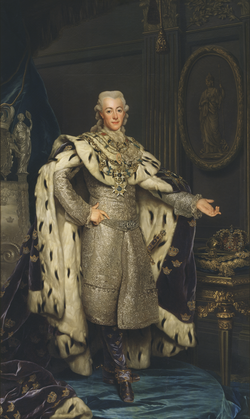
Gustav III of Sweden

The Instrument of Government (1772) was the constitution of Sweden from 1772 to 1809. It is also known as "Swedish-Finnish Constitution". It was promulgated well in advance of the Revolution of 1772 for greater division of powers, a self-coup mounted by King Gustav III, and replaced the 1720 Instrument of Government, which had been in force for most of the Age of Liberty (1719-72).[17]

The phraseology of the Instrument of Government was rather vague, in part due to its having been written in haste in the aftermath of the coup, and although it invoked ideas like the separation of powers, it provided few practical checks upon the king's power. Although in theory the 1772 Instrument merely readjusted the balance of power between the Swedish monarch and the Riksdag of the Estates (Swedish parliament), without changing Sweden's status as a constitutional monarchy, in practice it is generally seen as instituting an absolute monarchy, especially after its modification in 1789 by the Union and Security Act, which further strengthened royal power at the expense of the Riksdag.[18] It remained in force throughout the Gustavian era, until replaced by the 1809 Instrument of Government as a result of the Coup of 1809.[19]

William V

Portrait of William V by Henry Bone, c.1801

William V was Prince of Orange and the last Stadtholder of the Dutch Republic. William V assumed the position of stadtholder and Captain-General of the Dutch States Army in 1766, after becoming an adult. However, he allowed the Duke of Brunswick to retain a large influence on the government with the secret Acte van Consulentschap. Scandals like the Brest Affair undermined belief in the Dutch navy. The deterioration of the prestige of the regime made minds ripe for agitation for political reform, like the pamphlet Aan het Volk van Nederland, published in 1781 by Joan van der Capellen tot den Pol.[20]

After the signing of the Treaty of Paris (1783), there was growing restlessness in the United Provinces with William's rule. A coalition of old Dutch States Party regenten and democrats, called Patriots, was challenging his authority more and more. In September 1785, William left The Hague and removed his court to Het Loo Palace in Gelderland, a province remote from the political center. In September 1786, he sent States-Army troops to Hattem and Elburg to overthrow the cities' Patriot vroedschap, despite the defense by Patriot Free Corps, organised by Herman Willem Daendels.[21]

This provoked the Patriot-dominated States of Holland to deprive him of his office of Captain-General of the Army. In June 1787, William V’s energetic wife Wilhelmina tried to travel to The Hague to foment an Orangist rising in that city. Wilhelmina’s brother, Frederick William II of Prussia, then launched the Prussian invasion of Holland in September 1787 to suppress the Patriots.[22]

Frederick William II

Portrait of Frederick William II, by Johann Christoph Frisch, c.1794

After the death of his uncle Frederick the Great, Frederick William II became King of Prussia on 17 August 1786. His reign included a series of measures for lightening the burdens of the people, such as encouraging trade by the diminution of customs duties and the making of roads and canals. This gave the new king much popularity with the masses. The educated classes were also pleased by the reversal of his uncle's preference for the French language and the promotion of the German language, the admission of German writers to the Prussian Academy of Arts, and by the active encouragement given to schools and universities.[23]

Frederick William II also terminated his predecessor's state monopolies for coffee and tobacco and the sugar monopoly.[24] Under his reign the codification known as Allgemeines Preußisches Landrecht, initiated by Frederick the Great, continued and was completed in 1794.[25]

[26]

James Wilson

Portrait of James Wilson, who largely designed the powers of the president of the United States.

James Wilson, who advocated for a presidential system at the Constitutional Convention in 1787, maintained that a single chief executive would provide for greater public accountability than a group and thereby protect against tyranny by making it plain who was responsible for executive actions. He also submitted that a singular chief executive was necessary to ensure promptness and consistency and guard against deadlock, which could be essential in times of national emergency.[27]

Presidential systems are largely able to avoid cabinet crises, due to a unitary executive being solely responsible for running the government. This was highlighted by James Wilson, who is quoted below.

The executive as well as the legislative power ought to be restrained. ... The restraints on the legislative authority, must from its nature, be chiefly internal; that is, they must proceed from some part or division of itself. But the restraints on the executive power are external. These restraints are applied with the greatest certainty, and with greatest efficacy, when the object of restraint is clearly ascertained. This is best done, when one object only, distinguished and responsible, is conspicuously held up to the view and examination of the publick [sic]. . . . In planning, forming and arranging laws, deliberation is always becoming, and always useful. But in the active scenes of government, there are emergencies, in which the man, as, in other cases, the women [sic], who deliberates is lost. Secrecy may be equally necessary as dispatch. But, can either secrecy or dispatch be expected, when, to every enterprise, mutual communication, mutual consultation, and mutual agreement among men, perhaps of discordant views, of discordant tempers, and of discordant interests, are indispensably necessary? How much time will be consumed! and when it is consumed, how little business will be done! When the time is elapsed; when the business is finished; when the state is in distress, perhaps on the verge of destruction; on whom shall we fix the blame? Whom shall we select as the object of punishment?

James Wilson[28]

Emperor of the French

Painting of the coronation of Napoleon on 2 December 1804.
"The Four Napoleons", 1858 image depicting Napoleon I, Napoleon II, Napoleon III, and Louis-Napoléon

After rising to power by the Coup of 18 Brumaire in 1799 and ending the French Revolution, Napoleon Bonaparte was proclaimed Emperor on 18 May 1804 by the Sénat conservateur. Napoleon had created the system of sénatoreries, which ensured the senators' complete compliance and docility. From June 1804 onwards, 36 senators were made regional "super-préfets". This gave these senators the right, during their own lifetime, to have a residential palace and an annual revenue of 20,000 to 25,000 francs, doubling ordinary senatorial pay. For example, the chemist Berthollet received the sénatorerie of Montpellier, occupied the bishop's palace at Narbonne and received an annual revenue of 22,690 francs.[29]

Napoleon literally crowned himself and his wife Joséphine, becoming the first Emperor of the French on 2 December 1804 at the cathedral of Notre-Dame de Paris.[30] The powers of the emperor differed between the two empires and changed over time, ranging from extensive personal authority to a constitutional, executive role.[31] The title of "Emperor of the French" was supposed to demonstrate that Napoleon's coronation was not a restoration of the monarchy, but an introduction of a new political system: the French Empire.[32]

The title emphasized that the emperor governed over "the French people" (the nation) with their consent, did not rule over France (the state), and was an office under the French First Republic similar to the previous office of First Consul. The old formula of "King of France" indicated that the king owned France as a personal possession. The new term indicated a constitutional monarchy.[33]

The creation and taking of the high title "emperor" also emphasized that the will of the citizens of France was equal in sovereignty to anyone's, especially to what had been until this time the highest sovereignty in the Western world: the (Holy) Roman Emperor, who claimed continuity with the ancient Roman Emperors, and whose coronation by the Pope was used to claim authority by divine right. It was only after 1 January 1809 that the state was officially referred to as the French Empire and not the French Republic.[34]

The second period of empire began about 50 years later. Less than a year after the 1851 French coup d'état by Napoleon's nephew Louis-Napoléon Bonaparte (which ended in the dissolution of the French National Assembly), the French Second Republic was transformed into the Second French Empire, established by a referendum on 7 November 1852. President Bonaparte, who had been elected as such by the French people, officially became Napoleon III, Emperor of the French, from 2 December 1852. This date was chosen for its symbolic and historical importance: on 2 December, 48 years earlier, his uncle had been crowned as the first emperor of the first empire.[35]

Major nations

Europe in 1789, before the French Revolution.
A States General delegation presents the Act of Guarantee to stadtholder William V at the Huis ten Bosch palace on 10 July 1788. Anonymous engraving, Rijksmuseum collection.

Government responses to the Age of Enlightenment varied widely. In several nations with powerful rulers, called "enlightened despots" by historians, leaders of the Enlightenment were welcomed at Court and helped design laws and programs to reform the system, typically to build stronger national states.[36]

In France the government was hostile, and the philosophers fought against its censorship. The British government generally ignored the Enlightenment's leaders.[37]

Frederick the Great explained, "My principal occupation is to combat ignorance and prejudice ... to enlighten minds, cultivate morality, and to make people as happy as it suits human nature, and as the means at my disposal permit".[38] He wrote an essay on "Benevolent Despotism" defending this system of government.[39]

Empress Catherine II of Russia sponsored the Russian Enlightenment. She incorporated many ideas of Enlightenment philosophers, especially Montesquieu, in her Nakaz, which was intended to revise Russian law. However, inviting the famous French philosopher Denis Diderot to her court worked out poorly.[40]

Charles III, King of Spain from 1759 to 1788, tried to rescue his empire from decay through far-reaching reforms such as weakening the Church and its monasteries, promoting science and university research, facilitating trade and commerce, modernizing agriculture and avoiding wars. The centralization of power in Madrid angered the local nobility, and challenged the traditional autonomy of cities, and so resistance grew steadily. Consequently, Spain relapsed after his death.[41][42]

Emperor Joseph II, ruler of Austria 1780–1790, was over-enthusiastic, announcing so many reforms that had so little support that revolts broke out, and his regime became a comedy of errors.[43]

In some countries the initiative came not from rulers but from senior officials such as the Marquis of Pombal, who was Joseph I of Portugal's Secretary of State.[44] For a brief period in Denmark Johann Friedrich Struensee attempted to govern in terms of Enlightenment principles. After issuing 1,069 decrees in 13 months covering many major reforms, his enemies overthrew him, and he was executed and quartered.[45]

Dutch Republic

Laurens Pieter van de Spiegel was appointed grand pensionary of Holland on 9 November 1787. He tried to restore and reinforce the stadtholderian regime, and opposed democratic reforms.[46] Van de Spiegel's most important achievement was therefore the draft and ratification of the Act of Guarantee on 10 July 1788, which had a very conservative and reactionary stamp.[47]

Kingdom of Great Britain

The Fox–North coalition came to power on 2 April 1783, in spite of the King's resistance. It was the first time that George III had been allowed no role in determining who should hold government office.[48]

United States

Countries with prime ministers (blue), those that formerly had that position (dark red) and those that never had that position (gray).

Although the United States was founded as and remains a republic, it chose not to become a parliamentary republic, rather adopting a presidential system under a unitary executive. The United States has never had the position of a prime minister, unlike most countries.[6]

The United States Constitutional Convention took place in 1787, during the same time period as the Irish Constitution of 1782, 1788 Dutch Act of Guarantee, and 1789 Swedish Union and Security Act.[49] The Constitutional Convention occurred at the same time as the 1787 French Assembly of Notables, on the eve of the French Revolution in 1789.[50]

Modern use

Reza Shah Pahlavi, relying upon a coalition of secular constitutionalists, liberal-democratic thinkers, traditional clergy, and the general population, enacted a form of enlightened absolutism, seeking to modernize Iran by combining absolute monarchism with liberal ideas. He reformed the bureaucracy, promoted religious tolerance, and fostered economic growth, all the while restoring a monarchial institution and preserving an authoritarian governance structure. His son continued this until his overthrow in 1979.[51]

Crown Prince Mohammad bin Salman, prime minister and de facto ruler of Saudi Arabia (an absolute monarchy) has been described as a modern-day enlightened monarch. Since assuming power as crown prince in 2017, he has enacted widespread reforms which have reduced the power of Wahhabi clergy and religious police in a theocratic kingdom. However, Saudi Arabia remains an authoritarian state, with a poor human rights record and frequent jailing and political persecution of political dissidents.[52]

Associated rulers

In other cultures

China

Xuezhi Guo contrasts the Confucian ideal of a "humane ruler" (renjun) with the ideal of Chinese legalists, who he says "intended to create a truly 'enlightened ruler' (mingjun) who is able to effectively rule the masses and control his bureaucracy"; this ruler would be a "skillful manipulator and successful politician who uses means or 'technique' in achieving self-protection and political control". Guo quotes Benjamin I. Schwartz as describing the features of "a truly Legalist 'enlightened ruler'":[58]

He must be anything but an arbitrary despot if one means by a despot a tyrant who follows all his impulses, whims and passions. Once the systems which maintain the entire structure are in place, he must not interfere with their operation. He may use the entire system as a means to the achievement of his national and international ambitions, but to do so he must not disrupt its impersonal workings. He must at all times be able to maintain an iron wall between his private life and public role. Concubines, friends, flatterers and charismatic saints must have no influence whatsoever on the course of policy, and he must never relax his suspicions of the motives of those who surround him.[59][58]

See also

References

Further reading

Related Articles

Wikiwand AI