Bioche's rules
From Wikipedia, the free encyclopedia
Bioche's rules, formulated by the French mathematician Charles Bioche (1859–1949), are rules to aid in the computation of certain indefinite integrals in which the integrand contains sines and cosines.
In the following, is a rational expression in and . In order to calculate , consider the integrand . We consider the behavior of this entire integrand, including the , under translation and reflections of the t axis. The translations and reflections are ones that correspond to the symmetries and periodicities of the basic trigonometric functions.


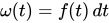

Bioche's rules state that:
- If , a good change of variables is .
- If , a good change of variables is .
- If , a good change of variables is .
- If two of the preceding relations both hold, a good change of variables is .
- In all other cases, use .
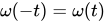






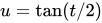
Because rules 1 and 2 involve flipping the t axis, they flip the sign of dt, and therefore the behavior of ω under these transformations differs from that of ƒ by a sign. Although the rules could be stated in terms of ƒ, stating them in terms of ω has a mnemonic advantage, which is that we choose the change of variables u(t) that has the same symmetry as ω.
These rules can be, in fact, stated as a theorem: one shows[1] that the proposed change of variable reduces (if the rule applies and if f is actually of the form ) to the integration of a rational function in a new variable, which can be calculated by partial fraction decomposition.
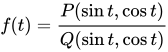
To calculate the integral , Bioche's rules apply as well.
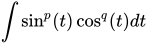
- If p and q are odd, one uses ;
- If p is odd and q even, one uses ;
- If p is even and q odd, one uses ;
- If not, one is reduced to lineariz.


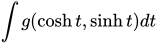
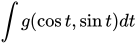




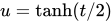








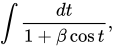

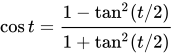
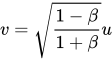
![{\displaystyle \int {\frac {\mathrm {d} t}{1+\beta \cos t}}={\frac {2}{\sqrt {1-\beta ^{2}}}}\arctan \left[{\sqrt {\frac {1-\beta }{1+\beta }}}\tan {\frac {t}{2}}\right]+c.}](https://wikimedia.org/api/rest_v1/media/math/render/svg/bf6d7dde57e6fdd84470f4cf2bdf815ac5e08506)
