Böttcher's equation
From Wikipedia, the free encyclopedia
Böttcher's equation, named after Lucjan Böttcher, is the functional equation

where
- h is a given analytic function with a superattracting fixed point of order n at a, (that is, in a neighbourhood of a), with n ≥ 2
- F is a sought function.

The logarithm of this functional equation amounts to Schröder's equation.
Solution
Solution of functional equation is a function in implicit form.
Lucian Emil Böttcher sketched a proof in 1904 on the existence of solution: an analytic function F in a neighborhood of the fixed point a, such that:[1]

This solution is sometimes called:
- the Böttcher coordinate
- the Böttcher function[2]
- the Boettcher map.
The complete proof was published by Joseph Ritt in 1920,[3] who was unaware of the original formulation.[4]
Böttcher's coordinate (the logarithm of the Schröder function) conjugates h(z) in a neighbourhood of the fixed point to the function zn. An especially important case is when h(z) is a polynomial of degree n, and a = ∞ .[5]
Explicit
One can explicitly compute Böttcher coordinates for:[6]
- power maps
- Chebyshev polynomials

Examples
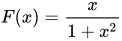
For the function h and n=2[7]
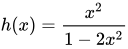
the Böttcher function F is:
Applications
Böttcher's equation plays a fundamental role in the part of holomorphic dynamics which studies iteration of polynomials of one complex variable.
Global properties of the Böttcher coordinate were studied by Fatou[8] [9] and Douady and Hubbard.[10]