Cantor's isomorphism theorem
From Wikipedia, the free encyclopedia
In order theory and model theory, branches of mathematics, Cantor's isomorphism theorem states that every two nonempty countable dense unbounded linear orders are order-isomorphic.
The theorem is named after Georg Cantor, who first published it in 1895, using it to characterize the (uncountable) ordering on the real numbers. It can be proved by a back-and-forth method that is also sometimes attributed to Cantor but was actually published later, by Felix Hausdorff. The same back-and-forth method also proves that countable dense unbounded orders are highly symmetric, and can be applied to other kinds of structures. However, Cantor's original proof only used the "going forth" half of this method. In terms of model theory, the isomorphism theorem can be expressed by saying that the first-order theory of unbounded dense linear orders is countably categorical, meaning that it has only one countable model, up to logical equivalence.
One application of Cantor's isomorphism theorem involves temporal logic, a method for using logic to reason about time. In this application, the theorem implies that it is sufficient to use intervals of rational numbers to model intervals of time: using irrational numbers for this purpose will not lead to any increase in logical power.

Cantor's isomorphism theorem is stated using the following concepts:
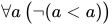
- A linear order or total order is defined by a set of elements and a comparison operation that gives an ordering to each pair of distinct elements and obeys the transitive law.[1][2] The familiar numeric orderings on the integers, rational numbers, and real numbers are all examples of linear orders.[2]
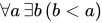
- Unboundedness means that the ordering does not contain a minimum or maximum element. This is different from the concept of a bounded set in a metric space. For instance, the open interval (0,1) is unbounded as an ordered set, even though it is bounded as a subset of the real numbers, because neither its infimum 0 nor its supremum 1 belong to the interval.[1] The integers, rationals, and reals are also unbounded.[2]
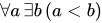
- An ordering is dense when every pair of elements has another element between them.[1] This is different from being a topologically dense set within the real numbers.[2] The rational numbers and real numbers are dense in this sense, as the arithmetic mean of any two numbers belongs to the same set and lies between them, but the integers are not dense because there is no other integer between any two consecutive integers.[3]
- The integers and rational numbers both form countable sets, but the real numbers do not, by a different result of Cantor, his proof that the real numbers are uncountable.[2]
- Two linear orders are order-isomorphic when there exists a one-to-one correspondence between them that preserves their ordering.[1][2] For instance, the integers and the even numbers are order-isomorphic, under a bijection that multiplies each integer by two.[3]
With these definitions in hand, Cantor's isomorphism theorem states that every two unbounded countable dense linear orders are order-isomorphic.[1]
Within the rational numbers, certain subsets are also countable, unbounded, and dense. The rational numbers in the open unit interval (0,1) are an example. Another example is the set of dyadic rational numbers, the numbers that can be expressed as a fraction with an integer numerator and a power of two as the denominator. By Cantor's isomorphism theorem, the dyadic rational numbers are order-isomorphic to the whole set of rational numbers. In this example, an explicit order isomorphism is provided by Minkowski's question-mark function.[4] Another example of a countable unbounded dense linear order is given by the set of real algebraic numbers, the real roots of polynomials with integer coefficients. In this case, they are a superset of the rational numbers, but are again order-isomorphic.[5] It is also possible to apply the theorem to other linear orders whose elements are not defined as numbers. For instance, the binary strings that end in a 1, in their lexicographic order, form another isomorphic ordering.[6]
Proofs
One proof of Cantor's isomorphism theorem, in some sources called "the standard proof",[7] uses the back-and-forth method. This proof builds up an isomorphism between any two given orders, using a greedy algorithm, in an ordering given by a countable enumeration of the two orderings. In more detail, the proof maintains two order-isomorphic finite subsets and of the two given orders, initially empty. It repeatedly increases the sizes of and by adding a new element from one order, the first missing element in its enumeration, and matching it with an order-equivalent element of the other order, proven to exist using the density and lack of endpoints of the order. The two orderings switch roles at each step: the proof finds the first missing element of the first order, adds it to , matches it with an element of the second order, and adds it to ; then it finds the first missing element of the second order, adds it to , matches it with an element of the first order, and adds it to , etc. Every element of each ordering is eventually matched with an order-equivalent element of the other ordering, so the two orderings are isomorphic.[8]


Although the back-and-forth method has also been attributed to Cantor, Cantor's original publication of this theorem in 1895–1897 used a different proof.[8] In an investigation of the history of this theorem by logician Charles L. Silver, the earliest instance of the back-and-forth proof found by Silver was in a 1914 textbook by Felix Hausdorff, his Grundzüge der Mengenlehre.[8]
Instead of building up order-isomorphic subsets and by going "back and forth" between the enumeration for the first order and the enumeration for the second order, Cantor's original proof only uses the "going forth" half of the back-and-forth method.[1] It repeatedly augments the two finite sets and by adding to the first missing element of the first order's enumeration, and adding to the order-equivalent element that is first in the second order's enumeration. This naturally finds an equivalence between the first ordering and a subset of the second ordering, and Cantor then argues that the entire second ordering is included.[1][8]
The back-and-forth proof has been formalized as a computer-verified proof using Rocq, an interactive theorem prover. This formalization process led to a strengthened result that when two computably enumerable linear orders have a computable comparison predicate, and computable functions representing their density and unboundedness properties, then the isomorphism between them is also computable.[9]