Introducing the transformation  gives
gives

Now, the equation is separable, thus

The denominator on the left hand side can be factorized if we solve the roots of the equation  and the roots are
 ![{\displaystyle a,\ b=\pm \left[B+{\sqrt {(2A+B)^{2}-16C}}\right]/2}](https://wikimedia.org/api/rest_v1/media/math/render/svg/1cfb127f366fa540577b8646f14480ac735d4e10) , therefore
, therefore

If  , the solution is
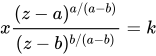
where  is an arbitrary constant. If
  , (
, ( ) then the solution is
![{\displaystyle x(z-a)\exp \left[{\frac {a}{a-z}}\right]=k.}](https://wikimedia.org/api/rest_v1/media/math/render/svg/5b7d10cb12c33ded6cf8ae24b1f17b11c78e56a5)
When one of the roots is zero, the equation reduces to a special-case of Clairaut's equation and a parabolic solution is obtained in this case,  and the solution is

The above family of parabolas are enveloped by the parabola 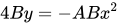 , therefore this enveloping parabola is a singular solution.



