Tanacetum balsamita
Species of herb
From Wikipedia, the free encyclopedia
Tanacetum balsamita is a perennial temperate herb known as costmary,[2] alecost,[3] balsam herb, bible leaf, or mint geranium.[3][4][5] A fragrant plant native to southern Europe and western Asia, it has been used over centuries for culinary, aromatic, and traditional medicine purposes.[4]

| Tanacetum balsamita | |
|---|---|
| |
Scientific classification  | |
| Kingdom: | Plantae |
| Clade: | Embryophytes |
| Clade: | Tracheophytes |
| Clade: | Angiosperms |
| Clade: | Eudicots |
| Clade: | Asterids |
| Order: | Asterales |
| Family: | Asteraceae |
| Genus: | Tanacetum |
| Species: | T. balsamita |
| Binomial name | |
| Tanacetum balsamita | |
| Synonyms[1] | |
| |

Description
Costmary is a perennial with oval serrated leaves and can grow up to 2 m (6.6 ft) high. During summer, it shows small, yellow, button-shaped blossoms which appear in clusters.[6]
Name
Origin and spread
The plant seems to have originated in the Mediterranean. Whether the plant called "balsamita" described by Columella in 70 AD is the same is unclear. Costmary was widely grown since the medieval times in herb gardens until the late 19th and early 20th centuries.[4] In the 21st century, it has mostly disappeared in Europe, but is still widely used in southwest Asia.[6] It is referred to by Nicholas Culpeper as the 'balsam herb'.[5]
Phytochemicals
Leaves contain carvone as the main phytochemical (about 50% of total), together with minor amounts of β-thujone and other carvone-related chemicals.[7][better source needed]
Traditional medicine
Gallery
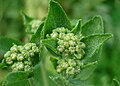 Flower clusters
 Leaves


