Crouzeix's conjecture
Theorem in matrix analysis
From Wikipedia, the free encyclopedia
Crouzeix's conjecture is a problem in matrix analysis proposed by Michel Crouzeix in 2004,[1] and it can be stated as follows:
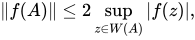
where the set is the field of values of a n×n (i.e. square) complex matrix and is a complex function that is analytic in the interior of and continuous up to the boundary of . Slightly reformulated, the conjecture can also be stated as follows: for all square complex matrices and all complex polynomials :


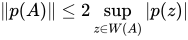
holds, where the norm on the left-hand side is the spectral operator 2-norm.
History
Crouzeix's theorem, proved in 2007, states that:[2]

(the constant is independent of the matrix dimension, thus transferable to infinite-dimensional settings).

Michel Crouzeix and Cesar Palencia proved in 2017 that the result holds for ,[3] improving the original constant of . More recently, dimension-dependent improvements have been obtained: Malman, Mashreghi, O'Loughlin and Ransford showed that for each fixed dimension there exists a constant such that the inequality holds for all matrices.[4]


Related work connects the constant in Crouzeix-type inequalities to configuration constants arising from the Neumann–Poincaré operator and yields domain-dependent improvements of the Crouzeix–Palencia bound in certain settings.[5]
The conjecture states that the constant can be refined to .

Special cases
Before the general case was resolved, the conjecture was shown to hold in several special cases. For instance, it holds for all normal matrices,[6] for tridiagonal 3×3 matrices with elliptic field of values centered at an eigenvalue[7] and for general n×n matrices that are nearly Jordan blocks.[6]. Furthermore, Anne Greenbaum and Michael L. Overton provided numerical support for Crouzeix's conjecture.[8]
Proof
On July 27, 2026, neurosurgeon Shanmu Jin posted a preprint claiming a proof of Crouzeix's conjecture.[9] Jin reported that the proof was obtained with the assistance of OpenAI's GPT-5.6 Sol, after which he checked the resulting argument.[10] Greenbaum and Alex Townsend reported that they and Crouzeix had thoroughly reviewed the proof and believed it to be correct.[10]
On August 4, 2026, Emiel Lorist and Felix Schwenninger posted an independent proof of the conjecture using a different argument.[10] They reported that GPT-5.6 in its Sol variant "was used to explore proof strategies for this note".[11]
