Dailekh District
District in Karnali Province, Nepal
From Wikipedia, the free encyclopedia
Dailekh District (Nepali: दैलेख जिल्ला pronounced [dʌi̯lekʰ] ⓘ) a part of Karnali Province, is one of the seventy-seven districts of Nepal. The district, with Dailekh as its district headquarters, covers an area of 1,502 km2 (580 sq mi) and had a population of 225,201 in 2001[2] and 261,770 in 2011.[3]

Dailekh District
दैलेख जिल्ला | |
|---|---|
View of fields in Guranshe | |
 Location of Dailekh District (dark yellow) in Karnali | |
| Coordinates: 28°50′15″N 81°42′28″E | |
| Country |  Nepal Nepal |
| Province | Karnali Province |
| Admin HQ. | Dailekh (Narayan) |
| Municipality | |
| Government | |
| • Type | Coordination committee |
| • Body | DCC, Dailekh |
| • Head | Mr. Prem Bahadur Thapa |
| • Parliamentary constituencies | 2 seats List
|
| • Provincial constituencies | 4 seats List
|
| Area | |
• Total | 1,505 km2 (581 sq mi) |
| Highest elevation | 4,168 m (13,675 ft) |
| Lowest elevation | 544 m (1,785 ft) |
| Population (2011)[1] | |
• Total | 260,855 |
| • Density | 173.3/km2 (448.9/sq mi) |
| Demographics | |
| • Ethnic groups | Chetri, Kami, Thakuri |
| • Female ♀ | 51% |
| Human Development Index | |
| • Literacy | 62% |
| Time zone | UTC+05:45 (NPT) |
| Postal Codes | 21600, 21602, 21603, 21604, 21605, 21607..., 21610 |
| Telephone Code | 089 |
| Main Language(s) | Nepali |
| Major highways | Mid-Hill (under cons.) |
| Website | ddcdailekh.gov.np |
Etymology
It is said that the name Dailekh is derived from Dadhi Lekh. Dadhi stands for Dadhichi. Dadhichi was a sage in ancient time and Lekh mean hill. Etymologically ‘Dadhi Lekh’ means the hill where sage Dadhichi meditated.[4][5] There is also another story about name that, in ancient time it was a place of Devatas, so it called "Daibalok" which later became 'Dailekh'.[4][5]
History
Dailekh District was a part of Khasa kingdom during 12th to 14th century.[6] Sinja Valley was the ancient capital city and powerful town of the Khasa Kingdom[7]: 76 [8] After the fall down of the Khasa Kingdom it divided into many small kingdoms. Before the unification of modern Nepal, the area of the Karnali region had a united kingdom named Baise Rajya (twenty-two principalities). Dailekh principality was one of twenty-two principalities.
Geography and climate
Dailekh is a high, hilly district out of ten districts of Karnali Province. It is situated at coordinates of 28° 35' 00" N to 29° 08' 00" N Latitudes and 81° 25' 00" E to 81° 53' 00" E of Longitudes. The lowest elevation is 544m and the highest elevation is 4,168m. The headquarter is situated at an elevation of 1448m. The district has covered 80% of mid-hill land and 21% of high-hill land. The total area of the district is 1,505 square kilometres (581 mi2).[5]
On the basis of altitude, this district can be classified into 4 different sub-categories:
| Climate Zone[9] | Elevation Range | % of Area |
|---|---|---|
| Upper Tropical | 300 to 1,000 meters 1,000 to 3,300 ft. |
16.7% |
| Subtropical | 1,000 to 2,000 meters 3,300 to 6,600 ft. |
64.5% |
| Temperate | 2,000 to 3,000 meters 6,400 to 9,800 ft. |
16.1% |
| Subalpine | 3,000 to 5,500 meters 9,800 to 18,044 ft. |
2.4% |
Transportation
Dailekh is connected with Birendranagar (the capital city of Karnali Province) with a road called Dailekh road (F-48). Dailekh road meets to Ratna Highway (NH-12) at Birendranagar (Surkhet). Ratna Highway is connected with Mahendra Highway (NH-1) at Kohalpur. Through Mahendra Highway one can get access to Kathmandu, Pokhara and other cities of Nepal.
There is another road connecting Dailekh to Karnali Highway (NH-13) via Dullu.
The national capital Kathmandu is at distance of 647.41 kilometres (402.28 mi) from Dailekh.
The nearest airport for Dailekh is Surkhet Airport which is about 70 kilometres (43 mi) at distance from Dailekh.
Demographics
| Census year | Pop. | ±% p.a. |
|---|---|---|
| 1981 | 166,527 | — |
| 1991 | 187,400 | +1.19% |
| 2001 | 225,201 | +1.85% |
| 2011 | 261,770 | +1.52% |
| 2021 | 253,319 | −0.33% |
 | ||
| Source: Citypopulation[10] | ||
At the time of the 2021 Nepal census, Dailekh District had a population of 252,313. 10.62% of the population is under 5 years of age. It has a literacy rate of 75.50% and a sex ratio of 1089 females per 1000 males. 122,905 (48.71%) lived in municipalities.[11]
Khas people make up a majority of the population with 88% of the population, while Khas Dalits make up 28% of the population. Hill Janjatis make up 11% of the population, of which Magars are 9% of the population.[12]
- Nepali (95.9%)
- Magar Dhut (2.96%)
- Others (1.14%)
At the time of the 2021 census, 95.90% of the population spoke Nepali and 2.96% Magar Dhut as their first language.[13] In 2011, 97.9% of the population spoke Nepali as their first language.[14]
Constituency
Dailekh comprises 2 parliamentary seats and 4 provincial seats:
| Constituency | Area | Seat | MP/MLA | Party |
|---|---|---|---|---|
| Dailekh 1 | ||||
| Dailekh 2 | ||||
| Dailekh 1(A) | ||||
| Dailekh 1(B) | ||||
| Dailekh 2(A) | ||||
| Dailekh 2(B) |
Divisions of Dailekh
As per the new constitution of Nepal 2015, the district is divided into 4 urban municipalities and 7 rural municipality;
| # | Municipality | Type | Area | Population | Website |
|---|---|---|---|---|---|
| 1 | Narayan | Urban | 110.63 | 27,037 | narayanmun |
| 2 | Dullu | Urban | 156.77 | 41,540 | dullumun |
| 3 | Aathbis | Urban | 168 | 29,227 | aathbismun |
| 4 | Chamunda Bindrasaini | Urban | 90.6 | 26,149 | chamundabindrasainimun |
| 5 | Thantikandh | Rural | 88.22 | 18,896 | thantikandhmun |
| 6 | Bhairabi | Rural | 110.46 | 21,233 | bhairabimun |
| 7 | Mahabu | Rural | 110.8 | 19,277 | mahabumun |
| 8 | Naumule | Rural | 228.59 | 20,802 | naumulemun |
| 9 | Dungeshwar | Rural | 105.19 | 15,890 | dungeshwormun |
| 10 | Gurans | Rural | 164.79 | 22,033 | guransmun |
| 11 | Bhagawatimai | Rural | 151.52 | 18,778 | bhagawatimaimun |
| Dailekh | District | 1505 | 260,862 | ddcdailekh |
Former VDCs and Municipalities
Gallery
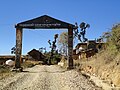 An entrance gate to Dailekh District in Ranimatta Mid-western Nepal
 Aerial view of Dailekh District (Mid Western Nepal) on the way to Surkhet from Humla
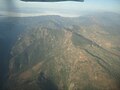 Aerial view of Dailekh District (Mid Western Nepal) on the way to Surkhet from Humla
 River Karnali, an aerial view of Dailekh District (Mid Western Nepal) on the way to Surkhet from Humla


See also
- Zones of Nepal
- "Districts of Nepal". Statoids.
