Drabsha
Symbol of Mandaeism
From Wikipedia, the free encyclopedia
The drabsha[1][2] (Classical Mandaic: ࡃࡓࡀࡁࡔࡀ, romanized: drabša; Modern Mandaic: drafšā[3]) or darfash (Persian: درفش) is the symbol of the Mandaean faith. It is typically translated as 'banner'.[4]

Etymology
The Mandaic term drabša is derived from the Middle Persian word drafš, which means 'banner or standard; a flash of light; sunrise'. In Mandaic, drabša can also mean 'a ray or beam of light'.[5]
An uncommon variant spelling is drapša, which may have been the original spelling.[6]
Description and symbolism
The drabša is a banner in the shape of a cross made of two branches of olive wood fastened together and half covered with a piece of white cloth traditionally made of pure silk, and seven branches of myrtle. The drabša white silk banner is not identified with the Christian cross. Instead, the four arms of the drabsha symbolize the four corners of the universe, while the pure silk cloth represents the Light of God (Hayyi Rabbi).[7] The seven branches of myrtle represent the seven days of creation.[8][9] The drabsha is viewed as a symbol of light and the light of the sun, moon and stars is envisaged to shine from it.[10] It may be of pre-Christian origin and used originally to hang a prayer shawl during immersion in the river (masbuta).[10]
In Mandaean manuscripts
Mandaean manuscripts often contain descriptions and illustrations of named drabšia. The most common names for drabšia are Shishlameil, Shishlam, and Bihram. The following drabšia names are mentioned in various Mandaean manuscripts:[11]
- Scroll of the Rivers (DC 7): Šišlamʿil, Bihram, Nahriel
- Diwan Abatur (DC 8): Nbaṭ, Šamišiel
- Zihrun Raza Kasia (DC 27): Šišlamʿil, Bihram
- Scroll of Exalted Kingship (DC 34): Šišlamʿil
- Baptism of Hibil Ziwa (DC 35): Bihram, Šišlam, Mašriel
- Alma Rišaia Zuṭa (DC 48): Azahʿil, Azazʿil, Kliliaiil, Nhurʿil, Nurʿil, Ramʿil, Šišlamʿil
- Secrets of the Ancestors (MS Asiat. Misc. C. 13): Barmʿil (twice), Bihram, Bihdad, Manharʿil (four times), Nurʿil, Rʿil, Sahqʿil, Šišlam, Šišlamʿil (twice)
Qulasta
In E. S. Drower's version of the Qulasta, prayers 330–347 (corresponding to Part 4 of Mark Lidzbarski's Oxford Collection) are dedicated to the drabša. In many of these prayers, which mention the unfurling of drabshas, individual drabshas have given names.[12]
- Šišlamiel (various prayers)
- Šašlamiel (prayer 347)
- Manhariel (prayer 334)
- Pirun (prayer 333) (also the name of a gufna)
- Zihrun (prayers 332, 340, 341, 374)
Drabsha prayer
During Parwanaya, the buta drabša (Qulasta prayers CP 337–339 = Oxford Collection 4.8–11) is recited by Mandaean laypeople, who repeat the prayer after a priest as they put klilas onto the drabsha. Below is a transliteration of the version recited by Najah Choheili[13] and Salem Choheili,[14] both of whom reside in Ahvaz, Iran. The English translation below is partially based on Gelbert & Lofts (2025) and has been revised.[15]
The prayer describes the drabsha as a ray of light (since in Mandaic, drabša can also mean 'ray of light') originating from the World of Light. It is passed to Hibil Ziwa and then to Adam Kasia, and finally to the chosen Nasoraeans. The drabsha, now manifested as a physical banner, is set up so that the water of the yardna and the radiance (ziwa) of the banner, representing light, can come together.
| Mandaic transliteration | English translation |
|---|---|
|
|
Gallery
 Artistic rendition of the Mandaean drabsha
 Drabsha planted into the floor at Yahya Yuhana Mandi in Sydney, Australia
 Tarmida Sahi Bashikh preparing the drabsha at Yahya Yuhana Mandi in Sydney, Australia
 Tarmida Sahi Bashikh standing next to a drabsha, at Yahya Yuhana Mandi during Parwanaya 2025
 An actual drabsha (left) next to a symbolic drabsha (center) at Ganzibra Dakhil Mandi in Liverpool, Sydney, Australia
 Front side of a drabsha at Ganzibra Dakhil Mandi in Liverpool, Sydney, Australia
 Back side of a drabsha at Ganzibra Dakhil Mandi in Liverpool, Sydney, Australia
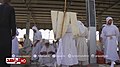 A drabsha (center) carried during a Parwanaya festival held in Maysan Governorate, southern Iraq in March 2019
 A drabsha being carried to the Tigris River

 A drabsha (darfash) golden necklace


,_Maysan,_Iraq_-_Mar_17,_2019_09.jpg)
,_Maysan,_Iraq_-_Mar_17,_2019_13.jpg)


See also
- Kushta – Mandaic religious concept of truth
- Rasta (Mandaeism) – Mandaean ceremonial garment
- Temple menorah – Ancient Hebrew lampstand
Notes
- Root: KRKL 'to encompass, bind' (Drower & Macuch 1963, A Mandaic dictionary)
- Root: YZP 'to borrow, lend, be added' (Drower & Macuch 1963, A Mandaic dictionary)
