Diagonal intersection
From Wikipedia, the free encyclopedia
Diagonal intersection is a term used in mathematics, especially in set theory.
If 
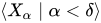

is defined to be
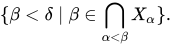
That is, an ordinal 

![{\displaystyle \displaystyle \bigcap _{\alpha <\delta }([0,\alpha ]\cup X_{\alpha }),}](https://wikimedia.org/api/rest_v1/media/math/render/svg/f6316e249339d97a2d13066c9d9f1d66a7b5259f)
where the closed interval from 0 to 
For κ an uncountable regular cardinal, in the Boolean algebra P(κ)/INS where INS is the nonstationary ideal (the ideal dual to the club filter), the diagonal intersection of a κ-sized family of subsets of κ does not depend on the enumeration. That is to say, if one enumeration gives the diagonal intersection X1 and another gives X2, then there is a club C so that X1 ∩ C = X2 ∩ C.
A set Y is a lower bound of F in P(κ)/INS only when for any S ∈ F there is a club C so that Y ∩ C ⊆ S. The diagonal intersection ΔF of F plays the role of greatest lower bound of F, meaning that Y is a lower bound of F if and only if there is a club C so that Y ∩ C ⊆ ΔF.
This makes the algebra P(κ)/INS a κ+-complete Boolean algebra, when equipped with diagonal intersections.
See also
References
- Thomas Jech, Set Theory, The Third Millennium Edition, Springer-Verlag Berlin Heidelberg New York, 2003, page 92, 93.
- Akihiro Kanamori, The Higher Infinite, Second Edition, Springer-Verlag Berlin Heidelberg, 2009, page 2.
This article incorporates material from diagonal intersection on PlanetMath, which is licensed under the Creative Commons Attribution/Share-Alike License.
| General | |||||||||
|---|---|---|---|---|---|---|---|---|---|
| Theorems (list) and paradoxes | |||||||||
| Logics |
| ||||||||
| Set theory |
| ||||||||
| Formal systems (list), language and syntax |
| ||||||||
| Proof theory | |||||||||
| Model theory | |||||||||
| Computability theory | |||||||||
| Related | |||||||||

| Overview |  | |
|---|---|---|
| Axioms | ||
| Operations |
| |
| ||
| Set types | ||
| Theories | ||
| ||
| Set theorists | ||
 | This mathematical logic-related article is a stub. You can help Wikipedia by expanding it. |