
Directive 92/58/EEC
European Directive harmonizing safety signs
From Wikipedia, the free encyclopedia
The Directive 92/58/EEC specifies the minimum requirements for safety signs within the European Union.[1] It superseded the Directive 77/576/EEC.[1] While not being replaced by the standard ISO 7010, both signage systems can be used.[2] This directive does not apply to signage used for controlling roadway, railway, waterway or air transportation.[1]

| European Union directive | |
 | |
| Title | COUNCIL DIRECTIVE 92/58/EEC of 24 June 1992 on the minimum requirements for the provision of safety and/or health signs at work (ninth individual Directive within the meaning of Article 16 (1) of Directive 89/391/EEC) |
|---|---|
| Made by | Council |
| Journal reference | L 245, 26 August 1992, pp. 23–42 |
| History | |
| Date made | 24 June 1992 |
| Entry into force | 22 July 1992 |
| Other legislation | |
| Replaces | Directive 77/576/EEC |
| Amended by |
|
| Substantially amended | |
Structure
Directive 92/58/EEC consists of 3 sections, 12 articles and 9 annexes.[1] Section one simply defines the function of the directive, as well as provide definitions. Section 2 specifies that employers are required to post safety/health signs, whenever a hazard can't be eliminated.[1] It also provides guidance to member states regarding adoption of the directive in their laws and the implementation of the law. Signs already in use had to be brought up to Directive 92/58/EEC standards within 18 months after 24 June 1994. Signs posted on or after 24 June 1994 were required to comply with the directive when posted.[1] Section 3 contained the effective date for the directive, repealed the older Directive 77/576, and reporting obligations of member states to the European Commission.[1]
Annexes
The nine annexes of the directive layout the actual designs and requirements of signs regulated by the directive.[1]
Annex I
Annex I, General Minimum Requirements Concerning Safety And/Or Health Signs At Work, lays out the types of signs, the colors used on signs, and the implementation/installation of signs.[1]
| Colour | Purpose | Examples |
|---|---|---|
| Red | Prohibited sign | Restriction of dangerous or undesirable behaviours or objects |
| Danger alarm | Stop, shutdown, evacuate, identification and location of emergency stop switches | |
| Fire-fighting equipment | Identification and location of fire-fighting equipment | |
| Yellow/amber | Warning sign | Identification of hazards |
| Blue | Mandatory sign | requiring a specific behaviour or action, wearing personal protective equipment |
| Green | Emergency escape, first aid sign | location and identification of doors, exits, evacuation routes, equipment and facilities |
| No danger | Return to normal working |
Annex II (Signboards)
Annex II, Minimum General Requirements Concerning Signboards, spells out the designs of symbols used in the directive. While specific symbol designs are provided, pictograms are permitted to vary so long as the variation in design does not reduce the symbol's effectiveness at conveying its meaning.[1]
The directive contains five categories of signs, as shown below:[1]
Prohibitory signs
 No smoking
 Smoking and naked flames forbidden
 No access for pedestrians
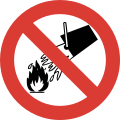 Do not extinguish with water
 Not drinkable
 No access for unauthorized persons
 No access for industrial trucks
 Do not touch


Warning signs
 Flammable material or high temperature
 Explosive material
 Toxic material
 Corrosive material
 Radioactive material
 Overhead load
 Industrial vehicles
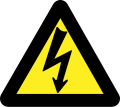 Danger: electricity
 General danger
 Laser beam
 Oxidant material
 Non-ionizing radiation
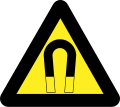 Strong magnetic field
 Obstacles
 Drop
Drop Biological risk
 Low temperature
 Harmful or irritant material
(Withdrawn 2014)[3]


Mandatory signs
 Eye protection must be worn
 Safety helmet must be worn
 Ear protection must be worn
 Respiratory equipment must be worn
 Safety boots must be worn
 Safety gloves must be worn
 Safety overalls must be worn
 Face protection must be worn
 Safety harness must be worn
 Pedestrians must use this route
 General mandatory sign (to be accompanied where necessary by another sign)


Emergency escape or first-aid signs
 Emergency exit/escape route
 Emergency exit/escape route
 Emergency exit/escape route
 Emergency exit/escape route
 Emergency exit/escape route
 This way (supplementary information sign)
 This way (supplementary information sign)
 This way (supplementary information sign)
 This way (supplementary information sign)
 First-aid post
 Stretcher
 Safety shower
 Eyewash
 Emergency telephone for first-aid or escape


Fire-fighting signs
 Fire hose
 Ladder
 Fire extinguisher
 Emergency fire telephone
 This way (supplementary information sign)
 This way (supplementary information sign)
 This way (supplementary information sign)
 This way (supplementary information sign)


Annex III
Annex III, Minimum Requirements Governing Signs on Containers and Pipes', lays out specific requirements for labeling of piping systems and storage containers containing dangerous substances defined by Directives 67/548 and 88/379.
Annex IV
Annex IV, Minimum Requirements for the identification and location of fire-fighting equipment, is specific to fire-fighting equipment, specifying that red should be used to mark the equipment and its storage location, to supplement the fire-fighting signage provided in Annex III.
Annex V

Annex V, Minimum Requirements Governing Signs Used For Obstacles and Dangerous Locations, and Marking Traffic Routes, lays out the use of colored stripes for marking obstacles and identifying of traffic routes in work places.[1]
Annex VI
Annex VI, Minimum Requirements for Illuminated Signs, sets standards for the use of illuminated signage, the incorporation of colors and pictograms, as defined in Annex I and II and usage with acoustic signals.[1]
Annex VII
Annex VII, Minimum requirements for Acoustic Signs, sets requirements for sound signals, such as horns, sirens, alarm bells.[1]
Annex VIII
Annex VIII, Minimum requirements for Verbal Communication, sets requirements for communications using words, and defines specific code words.[1]
| Code word | Meaning |
|---|---|
| Start | To indicate the start of a command |
| Stop | To interrupt or end a movement |
| End | To stop the operation |
| Raise | To have a load raised |
| Lower | To have a load lowered |
| Forwards | To be coordinated with the corresponding hand signals |
| Backwards | |
| Right | |
| Left | |
| Danger | For an emergency stop |
| Quickly | To speed up a movement for safety reasons |
Annex IX
Annex IX, Minimum Requirements for Hand Signals, describes specific hand signals and the requirements of a "signalman", the person giving the hand signs.[1]
| Meaning | Description | Illustration |
|---|---|---|
| A. General Signals | ||
| Start. Attention. Start of command. | Both arms extended horizontally with the palms facing forward. |  |
| Stop. Interruption. End of movement. | The right arm points upward with the palm facing forwards. |  |
| End of the operation. | Both hands are clasped at chest height. |  |
| B. Vertical Movements | ||
| Raise | The right arm points skywards with the palm facing forward and slowly makes a circle. |  |
| Lower | The right arm points downwards with the palm facing inwards and slowly makes a circle. |  |
| Vertical Distance | The hands indicate the relevant distance. |  |
| C. Horizontal Movements | ||
| Move forwards. | Both arms are bent with the palms facing upwards, and the forearms make slow movements towards the body. |  |
| Move backwards. | Both arms are bent with the palms facing downwards, and the forearms make slow movements away from the body. |  |
| Right to the signalman. | The right arm is extended more or less horizontally with the palm facing downwards and slowly makes small movements to the right. |  |
| Left to the signalman. | The left arm is extended more or less horizontally with the palm facing downwards and slowly makes small movements to the left. |  |
| Horizontal Distance | The hands indicate the relevant distance |  |
| D. Danger | ||
| Danger. Emergency stop. | Both arms point upwards with the palms facing forwards. |  |
| Quick | Make all movements faster | N/a |
| Slow | Make all movements slower | N/a |
Implementation in member states
European member states adopted the directive in the following legal acts in their nation.
- Austria: Kennzeichnungsverordnung[4]
- Belgium: Arrêté royal du 17 juin 1997 [5]
- Bulgaria: РД-07/8 от 20 декември 2008 г.[6]
- Croatia: NN 29/2005 [7]
- Cyprus: Σημανσης Ασφαλειας Και Υγειας Στους Χωρους Εργασιας 2012 [8]
- Czechia: Č 11/2002 Sb.[9] (Replaced by Č 375/2017 Sb.[10])
- Denmark: BEK nr 1246 af 11/12/2009 [11]
- Estonia: Vastu võetud 30.11.1999 nr 75 Ohumärguannete kasutamise nõuded töökohas[12]
- Finland: Nr. 687/2015 [13]
- France: Arrêté du 4 novembre 1993 relatif à la signalisation de sécurité et de santé au travail[14]
- Germany: Arbeitsstättenverordnung,[15] specified by Technische Regel für Arbeitsstätten ASR A1.3[16]
- Greece: Π.Δ. 105/1995 [17]
- Hungary: 2/1998. (I. 16.) MüM rendelet a munkahelyen alkalmazandó biztonsági és egészségvédelmi jelzésekről [18]
- Ireland: Safety, Health and Welfare At Work (Signs) Regulations, 1995[19]
- Italy: Decreto Legislativo 14 agosto 1996, n. 493,[20] replaced by Decreto Legislativo 9 aprile 2008, n. 81[21]
- Latvia: Rīgā 2002.gada 3.septembrī prot. Nr.37 17.§ [22]
- Lithuania: 1999 m. lapkričio 24 d. Nr. 95 Vilnius [23]
- Malta: S.L.424.16 2002 [24]
- Netherlands: Arbeidsomstandighedenregeling [25]
- Portugal: Portaria n.º 1456-A 1995, de 11 de dezembro [26]
- Romania: Hotararea de Guvern 971 din 2006 [27]
- Slovakia:Z.z. 387/2006
- Slovenia:Uradni list RS, št. 34/10
- Spain: Real Decreto n° 485/97 [28]
- Sweden: AFS 2008-13 (Replaced by AFS 2020-1)
Similar implementation in non-EU member states
- Iceland: Stjtíð. B, nr. 707/1995
- India: IS 9457 2005 (A copy of the preceding standard 77/576/EEC was also active in India as IS 9457 1980)
- Northern Cyprus: 35/2008 Sayılı Yasa
- Finland: Forskrift 6. oktober 1994 nr. 972
- Ukraine: Кабінету Міністрів України постанова від 25 листопада 2009 р. N 1262 Київ [29]
- Turkey: Resmi Gazete Tarihi: 25325/2003
- United Kingdom: The Health and Safety (Safety Signs and Signals) Regulations 1996[30] (Passed when an EU member, no longer a member.) The Law and Sign Standard is still in force and in-accordance with the EU (2024)
See also
- ISO 3864 - ISO standard for safety sign design
- ISO 7010 - ISO standard for safety symbols
- Napo in... The Best Signs Story


