Dunnett's test is performed by computing a Student's t-statistic for each experimental, or treatment, group where the statistic compares the treatment group to a single control group.[8][9] Since each comparison has the same control in common, the procedure incorporates the dependencies between these comparisons. In particular, the t-statistics are all derived from the same estimate of the error variance which is obtained by pooling the sums of squares for error across all (treatment and control) groups. The formal test statistic for Dunnett's test is either the largest in absolute value of these t-statistics (if a two-tailed test is required), or the most negative or most positive of the t-statistics (if a one-tailed test is required).
In Dunnett's test we can use a common table of critical values, but more flexible options are nowadays readily available in many statistics packages. The critical values for any given percentage point depend on: whether a one- or- two-tailed test is performed; the number of groups being compared; the overall number of trials.
The analysis considers the case where the results of the experiment are numerical, and the experiment is performed to compare p treatments with a control group. The results can be summarized as a set of  calculated means of the sets of observations,
 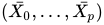 , while
 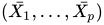 are referring to the treatment and
  is referring to the control set of observations, and
  is an independent estimate of the common standard deviation of all
  sets of observations. All
  of the sets of observations are assumed to be independently and normally distributed with a common variance
  and means
  . There is also an assumption that there is an available estimate
  for .
for .
Dunnett's test's calculation is a procedure that is based on calculating confidence statements about the true or the expected values of the  differences
  , thus the differences between treatment groups' mean and control group's mean. This procedure ensures that the probability of all statements being simultaneously correct is equal to a specified value,
  . When calculating one sided upper (or lower) confidence interval for the true value of the difference between the mean of the treatment and the control group, constitutes the probability that this actual value will be less than the upper (or greater than the lower) limit of that interval. When calculating two-sided confidence interval, constitutes the probability that the true value will be between the upper and the lower limits.
First, we will denote the available N observations by  when
when  and
and  and estimate the common variance by, for example:
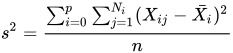 when is the mean of group
  and
and  is the number of observations in group , and
 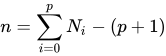 degrees of freedom. As mentioned before, we would like to obtain separate confidence limits for each of the differences
  such that the probability that all confidence intervals will contain the corresponding
  is equal to .
We will consider the general case where there are treatment groups and one control group. We will write:
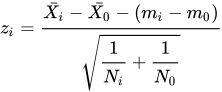
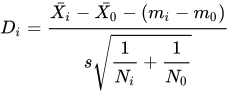
we will also write:  , which follows the Student's t-statistic distribution with n degrees of freedom. The lower confidence limits with joint confidence coefficient for the treatment effects will be given by:

and the constants  are chosen so that
  .
Similarly, the upper limits will be given by:
.
Similarly, the upper limits will be given by:

For bounding in both directions, the following interval might be taken:

when  are chosen to satisfy
  .
The solution to those particular values of for two sided test and for one sided test is given in the tables.[5] An updated table of critical values was published in 1964.[6]
.
The solution to those particular values of for two sided test and for one sided test is given in the tables.[5] An updated table of critical values was published in 1964.[6]








![{\displaystyle 61-50\pm 10.25=[0.75,21.25]\,{\text{lbs}}}](https://wikimedia.org/api/rest_v1/media/math/render/svg/c0ed1206b46741875f1f28db95923a71e6f4bbc8)
![{\displaystyle 52-50\pm 10.25=[-8.25,12.25]\,{\text{lbs}}}](https://wikimedia.org/api/rest_v1/media/math/render/svg/35477d99566078ec8b492c266ee7a960ffbd3883)
![{\displaystyle 45-50\pm 10.25=[-15.25,5.25]\,{\text{lbs}}}](https://wikimedia.org/api/rest_v1/media/math/render/svg/36942d91f942c4375db13d1fb864a9d9e2e22023)