Ficus tinctoria
Species of fig
From Wikipedia, the free encyclopedia
Ficus tinctoria, also known as dye fig, or humped fig is a hemiepiphytic tree in the genus Ficus. It is also one of the species known as a strangler fig.[3]

| Dye fig | |
|---|---|
| |
Scientific classification  | |
| Kingdom: | Plantae |
| Clade: | Embryophytes |
| Clade: | Tracheophytes |
| Clade: | Angiosperms |
| Clade: | Eudicots |
| Clade: | Rosids |
| Order: | Rosales |
| Family: | Moraceae |
| Genus: | Ficus |
| Subgenus: | F. subg. Sycidium |
| Species: | F. tinctoria |
| Binomial name | |
| Ficus tinctoria | |
| Synonyms[2] | |
|
List
| |

It is found in Asia, Malesia, northern Australia, and the South Pacific islands.[3] It grows in moist valleys.[4]
Palms are favorable host species. Root systems of dye fig can come together to be self-sustaining, but the epiphyte usually falls if the host tree dies or rots away.[5]
In Australia it is recorded as a medium-sized tree with smooth, oval green leaves.[3] It is found often growing in rocky areas or over boulders.[3] The leaves are asymmetrical.[6]
The small rust-brown fruit of the dye fig are the source of a red dye used in traditional fabric making in parts of Oceania and Indonesia.
The fruit is also edible and constitute as a major food source in the low-lying atolls of Micronesia and Polynesia.[7]
Subspecies
Two subspecies are accepted:[8]
- Ficus tinctoria subsp. gibbosa (Blume) Corner
- Ficus tinctoria subsp. tinctoria
Gallery
 Leaves and mature fruit
 Branch leaf pattern
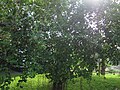 Mature tree
 Fruits, asymmetric leaf with vein offset to one side.


