Elastic instability
From Wikipedia, the free encyclopedia

Elastic instability is a form of instability occurring in elastic systems, such as buckling of beams and plates subject to large compressive loads.
There are a lot of ways to study this kind of instability. One of them is to use the method of incremental deformations based on superposing a small perturbation on an equilibrium solution.
Moment equilibrium condition
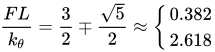
Consider as a simple example a rigid beam of length L, hinged in one end and free in the other, and having an angular spring attached to the hinged end. The beam is loaded in the free end by a force F acting in the compressive axial direction of the beam, see the figure to the right.
Assuming a clockwise angular deflection , the clockwise moment exerted by the force becomes . The moment equilibrium equation is given by



where is the spring constant of the angular spring (Nm/radian). Assuming is small enough, implementing the Taylor expansion of the sine function and keeping the two first terms yields

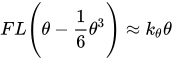
which has three solutions, the trivial , and

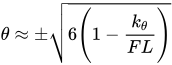
which is imaginary (i.e. not physical) for and real otherwise. This implies that for small compressive forces, the only equilibrium state is given by , while if the force exceeds the value there is suddenly another mode of deformation possible.


Energy method
The same result can be obtained by considering energy relations. The energy stored in the angular spring is
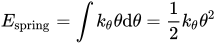
and the work done by the force is simply the force multiplied by the vertical displacement of the beam end, which is . Thus,


The energy equilibrium condition now yields as before (besides from the trivial ).


Stability of the solutions
Any solution is stable iff a small change in the deformation angle results in a reaction moment trying to restore the original angle of deformation. The net clockwise moment acting on the beam is


An infinitesimal clockwise change of the deformation angle results in a moment

which can be rewritten as

since due to the moment equilibrium condition. Now, a solution is stable iff a clockwise change results in a negative change of moment and vice versa. Thus, the condition for stability becomes



The solution is stable only for , which is expected. By expanding the cosine term in the equation, the approximate stability condition is obtained:
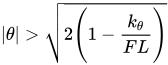
for , which the two other solutions satisfy. Hence, these solutions are stable.