Mains electricity by country
From Wikipedia, the free encyclopedia
This is an overview of mains electricity by country, with a focus on listing the regional differences in plug and socket types, nominal supply voltages, and AC supply frequencies commonly used for delivering electrical power to low-voltage appliances, equipment, and lighting typically found in homes and offices.
For industrial machinery, see industrial and multiphase power plugs and sockets.
Voltage and frequency

Mains electricity varies in voltage and AC frequency across the world. As shown in the adjacent map and in the table below, premises in most of the world receive a supply of between 220 and 240 volts (V) (nominal) at an AC frequency of 50 hertz (Hz). North America is the biggest exception.
With the notable exception of North America, premises around the world receive either a three-phase supply or a single-phase supply derived from a three-phase system. In North America, most premises are instead served by a unique split-phase connection which provides a choice of either 120 or 240 V at 60 Hz. Each circuit in the premises can be connected to either one of two 120 V supplies (at 180° of phase separation) or to a 240 V supply, with the latter being useful for appliances with larger power requirements. Different sockets are mandated for different voltage or current levels.
Internationally standardized mains supply voltages and frequencies are defined in IEC 60038. In a 1997 amendment, the old standard values of 220/380 V (single-phase/three-phase) and 240/415 V were replaced with a new harmonized standard of 230/400 V, but the use of the old standards may still persist in some regions. All voltages expressed in this article are AC RMS and are nominal values. Standards and laws define the nominal values for each region and are accompanied with a certain degree of permitted variation. Thus the nominal value may deviate somewhat from typically encountered values.
Current
Many countries with a voltage around 120 V use 10 A for regular usage and 15 or 16 A for high-power applications (heaters, motors). Appliances may include batteries and/or supercapacitors to compensate for the lack of outlets above 10 A, or to further increase the usable power beyond the maximum output of 15 or 16 A outlets (if such are available).[1] Due to the high cost of those appliances, applications that require high power at low cost are less common in 120 V countries (for example, electric kettles are relatively rare in the USA).[2]
Some countries with a voltage around 230 V use 10 A for regular usage and 15 or 16 A for high-power applications. In such cases, 15 and 16 A outlets may be much less common, since 10 A at 230 V already provides considerably more power than even the high-power (16 A) outlets in 120 V countries. Sockets of Type E (Belgian/French) and Type F (Schuko), used in large parts of continental Europe and various other countries, are rated for 16 A at 230 V.[3] However, the actual circuit protection may vary by country, as some national wiring codes allow lower ratings such as 10 A or 13 A for ordinary outlets.[citation needed]
Plugs

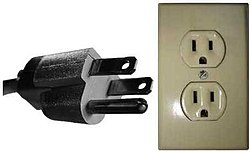
A • B, A • C • D, M • E, C • F, C • G • H, C • I • J, C • K, C • L, C • N, C
Socket and plug types can vary significantly by region. In some cases plugs from one region may fit sockets of another, but physical compatibility of receptacles may not ensure compatibility of voltage, frequency, or connection to earth (ground), including plugs and cords. In some areas, plugs and sockets from outdated standards may still exist. Foreign enclaves, extraterritorial government installations, or buildings frequented by tourists, may support plugs not otherwise used in the host country for the convenience of travellers.
A system of identification of plug and socket types is used here in the adjacent world map and the below table, involving a single letter (from A to O). This comes from the IEC World Plugs which defines these letters in terms of a general description, without making reference to specific standards. Where a plug does not have a specific assigned letter code, it may be defined by the style sheet number listed in the IEC TR 60083 standard.[4]
Identification guide

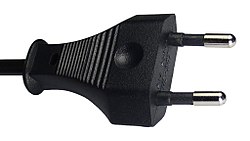
 CEE 7/17 2-pin plug; max 16 A, ungrounded

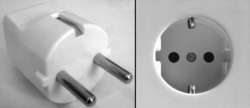
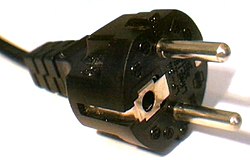

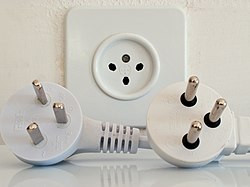
 Type I (AS/NZS 3112, GB/T 1002, IRAM 2073 and 2071); Argentine version has reversed polarity compared to Chinese and Australasian versions; max 10–20 A


.png)


Table of mains voltages, frequencies, and plugs
Supply voltages are presented here as in IEC 60038. Those with an A/B form thus represent phase-to-neutral (A) and phase-to-phase (B) voltages respectively, with the exception of 120/240 and 110/220 split-phase. If several voltages are listed (separated by linebreaks), the first one is typically the standard mains voltage that most residential buildings and offices receive, while additional (higher) voltages may be used in industrial settings.
| Country or territory | Plug type[a] | National plug standard[4] |
Nominal supply voltage[10][11] | Supply frequency[10] | Notes |
|---|---|---|---|---|---|
 Afghanistan Afghanistan |
C, F | 220/380 V | 50 Hz | ||
 Albania Albania |
C, F | 230/400 V | 50 Hz | ||
 Algeria Algeria |
C, F | 230/400 V | 50 Hz | ||
 American Samoa American Samoa |
A B I |
NEMA 1-15 NEMA 5-15 AS/NZS 3112 |
120/208 V | 60 Hz | Type I is used due to close proximity with independent western neighbour Samoa. |
 Andorra Andorra |
C, F | 230/400 V | 50 Hz | ||
 Angola Angola |
C, F | 220/380 V | 50 Hz | ||
 Anguilla Anguilla |
A, B | 110 V 120/208 V 127/220 V 240/415 V |
60 Hz | ||
 Antigua and Barbuda Antigua and Barbuda |
A, B | 230/400 V | 60 Hz | ||
 Argentina Argentina |
C, I | IRAM 2073 | 220/380 V[12] | 50 Hz | Live and neutral reversed compared to Chinese and Australian/NZ Type I. |
 Armenia Armenia |
C, F | 230/400 V | 50 Hz | ||
 Aruba Aruba |
A, B, F | 127/220 V | 60 Hz | ||
 Australia Australia |
I | AS/NZS 3112 | 230/400 V | 50 Hz | Western Australia uses 240/415 V[13] |
 Austria Austria |
C F |
ÖVE-IG/EN 50075 ÖVE/ÖNORM E 8620 |
230/400 V | 50 Hz | |
 Azerbaijan Azerbaijan |
C, F | 220/380 V | 50 Hz | ||
 Bahamas Bahamas |
A, B | 120/208 V | 60 Hz | ||
 Bahrain Bahrain |
G | 230/400 V | 50 Hz | ||
 Bangladesh Bangladesh |
A, C, D, G[14] | 220/380 V | 50 Hz | ||
 Barbados Barbados |
A, B | 115/200 V | 50 Hz | ||
 Belarus Belarus |
C, F | 230/400 V[15] | 50 Hz | ||
 Belgium Belgium |
C, E | NBN C 61 112-1 | 230/400 V | 50 Hz | |
 Belize Belize |
A, B, G | 110/190 V 220/380 V |
60 Hz | ||
 Benin Benin |
C, E | 220/380 V | 50 Hz | ||
 Bermuda Bermuda |
A, B | 120/208 V | 60 Hz | ||
 Bhutan Bhutan |
C, D, F, G, M | 230/400 V | 50 Hz | ||
 Bolivia Bolivia |
A, B, C | 230/400 V[16] | 50 Hz | ||
 Bonaire,[17][18][19][20] Bonaire,[17][18][19][20]  Sint Eustatius and Sint Eustatius and  Saba Saba |
A, B | 127/220 V | 50 Hz | Sockets for 220-240 V European Type C plugs are typically available at hotels; some buildings modify voltage, so travellers are advised to check before plugging in. Type F are also available at some hotels. | |
 Bosnia and Herzegovina Bosnia and Herzegovina |
C, F | 230/400 V | 50 Hz | ||
 Botswana Botswana |
D, G, M | 230/400 V | 50 Hz | ||
 Brazil Brazil |
C, N | NBR 14136 | 127/220 V 220/380 V[21] |
60 Hz[22] | Before standardization, socket types varied: C (very old installations), I (for air conditioners), and combinations like A/C and A/B/C. |
 British Virgin Islands British Virgin Islands |
A, B | 110/190 V | 60 Hz | ||
 Brunei Brunei |
G | 240/415 V | 50 Hz | ||
 Bulgaria Bulgaria |
C, F | 230/400 V | 50 Hz | ||
 Burkina Faso Burkina Faso |
C, E | 220/380 V | 50 Hz | ||
 Burundi Burundi |
C, E | 220/380 V | 50 Hz | ||
 Cambodia Cambodia |
A, C, G | 230/400 V | 50 Hz | Modern installations often have universal sockets that accept plugs of most common types, but without establishing earth contact when used with Type E/F plugs (American Type B and British Type G plugs will be properly earthed). Older installations are usually A/C hybrid sockets without earthing. | |
 Cameroon Cameroon |
C, E | 220/380 V | 50 Hz | ||
 Canada Canada |
A B NEMA 14-30 NEMA 14-50 |
CSA C22.2 No. 42[23] | 120/240 V 120/208 V 347/600 V[16][24] |
60 Hz | NEMA 5-20R outlets, which are similar to Type B but have a T-shaped neutral slot, are sometimes used for higher current 120 V equipment (up to 20 A). Homes are typically provided with 120/240 V split-phase power; NEMA 14-30R and 14-50R receptacles are provided on 240 V circuits for clothes dryers and electric stoves.[25] |
 Cape Verde Cape Verde |
C, F | 220/400 V | 50 Hz | ||
 Cayman Islands Cayman Islands |
A, B | 120/240 V | 60 Hz | ||
 Central African Republic Central African Republic |
C, E | 220/380 V | 50 Hz | ||
 Chad Chad |
C, D, E, F | 220/380 V | 50 Hz | ||
 Chile Chile |
C, F, L | 220/380 V | 50 Hz | Type L is the official national standard; Europlugs (Type C) are compatible. Schuko (Type F) plugs are often used for high power appliances. | |
 China China |
A, I | GB 1002-2024 | 220/380 V | 50 Hz | Type C no longer meets national standards since GB/T 1002-2021 came into effect; firms stopped producing, selling or installing Type C and A/C hybrid sockets, but A/C hybrid sockets can still be found in legacy installations. |
 Colombia Colombia |
A, B | 120/208 V[26] 277/480 V 120/240 V 240/208/120 V 240 V 480 V |
60 Hz[27] | NEMA 5-20R outlets, which are similar to Type B but have a T-shaped neutral slot, are sometimes used for higher current 120 V commercial equipments (up to 20 A). On the other hand, NEMA 10-50P outlets are sometimes used for 208 V and 240 V industrial equipments (up to 50 A). | |
 Comoros Comoros |
C, E | 220/380 V | 50 Hz | ||
 Congo, Republic of the Congo, Republic of the |
C, E | 230/400 V | 50 Hz | ||
 Congo, Democratic Republic of the Congo, Democratic Republic of the[28] |
C, E | 220/380 V | 50 Hz | ||
 Cook Islands Cook Islands |
I | AS/NZS 3112 | 240/415 V | 50 Hz | |
 Costa Rica Costa Rica |
A, B | 120/240 V 120/208 V[29][16] |
60 Hz | ||
 Côte d'Ivoire Côte d'Ivoire |
C, E | 230/400 V | 50 Hz | ||
 Croatia Croatia |
C, F | 230/400 V | 50 Hz | ||
 Cuba Cuba |
A, B, C, L | 110/190 V[16] | 60 Hz | Some modern hotels have 220 V sockets for European 2-pin plugs (Type C).[30] | |
 Curaçao Curaçao |
A,[31] B, F[32] | 127/220 V[31][33] 380 V |
50 Hz[31] | Some hotels and apartments have 220 V European sockets.[34] | |
 Cyprus Cyprus |
G | 240/415 V | 50 Hz | ||
 Czech Republic Czech Republic |
C, E | ČSN 35 4516 | 230/400 V | 50 Hz | |
 Denmark Denmark |
C E, F, K |
DS/EN 50075 DS 60884-2-D1[35] |
230/400 V | 50 Hz | Type E and F sockets are legal but rare; Type E, F and 7/7 plugs can be inserted into the widespread Type K sockets, but no earth contact is established. |
 Djibouti Djibouti |
C, E | 220/380 V | 50 Hz | ||
 Dominica Dominica |
D, G | 230/400 V | 50 Hz | ||
 Dominican Republic Dominican Republic |
A, B, C | 120/208 V 277/480 V[16] |
60 Hz | ||
 Ecuador Ecuador |
A, B | 120/208 V[16] | 60 Hz | ||
 Egypt Egypt |
C, F | 220/380 V | 50 Hz | ||
 El Salvador El Salvador |
A, B | 115/200 V[10][16][36] | 60 Hz | ||
 Equatorial Guinea Equatorial Guinea |
C, E | 220/380 V | 50 Hz | ||
 Eritrea Eritrea |
C, L | 230/400 V | 50 Hz | ||
 Estonia Estonia |
C, F | 230/400 V | 50 Hz | ||
 Eswatini Eswatini |
M | 230/400 V | 50 Hz | ||
 Ethiopia Ethiopia |
C, E, F, L | 220/380 V | 50 Hz | Type E is very rare because Ethiopia never had French influences. | |
 Falkland Islands Falkland Islands |
G | 240/415 V | 50 Hz | ||
 Faroe Islands Faroe Islands |
C, E, F, K | 230/400 V | 50 Hz | Same as in Denmark. | |
 Fiji Fiji |
I | AS/NZS 3112 | 240/415 V | 50 Hz | Same plugs and sockets as in Australia. |
 Finland Finland |
C F |
SFS-EN 50075 SFS 5610 |
230/400 V | 50 Hz | |
 France France |
C E |
NF EN 50075 NF C 61-314 |
230/400 V | 50 Hz | |
| French Guiana |
C, E | 220/380 V | 50 Hz | ||
 French Polynesia French Polynesia |
A, B, C, E, F | 110 V 220/380 V |
60 Hz[37] 50 Hz |
||
 Gabon Gabon |
C, E | 220/380 V | 50 Hz | ||
 Gambia Gambia |
G | 230/400 V | 50 Hz | ||
 Georgia Georgia |
C, F | 220/380 V | 50 Hz | ||
 Germany Germany |
C F |
DIN VDE 0620 DIN 49441 |
230/400 V | 50 Hz | |
 Ghana Ghana |
D, G | 230/400 V | 50 Hz | ||
 Gibraltar Gibraltar |
C, G | 240/415 V | 50 Hz | ||
 Greece Greece |
C, F | 230/400 V | 50 Hz | ||
 Greenland Greenland |
C, E, F, K | 230/400 V | 50 Hz | Same as in Denmark. | |
 Grenada Grenada |
G | 230/400 V | 50 Hz | ||
| Guadeloupe |
C, E | 230/400 V | 50 Hz | ||
 Guam Guam |
A, B | 110/190 V | 60 Hz | ||
 Guatemala Guatemala |
A, B | 120/208 V | 60 Hz | ||
 Guernsey Guernsey |
G | 230/400 V | 50 Hz | ||
 Guinea Guinea |
C, F, K | 220/380 V | 50 Hz | ||
 Guinea-Bissau Guinea-Bissau |
C, E, F | 220/380 V | 50 Hz | ||
 Guyana Guyana |
A, B, D, G | 240 V[38][39] 190 V[40][41] |
60 Hz[38][39] | ||
 Haiti Haiti |
A, B | 110/190 V[16] | 60 Hz | ||
 Honduras Honduras |
A, B | 120/208 V[16][42] | 60 Hz | ||
 Hong Kong Hong Kong |
G D, M[43] |
BS 1363 BS 546 |
220/380 V | 50 Hz | Type G is most common. |
 Hungary Hungary |
C F |
MSZ EN 50075 MSZ 9781-2 |
230/400 V | 50 Hz | |
 Iceland Iceland |
C, F | 230/400 V | 50 Hz | ||
 India India |
C, D, M | IS 1293:2019[44] | 230/400 V[10][45] | 50 Hz | The combination of a Type C, E or F plug with a Type D socket may often be workable, but it is unsafe to use.[46] From August 2015, the Bureau of Indian Standards (BIS) began clamping down on the sale of imported products with Type C/E/F plugs by pushing manufacturers and importers to comply with the IS 1293 standard.[47] In June 2022, BIS began enforcing the standard through mandatory certification of both imported and domestic products.[48] |
 Indonesia Indonesia |
C, F | SNI 04-3892.1.1-2003 | 230/400 V[49][50][51] | 50 Hz | |
 Iran Iran |
C, F | 220/400 V | 50 Hz | ||
 Iraq Iraq |
C, D, G | 230/400 V | 50 Hz | ||
 Ireland Ireland |
G | I.S. 401[52] | 230/400 V | 50 Hz | Type G is the only general purpose outlet type in use in Ireland. Bathrooms may have shaver sockets. These accept 2.5 A Europlug CEE 7/16 and UK type BS 4573 plugs, which used on shavers and toothbrushes. They do not accept larger Type C plugs and general purpose outlets are generally banned in bathrooms / wet areas. Some hotels may also provide a Type F (Schuko) socket as a convenience for European visitors. |
 Isle of Man Isle of Man |
G | 230/400 V[53] | 50 Hz[53] | Self-governing British crown dependency, but generally uses UK technical standards. | |
 Israel Israel |
C, H | 230/400 V | 50 Hz | ||
 Italy Italy |
C F, L |
CEI 23-34 CEI 23-50 |
230/400 V | 50 Hz | Type L uses two gauges of plug and socket. The 10 A version has pin spacing that is compatible with Europlug. The 16 A version uses wider pin spacing and larger pins. Hybrid outlets that accept both types are common and some also accept Type F. The ungrounded CEE contour plug (CEE 7/17) fits into such hybrid F/L outlets, but not into others. |
 Jamaica Jamaica |
A, B | 110/190 V | 50 Hz | ||
 Japan Japan |
A, B | JIS C 8303 | 100 V[54][55] 200 V 210 V[56] |
50 Hz 60 Hz[55] |
East Japan 50 Hz (Tokyo, Kawasaki, Sapporo, Yokohama, and Sendai); West Japan 60 Hz (Okinawa, Osaka, Kyoto, Kobe, Nagoya, Hiroshima). Most sockets accept only Type A plugs.[55] See Electricity transmission in Japan for more. |
 Jersey Jersey |
G | 230/400 V | 50 Hz | ||
 Jordan Jordan |
B, C, D, F, G, J | 230/400 V | 50 Hz | ||
 Kazakhstan Kazakhstan |
C, F | 230/400 V[57] | 50 Hz | ||
 Kenya Kenya |
G | 240/415 V | 50 Hz | ||
 Kiribati Kiribati |
I | AS/NZS 3112 | 230/400 V | 50 Hz | |
 Kosovo Kosovo |
C, F[58] | 230/400 V | 50 Hz | ||
 Kuwait Kuwait |
C, G | 240/415 V | 50 Hz | ||
 Kyrgyzstan Kyrgyzstan |
C, F | 220/380 V | 50 Hz | ||
 Laos Laos |
A, B, C, E, F | 230/400 V | 50 Hz | Some buildings and households have hybrid sockets compatible with Type A, B, and C. | |
 Latvia Latvia |
C, F | 230/400 V | 50 Hz | ||
 Lebanon Lebanon |
A, B, C, D, G | 220/400 V | 50 Hz | Type C sockets are the most frequent. Many buildings and households have double use sockets compatible with Type A and C. | |
 Lesotho Lesotho |
M | 220/380 V | 50 Hz | ||
 Liberia Liberia |
A, B[16][59][60] | 120/208 V[16][59][60] | 60 Hz | ||
 Libya Libya |
C, F, L[61] | 230/400 V[61] | 50 Hz | ||
 Liechtenstein Liechtenstein |
C, J | 230/400 V | 50 Hz | ||
 Lithuania Lithuania |
C, F | 230/400 V | 50 Hz | ||
 Luxembourg Luxembourg |
C, F | 230/400 V | 50 Hz | ||
 Macau Macau |
G D, M |
BS 1363 BS 546 |
230/400 V[62] | 50 Hz | |
 Madagascar Madagascar |
C, E[16] | 220/380 V[16] | 50 Hz | ||
 Malawi Malawi |
G | 230/400 V | 50 Hz | ||
 Malaysia Malaysia |
C[63] G[63] M[63][64] |
MS 1578:2003[63] MS 589:PT.1:1997[63] MS 1577:2003[63] |
230/400 V[65] | 50 Hz | Type G is most common. Devices using a Europlug (Type C) may be sold but require an adaptor, since there are usually no sockets for them. Some power strips accept both Type C and G plugs via slightly wider apertures and modified shutter mechanisms. Type M is used mainly for air conditioners and boilers. Bathrooms may have shaver supply units.[66] |
 Maldives Maldives |
D, G, J, K, L | 230/400 V | 50 Hz | ||
 Mali Mali |
C, E | 220/380 V | 50 Hz | ||
 Malta Malta |
G | 230/400 V | 50 Hz | ||
 Martinique Martinique |
C, E | 220/380 V | 50 Hz | ||
 Mauritania Mauritania |
C, E, F | 220 V | 50 Hz | ||
 Mauritius Mauritius |
C, E, G | 230/400 V | 50 Hz | ||
 Mexico Mexico |
A, B | NMX-J-163-ANCE | 120/240 V 127/220 V |
60 Hz | Both 120/240 V split-phase and 127/220 V three-phase are used. |
 Federated States of Micronesia Federated States of Micronesia |
A, B | 120/208 V | 60 Hz | ||
 Moldova Moldova |
C, F | 230/400 V | 50 Hz | ||
 Monaco Monaco |
C, E | 230/400 V | 50 Hz | ||
 Mongolia Mongolia |
C, E, F | 220/400 V | 50 Hz | ||
 Montenegro Montenegro |
C, F | 230/400 V | 50 Hz | ||
 Montserrat Montserrat |
A, B | 230/400 V | 60 Hz | ||
 Morocco Morocco |
C, E | 220/380 V[16][67][68] | 50 Hz | ||
 Mozambique Mozambique |
C, F, M | 220/380 V | 50 Hz | ||
 Myanmar Myanmar |
A, C, D, F, G, I | 230/400 V | 50 Hz | ||
 Namibia Namibia |
D, M | 220/380 V | 50 Hz | ||
 Nauru Nauru |
I | AS/NZS 3112 | 240/415 V | 50 Hz | |
 Nepal Nepal |
C, D, M | 230/400 V | 50 Hz | ||
 Netherlands Netherlands |
C F |
EN 50075 NEN 1020 |
230/400 V | 50 Hz | |
 New Caledonia New Caledonia |
C, F | 220/380 V | 50 Hz | Despite that New Caledonia is a French territory, German Schuko Type F sockets are used instead of French Type E sockets. | |
 New Zealand New Zealand |
I | AS/NZS 3112 | 230/400 V | 50 Hz | |
 Nicaragua Nicaragua |
A, B | 120/208 V | 60 Hz | ||
 Niger Niger |
A, B, C, D, E, F | 220/380 V | 50 Hz | ||
 Nigeria Nigeria |
D, G | 230/400 V | 50 Hz | ||
 Niue Niue |
I | AS/NZS 3112 | 230/400 V | 50 Hz | |
 North Korea North Korea |
C, F[69][70] | 220/380 V[16][69] | 50 Hz[16][69][70] | ||
 North Macedonia North Macedonia |
C, F | 230/400 V | 50 Hz | ||
 Norway Norway |
C F |
NEK EN 50075 NEK 502 |
230 V 400 V |
50 Hz | 230 V on IT grid, and 400 V on TN grid. |
 Oman Oman |
G | 240/415 V | 50 Hz | ||
 Pakistan Pakistan |
C, D, G, M | 230/400 V[71] | 50 Hz | ||
 Palau Palau |
A, B | 120/208 V | 60 Hz | ||
 Palestine Palestine |
C, H | 230/400 V | 50 Hz | ||
 Panama Panama |
A, B | 110/240 V | 60 Hz | ||
 Papua New Guinea Papua New Guinea |
I | AS/NZS 3112 | 240/415 V | 50 Hz | |
 Paraguay Paraguay |
A, B, C N |
– PNA-IEC 60906-1 |
220/380 V | 50 Hz | In 2022, Type N was chosen as new national standard, but so far hybrid A/C or A/B/C sockets are most common. |
 Peru Peru |
A, B, C[72][73][74] | 220/380 V | 60 Hz | ||
 Philippines Philippines |
A, B, C | 230/400 V[10][75] | 60 Hz | Many buildings and households have double-use sockets compatible with Type A and C, and often also with B for grounded plugs. NEMA 6-15 is used for air conditioners. | |
 Pitcairn Islands Pitcairn Islands |
I | AS/NZS 3112 | 230/400 V | 50 Hz | |
 Poland Poland |
C, E | BN-88/3064 | 230/400 V | 50 Hz | |
 Portugal Portugal |
C, E, F | NP 1260 | 230/400 V | 50 Hz | Type E is very rare, used only in very old installations. |
 Puerto Rico Puerto Rico |
A, B | 120 V 480 V |
60 Hz | ||
 Qatar Qatar |
D, F, G, L | 240/415 V | 50 Hz | ||
| Réunion |
C, E | 220/400 V | 50 Hz | ||
 Romania Romania |
C, F | 230/400 V | 50 Hz | ||
 Russia Russia |
C, F | 230/400 V[15] | 50 Hz | USSR (along with much of Eastern Europe) used GOST sockets with 4.0 mm pins similar to Type C plugs and the 4.8 mm standard used by Type E and F.[76] | |
 Rwanda Rwanda |
C, E, G[77][78] | 230/400 V | 50 Hz | Type G is the official standard, adopted to harmonize with the East African Community.[79] Types E sockets are no longer official but remain common in older buildings. The Europlug (Type C) that fits into them (but not officially into Type G sockets) remains in frequent usage too, though there are usually no dedicated sockets for it.[77][78] | |
 Saint Helena, Ascension and Tristan da Cunha Saint Helena, Ascension and Tristan da Cunha |
G[80] | 230/400 V | 50 Hz | ||
| Saint Martin (French) |
C, E | 220/380 V | 60 Hz | ||
 Sint Maarten (Dutch) Sint Maarten (Dutch) |
A, B | 120 V 127 V 220 V |
60 Hz | 127/220 V AC 60 Hz three-phase service. | |
 St. Kitts and Nevis St. Kitts and Nevis |
A, B, D, G | 230/400 V | 60 Hz | ||
 St. Lucia St. Lucia |
A, B, G | 240/400 V | 50 Hz | ||
| Saint Pierre and Miquelon |
C, E, F[81] | 230/400 V | 50 Hz | ||
 St. Vincent and the Grenadines St. Vincent and the Grenadines |
A, B, G[82] | 230/400 V[b] | 50 Hz[b] | ||
 Samoa Samoa |
I | AS/NZS 3112 | 230/400 V | 50 Hz | |
 San Marino San Marino |
C, F, L | 230/400 V | 50 Hz | ||
 São Tomé and Príncipe São Tomé and Príncipe |
C, F | 220/400 V | 50 Hz | ||
 Saudi Arabia Saudi Arabia |
G | SASO 2203 | 230/400 V[83] | 60 Hz[83] | |
 Senegal Senegal |
C, D, E, K | 230/400 V | 50 Hz | ||
 Serbia Serbia |
C F |
JUS N.E3.552 JUS N.E3.553 |
230/400 V | 50 Hz | |
 Seychelles Seychelles |
G | 240 V | 50 Hz | ||
 Sierra Leone Sierra Leone |
D, G | 230/400 V | 50 Hz | ||
 Singapore Singapore |
C G M |
– SS 145 SS 472 |
230/400 V | 50 Hz | Type G sockets are most common. Type C appliances may be sold, but may require an adaptor for use with these sockets. Type M is used mainly for air conditioners and other high-powered equipment.[84] Hotel bathrooms may have shaver supply units. |
 Slovakia Slovakia |
C, E, F | STN 34 4516 | 230/400 V | 50 Hz | |
 Slovenia Slovenia |
C, F | 230/400 V | 50 Hz | ||
 Solomon Islands Solomon Islands |
I[85] | AS/NZS 3112 | 230/400 V | 50 Hz | |
 Somalia Somalia |
C, G | 220/380 V | 50 Hz | ||
 South Africa South Africa |
C, M, N | SANS 164 | 230/400 V | 50 Hz | |
 South Korea South Korea |
C, F | KS C 8305 | 220/380 V | 60 Hz | |
 Spain Spain |
C, F | UNE 20315 | 230/400 V | 50 Hz | Type E is extremely rare, but it may appear in some buildings, such as the University Carlos III of Madrid. Almost every Spanish plug would work on Type E sockets. |
 Sri Lanka Sri Lanka |
D, G, M | SLS 734 | 230/400 V | 50 Hz | Only Type G permitted to be manufactured or imported from August 2017.[86] |
 Sudan Sudan |
C, D, F, G | 230/400 V | 50 Hz | ||
 Suriname Suriname |
C, F[87][88] | 127 V 220 V 400 V |
60 Hz | ||
 Sweden Sweden |
C F |
SS-EN 50075 SS 428 08 34 |
230/400 V | 50 Hz | Bathrooms may have shaver supply units. |
 Switzerland Switzerland |
C, J | SN 441011 (former: SEV 1011:2009)[89][90] | 230/400 V | 50 Hz | |
 Syria Syria |
C, E, L | 220/380 V | 50 Hz | ||
 Taiwan Taiwan |
A B |
CNS 690 CNS 15767 |
110/220 V[91][92] 220/380 V[92] |
60 Hz | Sockets in older buildings are often unearthed and accept only Type A plugs. High-power appliances such as air conditioners and ovens may run on 220 V via split-phase.[91] |
 Tajikistan Tajikistan |
C, F, I | 220/380 V | 50 Hz | ||
 Tanzania Tanzania |
D, G | 230/400 V | 50 Hz | ||
 Thailand Thailand |
A, B, C, O | TISS 166-2549[93][94] | 230/400 V | 50 Hz | Hybrid A/B/C sockets are most common; in addition to American (A, B) and Europlugs (C) they also accept the newly introduced Thai plug (O). Belgian/French and Schuko plugs (E, F) also fit, but no earth contact is established, hence the sale of appliances with E or F plugs has been banned. |
 Timor-Leste (East Timor) Timor-Leste (East Timor) |
C, E, F, I | 220/380 V | 50 Hz | ||
 Togo Togo |
C, E | 220/380 V | 50 Hz | ||
 Tonga Tonga |
I | AS/NZS 3112 | 230/400 V | 50 Hz | |
 Trinidad and Tobago Trinidad and Tobago |
A, B | 115/230 V 230/400 V |
60 Hz | ||
 Tunisia Tunisia |
C, E | 230/400 V | 50 Hz | ||
 Turkey Turkey |
C, F | 230/400 V[95] | 50 Hz | ||
 Turkmenistan Turkmenistan |
B, C, F | 220/380 V | 50 Hz | ||
 Tuvalu Tuvalu |
I | AS/NZS 3112 | 230/400 V | 50 Hz | |
 Uganda Uganda |
G | 240/415 V | 50 Hz | ||
 Ukraine Ukraine |
C, F | 230/400 V[96] | 50 Hz | ||
 United Arab Emirates United Arab Emirates |
G[97] | BS 1363[97] | 230/400 V[98] | 50 Hz[98] | Bathrooms may have shaver supply units.[97] |
| United Kingdom |
G[99] D, M |
BS 1363 BS 546 |
230/400 V[100] | 50 Hz | Type D mostly historical, nowadays used only for remotely switched lighting and similar. Type M historically used in domestic installations, now only for stage lighting (where they are increasingly replaced with Ceeform). Bathrooms may have shaver supply units.[101] |
 United States United States |
A B NEMA 14-30 NEMA 14-50 |
NEMA 1-15 NEMA 5-15 NEMA 14-30 NEMA 14-50 |
120/240 V 120/208 V 277/480 V[16] |
60 Hz | NEMA 5-20R outlets, which are similar to Type B but have a T-shaped neutral slot, are sometimes used for higher current 120 V equipment (up to 20 A). Homes are typically provided with 120/240 V split-phase power; NEMA 14-30R and 14-50R receptacles are provided on 240 V circuits for clothes dryers and electric stoves. |
 US Virgin Islands US Virgin Islands |
A B |
NEMA 1-15P NEMA 5-15P |
110 V 190 V |
60 Hz | |
 Uruguay Uruguay |
C, F, I, L | 230/400 V | 50 Hz | Type I was the main standard until the 1990s, and still appears in old installations. | |
 Uzbekistan Uzbekistan |
C, E, F | 220/380 V | 50 Hz | ||
 Vanuatu Vanuatu |
I | AS/NZS 3112 | 230/400 V | 50 Hz | |
 Venezuela Venezuela |
A, B | 120/208 V[10][102] 120/240 V[102] |
60 Hz[10][102] | Both 120/208 V three-phase and 120/240 V split-phase are used. | |
 Vietnam Vietnam |
A, B, C, F | TCVN 6188-1 | 220/380 V | 50 Hz | Most households use unearthed hybrid sockets that accept Type A and C plugs. Hybrid sockets that accept Type A, B, and C plugs are sometimes used in commercial installations. Type F plugs are frequently plugged into hybrid sockets, though this is somewhat unsafe, as no earth contact is made. |
 Yemen Yemen |
A, D, G | 240/400 V | 50 Hz | ||
 Zambia Zambia |
C, D, G | 230/400 V | 50 Hz | ||
 Zimbabwe Zimbabwe |
D, G | 220/380 V | 50 Hz |
Notes
- "C" indicates that buildings have three-pin sockets compatible with Europlugs, which also work with other plug types, or that buildings have some or all two-pin European style sockets, similar to CEE 7/1. Not all two-pin European plugs are compatible with all two-pin European sockets; see AC power plugs and sockets § Comparison of standard types.
- On the small, private island of Petit Saint Vincent, 110 V at 60 Hz are used.[82]

