Émile Peynot
French sculptor
From Wikipedia, the free encyclopedia
Émile Edmond Peynot (November 22, 1850 – December 12, 1932) was a prominent French artist sculptor and medallist.[1]

Born
November 22, 1850
Émile Edmond Peynot
November 22, 1850
NotableworkSculpture
AwardsPrix de Rome (1880)
Émile Peynot | |
|---|---|
Émile Peynot by Charles Mengin | |
| Born | Émile Edmond Peynot November 22, 1850 |
| Died | December 12, 1932 (aged 82) |
| Notable work | Sculpture |
| Awards | Prix de Rome (1880) |
Bio
Peynot was born in Villeneuve-sur-Yonne, Burgundy.
He became well known following his Grand Prize at the Prix de Rome sculpture competition in 1880,[2] and left a legacy of numerous monuments and reliefs in France as well as Argentina and Ecuador.
He created war memorials in Bar-le-Duc, Charenton-le-Pont, Ecouen, Joigny, Le Touquet-Paris-Plage, Liévin, Sens and for his home town, Villeneuve-sur-Yonne.
He died in Paris in 1932.
Famous works
- Marianne, Place Carnot, Lyon.
- Monument to Henri Schneider, Le Creusot.[3]
- Monument to François-Louis Français, Plombières-les-Bains, Vosges.
- Marchand Tunisien ("Tunisian Mechant"), portraying an Arab merchant cleaning his weapon.[4]
- Tunisian Merchant, 1883, Brooklyn Museum, New York.[5]
- La Aurora ("The Twilight"), Parque Centenario, Buenos Aires.
- Ofrenda Floral a Sarmiento ("Flowers for Sarmiento"), Palermo Rose Garden, Buenos Aires.
- La Lucha Eterna ("The Eternal Fight"), Parque El Ejido, Quito.
- Francia a la Argentina A gift from the French government created for Argentina centenary in 1910; it depicts two female figures, representing both countries, an angel of prosperity “Gloria” and four smaller figures: Science, Industry, Agriculture and the Arts.
Sculptures by Émile Peynot
 Francia a la Argentina, Buenos Aires
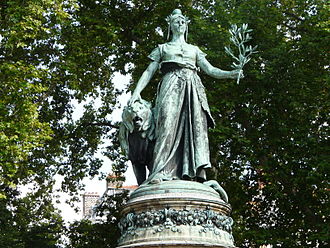 Marianne, Place Carnot, Lyon
 Shield of the City of Paris, Petit Palais
 Monument to Domingo Sarmiento, Buenos Aires
 La Lucha Eterna (The Eternal Struggle), Quito


.jpg)
See also
Bibliography
- Roland Conilleau, Emile Peynot, statuaire : Villeneuve-sur-Yonne 1850-1932, Clamecy, 2000, 77 p.

