Entropy power inequality
From Wikipedia, the free encyclopedia
In information theory, the entropy power inequality (EPI) is a result that relates to so-called "entropy power" of random variables. It shows that the entropy power of suitably well-behaved random variables is a superadditive function. The entropy power inequality was proved in 1948 by Claude Shannon in his seminal paper "A Mathematical Theory of Communication". Shannon also provided a sufficient condition for equality to hold; Stam (1959) showed that the condition is in fact necessary.
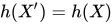
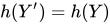
For a random vector with probability density function , the differential entropy of , denoted , is defined to be



and the entropy power of , denoted , is defined to be

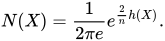
In particular, when is normally distributed with covariance matrix .


Let and be independent random variables with probability density functions in the space for some . Then


Moreover, equality holds if and only if and are multivariate normal random variables with proportional covariance matrices.