
Exile of Rama
Important event in Ramayana
From Wikipedia, the free encyclopedia
Background
Early years
Middle years
Abduction of Sita
Search for Sita
War of Lanka
Return to Ayodhya
Aftermath
Time of Composition
Scholarly estimates of the composition of the available text range from the 8th–5th[4][5] to 5th-4th centuries BCE,[6][b] "although the legends constituting it go back farther in time"[5] and later stages extend to the 3rd century CE.[6] Robert P. Goldman (1984) gives 750 BCE to 500 BCE as the probable date of the oral[7] composition of Valmiki's Ramayana, stating that "it is extremely unlikely that the archetype of the Vālmīki Rāmāyaṇā can be much earlier than the beginning of the seventh century B.C.",[4] while the core portions could not have been composed later than the 6th or 5th century BCE, as the narrative neither mentions Buddhism (founded in the 5th century BCE) nor reflects the later prominence of Magadha (which rose to power in the 7th century BCE). The text also mentions Ayodhya as the capital of Kosala, rather than its later name of Saketa or its successor capital of Shravasti.[c]
Gallery

 Rama, Lakshmana, and the Vishvamitra take leave of Dasharatha
 Dashratha grieving upon exile of Rama.
 Rama, Lakshmana, and Sita take up residence at the foot of the bounteous Chitrakuta Mountain
 Rama, Lakshmana, and Sita spend their first night alone in the wilderness.
 Death of Dasharatha.
 Bharata carries Rama's slippers on his head, in order to make them as representative of Rama, the actual king of Ayodhya.
 Rama, Vishvamitra, and Lakshmana approach the woods known as siddha ashram
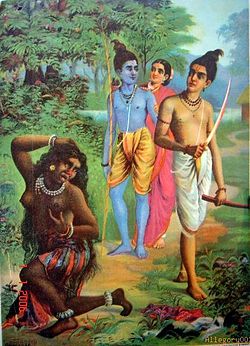 Lakshmana cuts off Shurpanakha's nose.
 Rama strikes down Khara with an arrow
 Jatayu killed by Ravana, painting by Raja Ravi Varma.
 Lakshmana consoled Rama
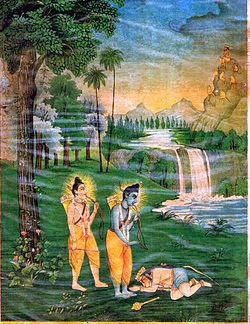 Hanuman meets Rama and Lakshmana.
 Sita shies away from Hanuman believing he is Ravana in disguise
 Lanka Dahan, the burning of Lanka by Hanuman.
 Killing of Ravana.
 Coronation of Rama.
 Sita in exile.
 Traditional Diwali celebration, so as to mark the returning of Sita and Rama after 14 years of exile.
 Rama in the exile, with his wife and brother
 Rama and Sita before going to exile
 Rama in exile in the forest, setting off to hunt deer - Museu do Oriente - Lisbon, Portugal
 Rama Spurns Suparnakha by Warwick Goble


.jpg)


See also
Explanatory notes
- (Goldman 1984, p. 21–22): "[I]n the Balakanda, as in the central five books of the epic, the kingdom of Kosala is represented as being at the height of its power and prosperity, governed from a major urban settlement called Ayodhya, [o]nly at the very end of the Uttara-kanda, [the] epilogue to the poem [w]e find reference to Sravasti as a successor capital. [A]s Jacobi also pointed out, the capital city of the unified realm of Kosala is invariably known as Ayodhya in the epic and never by the name Saketa, the name by which it comes to be known in much of the Buddhist and later literature"
- [a]Dating:
- Goldman (1984, p. 23): "we feel that it is extremely unlikely that the archetype of the Vālmīki Rāmāyaṇā can be much earlier than the beginning of the seventh century B.C., although it is impossible to demonstrate this with any sort of rigor [...] We have thus narrowed down the probable date of the composition of the Vālmīki Rāmāyaṇā, sometime between 750 and 500 B.C."
- Brockington (1998, pp. 379ff): "More recent suggestions about dating include [...] Goldman's suggestion of a date for the oldest parts [...] not before the beginning of the 7th century BCE (then defined as 'sometime between 750 and 500 BCE')".
- Brockington (1998, pp. 379ff): "My own statement was that the first stage belongs to the period from about the 5th to the 4th century before CE and this remains my view".
- Bose (2016), referring to Goldman (1984): "As viewed in the Indian tradition and by many (though not all) scholars, its probable date is set between 750 and 500 bce, although the legends constituting it go back farther in time"
- Goldman & Sutherland Goldman (2022, p. 3): "The oldest surviving version of the great tale of Rāma, and the one that is doubtless the direct or indirect source of all of the hundreds and perhaps thousands of other versions of the story, is the monumental, mid-first millennium BCE epic poem in some twenty-five thousand Sanskrit couplets attributed to Vālmīki."
- Goldman & Sutherland Goldman (2022, p. 7): "The core of the work appears to have been originally a product of the middle of the first millennium BCE".