The exsphere touches the face of the regular polyedron at the center
of the incircle of that face. If the exsphere radius is denoted rex, the radius of this incircle rin
and the dihedral angle between the face and the extension of the
adjacent face δ, the center of the exsphere
is located from the viewpoint at the middle of one edge of the
face by bisecting the dihedral angle. Therefore
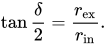
δ is the 180-degree complement of the
internal face-to-face angle.
Applied to the geometry of the Tetrahedron of edge length a,
we have an incircle radius rin = a/(2√3) (derived by dividing twice the face area (a2√3)/4 through the
perimeter 3a), a dihedral angle δ = π - arccos(1/3), and in consequence rex = a/√6.
The radius of the exspheres of the 6 faces of the Cube
is the same as the radius of the inscribed
sphere, since δ and its complement are the same, 90 degrees.
The dihedral angle applicable to the Icosahedron is derived by
considering the coordinates of two triangles with a common edge,
for example one face with vertices
at

the other at

where g is the golden ratio. Subtracting vertex coordinates
defines edge vectors,

of the first face and

of the other. Cross products of the edges of the first face and second
face yield (not normalized) face normal vectors

of the first and

of the second face, using g2=1+g.
The dot product between these two face normals yields the cosine
of the dihedral angle,
 OEIS: A208899
 OEIS: A132338
For an icosahedron of edge length a, the incircle radius of the triangular faces is rin = a/(2√3), and finally the radius of the 20 exspheres

