Homoeoid and focaloid
Geometric shell bounded by two concentric, similar ellipses or ellipsoids
From Wikipedia, the free encyclopedia
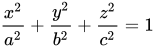
A homoeoid or homeoid is a shell (a bounded region) bounded by two concentric, similar ellipses (in 2D) or ellipsoids (in 3D).[1][2] When the thickness of the shell becomes negligible, it is called a thin homoeoid. The name homoeoid was coined by Lord Kelvin and Peter Tait.[3] Closely related is the focaloid, a shell between concentric, confocal ellipses or ellipsoids.[4]


Mathematical definition





Physical properties
Thin focaloids and homoeoids can be used as elements of an ellipsoidal matter or charge distribution that generalize the shell theorem for spherical shells. The gravitational or electromagnetic potential of a homoeoid homogeneously filled with matter or charge is constant inside the shell, so there is no force on a test particle inside of it.[5] Meanwhile, two uniform, concentric focaloids with the same mass or charge exert the same potential on a test particle outside of both.[4][1]
